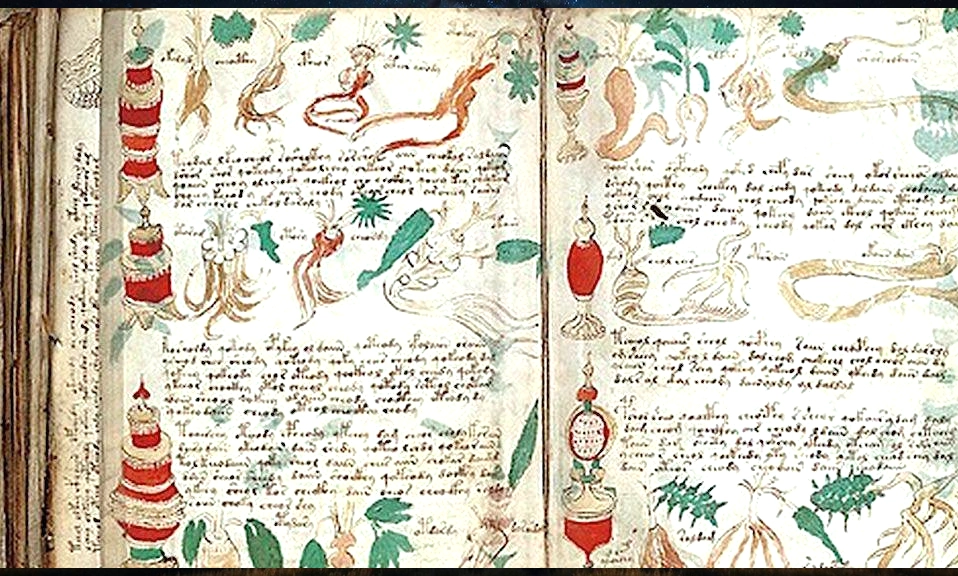
For 600 years, the smartest people on Earth have tried to read one book and failed.
Cryptographers from both World Wars. AI from Google. The NSA.
Nothing.
It’s 240 pages of vellum, filled with naked women in green pools, impossible plants that don’t exist, zodiac circles, and 38,000 words written in an alphabet no human has ever seen anywhere else.
We called it unreadable.
What if we were just holding it backwards?
The New Theory That’s Shaking Medieval Studies
The Voynich manuscript may be difficult to read for a surprisingly physical reason: its pages could have been assembled in the wrong order.
Instead, it may have been a collection of separate folded sheets that were later rearranged by someone who could not read the text.
In October 2026, medieval manuscript specialist Lisa Fagin Davis and information systems researcher Colin Layfield published a study that says exactly that: Researchers have suggested that the mysterious Voynich manuscript may have been bound incorrectly as early as the 15th century, meaning that its pages are now not arranged in their original order.
And it’s not a fringe theory. It was covered by Smithsonian Magazine, Archaeology Magazine, and Ancient Origins in the same week.
Wait, What Is The Voynich Manuscript Again?
Quick recap:
- Carbon-dated to early 1400s — In 2009, carbon-dating technology was used to conclude that the vellum used in the Voynich manuscript dates from the early fifteenth century
- 240 pages, hand-written on goat skin
- Written in “Voynichese” — a language with 20-25 characters that follows linguistic patterns (Zipf’s Law) like a real language, but matches no known language
- Illustrations divided into 5 sections: botanical (weird plants), astronomical, biological (naked women in tubes), cosmological, pharmaceutical, and recipes
- Named after Wilfrid Voynich, who found it in 1912 in an Italian monastery
- Now at Yale’s Beinecke Library under lock and key
- The goat skin binding is not original but was added roughly a century after its creation.
For 100 years, we assumed the order Yale has it in is the order the author wrote it in. Davis and Layfield say: Nope.
What They Found: The Book Was Never A Book
Researchers Colin Leifeld and Lisa Fagin Davis analyzed the manuscript’s structure using statistical methods and compared it with other medieval documents.
They did something no one had done systematically: They looked at the physical book, not the text.
Medieval books weren’t made like modern books. They were made of bifolia — big sheets folded in half to make 4 pages. A stack of bifolia makes a quire. The Voynich is 18 quires.
What Davis found:
Quire marks don’t match. Medieval scribes wrote numbers on quires to tell the binder the order. Voynich’s quire marks are weird — some are missing, some are duplicated. Someone who couldn’t read the text bound the pages together in the wrong order.
Text and drawings bleed across the wrong folds. Ink from one page doesn’t continue where it should on the next. Plants are cut in half in ways that don’t make sense — unless the pages next to them are wrong.
It was supposed to be a collection of individual bifolia meant to be read in sequence.
Think of it like this: Imagine you have 18 pamphlets about herbs, stars, and women’s health. You leave them on a table. 100 years later, someone who can’t read your handwriting comes along, picks them up, shuffles them, and sews them into a book.
That’s what we might have.
It all suggests that the Voynich Manuscript was supposed to be “a collection of individual bifolia meant to be read in sequence,” per the study.
Why This Changes EVERYTHING
The arrangement of the pages completely changes the understanding of the manuscript. The significance of these studies lies in the fact that page order is not merely a formal matter; it can completely alter the understanding of a manuscript’s content.
For 600 years, scholars tried to decode it like a novel: Page 1 -> Page 2 -> Page 3.
If it’s out of order, that’s like trying to read Cain’s Jawbone — a 100-page murder mystery puzzle published in 1934. The catch? All its pages are out of order. Officially, only four people have solved it.
- The “biological section” with naked women might actually be connected to the pharmaceutical section — making it a medieval gynecology manual
- The zodiac section might be a calendar that tells you when to pick the plants
- The weird plants might make sense if the recipe section came first
Researchers argue the Voynich manuscript was mis-bound, with pages in the wrong order, radically changing ideas about its drawings and indecipherable text.
Instead of assuming that the manuscript’s present order is correct and trying to explain every inconsistency within it, they suggest testing whether the physical structure itself needs to be reconstructed.
The Irony
“The irony is that whoever mis-bound this manuscript still did us a huge favour by ensuring its survival.”
If it had stayed as loose sheets, it would have been lost, burned, used to wrap fish. By binding it wrong, someone saved it.
So Have We Been Reading It Wrong For 100 Years?
Yes and no.
The singulion theory is not a translation of the Voynich Manuscript, and it does not establish what the text was intended to communicate. This study doesn’t decode it. It just says: We need to unbind it in our minds before we can unbind it on a computer.
Davis and Layfield now want to do a statistical reconstruction — using AI to see which pages should go together based on ink chemistry, handwriting pressure, and word frequency. Which botanical page’s words match which recipe page’s words?
It’s like putting a shredded document back together, but the shredder was a 15th-century binder who couldn’t read.
The 500-Year-Old Book Remains Unread — But Now We Know Why
What if the words have been sitting in the wrong order for hundreds of years?
Maybe the Voynich Manuscript isn’t an uncrackable alien code. Maybe it’s a very normal, very practical medieval handbook — about women’s health, herbal medicine, and astrology — that some confused monk in 1550 bound like a puzzle with no picture on the box.
We spent 600 years trying to read it cover to cover.
We should have been trying to unshuffle it.