When we think of the Apollo program, our minds instantly jump to July 1969. We picture Neil Armstrong’s boot print, the iconic “Eagle has landed” transmission, and the triumphant return of three heroes.
But the journey to the Moon was not a straight, victorious line. It was a perilous, high-stakes staircase built on blood, sweat, catastrophic failures, and unimaginable courage.
Between the announcement of President Kennedy’s goal in 1961 and the actual moon landing in 1969, NASA didn’t just build a rocket; they had to invent entirely new technologies, survive devastating tragedies, and push human beings further than they had ever dared to go.
Here is the dramatic, step-by-step story of what really happened to Apollo 1, 2, 3, and beyond, until humanity finally touched the stars.
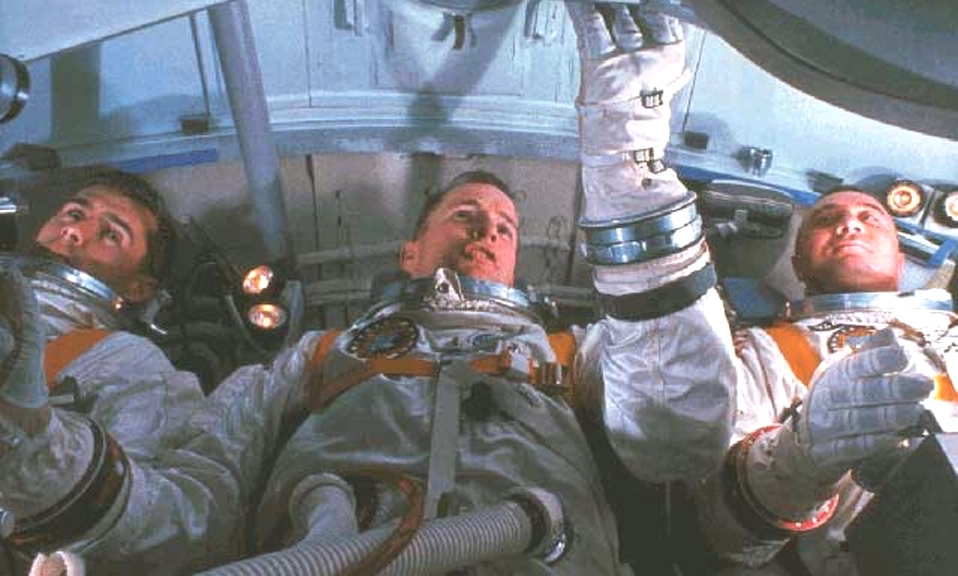
🔥 Apollo 1 (AS-204): The Ultimate Sacrifice (January 1967)
The Mission: The first crewed test of the Apollo Command/Service Module (CSM) in Earth orbit.
The Crew: Gus Grissom, Ed White, and Roger Chaffee.
What Happened: On January 27, 1967, during a routine “plugs-out” countdown simulation on the launch pad, a spark ignited the cabin’s pure oxygen environment. A flash fire swept through the capsule in seconds. The inward-opening hatch and high pressure made it impossible for the crew to escape. All three astronauts perished.
The Aftermath: This was a devastating, program-ending tragedy. But NASA didn’t cancel Apollo. Instead, they grounded the program for 20 months. They completely redesigned the Command Module, switching to a nitrogen-oxygen mix on the ground, replacing flammable materials with self-extinguishing ones, and installing a lightning-fast, outward-opening hatch. The crew’s sacrifice literally saved the lives of every astronaut who flew after them.
(Note: There were no official “Apollo 2” or “Apollo 3” crewed missions. NASA skipped those numbers out of respect for the Apollo 1 crew, resuming the sequence with uncrewed test flights.)
🚀 Apollo 4, 5, and 6: The Uncrewed Proving Grounds (1967–1968)
Before putting humans back in the fire, NASA had to prove the machines worked.
- Apollo 4 was the first test of the monstrous Saturn V rocket, proving it could lift the massive payload needed for a lunar mission.
- Apollo 5 tested the Lunar Module (LM) in Earth orbit, ensuring its descent and ascent engines could fire in the vacuum of space.
- Apollo 6 was a “shake-down” cruise for the Saturn V, enduring severe pogo oscillations (violent vibrations) that tested the rocket’s structural limits. It was rough, but it proved the rocket could still complete its mission.
🌍 Apollo 7: Getting Humans Back in the Sky (October 1968)
The Mission: The first crewed Apollo flight.
The Crew: Wally Schirra, Donn Eisele, and Walt Cunningham.
What Happened: This was a critical 11-day Earth-orbit mission to test the redesigned Command Module. It was a massive success, proving the life support, navigation, and rendezvous systems worked.
The Drama: It wasn’t all smooth sailing. All three astronauts caught severe head colds in space. Frustrated by Mission Control’s insistence that they wear their bulky, uncomfortable re-entry helmets (which made their sinus pain worse), the crew essentially staged a mild “mutiny,” refusing to put the helmets on. They landed safely, but the tension ensured that Schirra, Eisele, and Cunningham never flew in space again. Still, they proved the Apollo spacecraft was finally safe for humans.
🌑 Apollo 8: The Audacious Giant Leap (December 1968)
The Mission: The first humans to leave Earth orbit, travel to the Moon, and orbit it.
The Crew: Frank Borman, Jim Lovell, and Bill Anders.
What Happened: This remains one of the most daring decisions in the history of exploration. The Lunar Module wasn’t ready yet, and the Saturn V had only flown twice. But with the Soviet Union threatening to beat them to the Moon, NASA took a massive gamble: they strapped three men to a Saturn V and aimed them directly at the Moon.
The Triumph: It worked flawlessly. On Christmas Eve 1968, humanity heard the voices of Borman, Lovell, and Anders as they became the first humans to see the far side of the Moon and witness the iconic “Earthrise.” Their reading of the Book of Genesis while orbiting the Moon remains one of the most watched television broadcasts in history. They proved we could get there, navigate, and come back.
🕷️ Apollo 9: The Spider and the Gumdrop (March 1969)
The Mission: The first crewed flight of the entire Apollo spacecraft (Saturn V, Command Module, and Lunar Module) in Earth orbit.
The Crew: James McDivitt, David Scott, and Russell Schweickart.
What Happened: The Lunar Module (nicknamed “Spider”) was a bizarre, fragile-looking craft. Apollo 9’s job was to prove it could fly, separate from the Command Module (“Gumdrop”), and dock with it again in space. Schweickart even tested the new Apollo spacesuits outside the LM hatch.
The Triumph: The docking and undocking maneuvers were executed perfectly. The “Spider” could fly. The final major piece of the puzzle was proven to work.
🎬 Apollo 10: The Ultimate Dress Rehearsal (May 1969)
The Mission: The final test before the landing.
The Crew: Thomas Stafford, John Young, and Eugene Cernan.
What Happened: Apollo 10 did everything Apollo 11 would do, except actually land. They flew to the Moon, entered lunar orbit, and undocked the Lunar Module (“Snoopy”) from the Command Module (“Charlie Brown”). Stafford and Cernan flew “Snoopy” down to just 8.4 nautical miles (50,000 feet) above the lunar surface, scanning the landing site at Tranquility Base.
The Drama: During the ascent stage separation to return to the Command Module, the LM began tumbling wildly out of control due to a switch being set to the wrong position. Stafford and Cernan fought the controls, manually stabilizing the craft just seconds before it would have crashed into the Moon or been lost in space. They survived, docked safely, and returned to Earth. The dress rehearsal was complete.
🦅 Apollo 11: The Triumph (July 1969)
The Mission: The first crewed lunar landing.
The Crew: Neil Armstrong, Buzz Aldrin, and Michael Collins.
What Happened: On July 16, 1969, the Saturn V roared to life. Four days later, the Lunar Module Eagle separated from the Command Module Columbia. As Armstrong and Aldrin descended, the onboard computer flashed multiple “1202” program alarms, and Armstrong had to manually steer the craft past a boulder-filled crater to find a safe landing spot.
With only 25 seconds of fuel remaining, Eagle touched down. “Houston, Tranquility Base here. The Eagle has landed.”
While Collins orbited above, completely alone on the far side of the Moon, Armstrong and Aldrin stepped onto the surface, fulfilling Kennedy’s promise and achieving the impossible.
Success Was Not Inevitable
It is easy to look back at Apollo 11 as a destined, inevitable triumph. But the historical record shows something far more profound: Success was fragile.
It was purchased with the lives of the Apollo 1 crew. It was forged in the grueling, unglamorous uncrewed tests. It was risked on the audacious gamble of Apollo 8, perfected in the Earth orbit of Apollo 9, and nearly lost in the terrifying tumble of Apollo 10.
Every single mission from 1 to 10 was a necessary, non-negotiable stepping stone. Without the tragedy of Apollo 1, the redesigns wouldn’t have happened. Without Apollo 8, we wouldn’t have known the navigation worked. Without Apollo 10, we wouldn’t have known the Lunar Module could survive the descent and ascent.
Apollo 11 wasn’t a miracle. It was the hard-earned, meticulously engineered culmination of a decade of relentless human courage, iteration, and sacrifice.