The lithium-ion battery has powered the electric car revolution for over a decade. But it has a fundamental limitation: the liquid electrolyte that shuttles ions between electrodes is flammable, degrades over time, and caps how much energy you can pack into a given volume. The solid-state battery replaces that liquid with a solid material—and the promise is enormous: faster charging, longer range, and a dramatically lower risk of fire.
The technology has been “just a few years away” for more than a decade. In 2026, that timeline is finally collapsing. Toyota is projecting a car that can drive 745 miles on a charge completed in under 10 minutes. QuantumScape says it has solved the manufacturing problem that held the field back for years. And companies from China to Finland are moving from lab prototypes to pilot production lines.
But solid-state batteries still face real hurdles—dendrites, manufacturing yield, and a cost gap that the industry doesn’t expect to close until the mid-2030s. Here’s what the technology actually is, what it can do, and how close it really is.
What Is a Solid-State Battery?
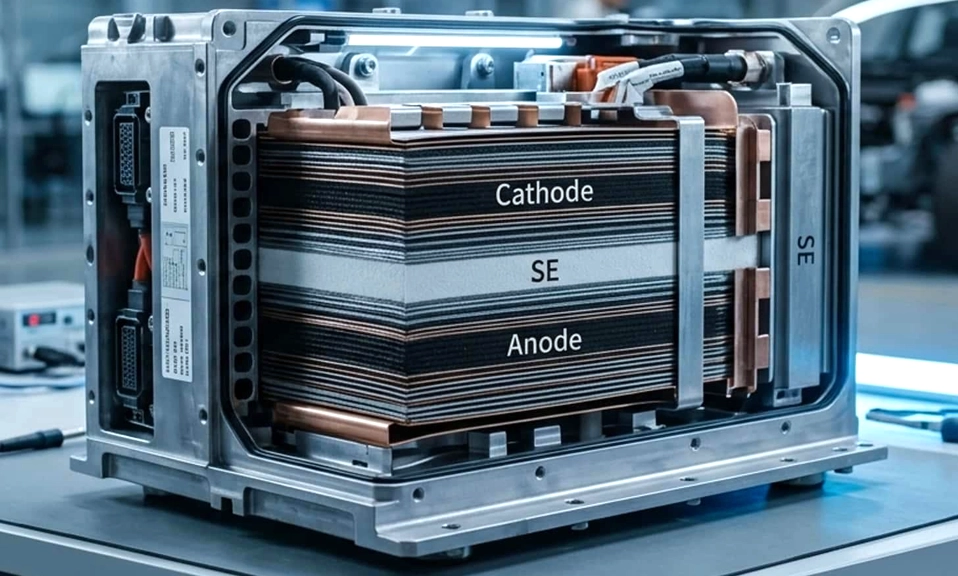
A conventional lithium-ion battery has three core components: a cathode (the positive electrode), an anode (the negative electrode), and an electrolyte—a liquid or gel that allows lithium ions to move between the two during charging and discharging.
A solid-state battery replaces that liquid electrolyte with a solid ceramic or polymer material. The ions still move, but they do so through a solid medium rather than a liquid one. This single change cascades through almost every aspect of battery performance.
The most advanced designs pair the solid electrolyte with a lithium-metal anode instead of the graphite anode used in conventional lithium-ion cells. Lithium metal can store far more energy per unit of mass, which is the primary reason solid-state batteries promise such dramatic improvements in energy density.
The Benefits: What Solid-State Actually Delivers
1. Energy Density: 400 Wh/kg and Beyond
The energy density of a battery determines how much range you can get from a given weight. Most modern lithium-ion batteries sit in the 200–300 Wh/kg range.
Solid-state cells are already reaching 400 Wh/kg in production-ready prototypes. Chery’s Rhinoceros S solid-state battery is rated at 400 Wh/kg. Donut Lab, a Finnish startup, claims the same figure for its cells. And research projections suggest that advanced solid-state designs could eventually reach 450–500 Wh/kg.
What that means in practice: At 400 Wh/kg, a battery pack that weighs the same as a current 250 Wh/kg pack could store 60% more energy. That translates directly into more range—or a lighter car with the same range, which improves efficiency further.
Toyota’s projection of 745 miles on a single charge is the most aggressive claim in the industry. Mercedes-Benz has already demonstrated a modified EQS with a solid-state pack exceeding 745 miles of range in real-world testing.
2. Charging Speed: Minutes, Not Hours
The second major advantage is charging speed. Solid electrolytes can tolerate higher current densities without the degradation and heat buildup that plague liquid-electrolyte cells.
Donut Lab’s solid-state battery has been independently tested by the VTT Technical Research Centre of Finland. The results: 80% charge in about 5–10 minutes, depending on conditions, with the battery retaining 99–100% of its capacity after the test. The tests used passive cooling—no complex liquid cooling system—which could simplify battery pack design and reduce cost.
Toyota’s target is even more ambitious: a charge completed in under 10 minutes for 745 miles of range.
For context, a typical lithium-ion EV today takes 20–40 minutes to charge from 10% to 80% at a fast charger. Solid-state could cut that to 10–15 minutes—close to the time it takes to fill a petrol tank.
3. Safety: Cooler, Less Flammable
The liquid electrolyte in a lithium-ion battery is flammable. Thermal runaway—a chain reaction that can lead to fire—is one of the technology’s most persistent safety concerns.
A solid electrolyte is not flammable. It also has higher thermal stability, reducing the risk of overheating and fire. Donut Lab’s cells, for example, are designed to eliminate the flammable liquid electrolyte entirely and mitigate dendrite formation, which is another safety concern.
4. Lifespan: 100,000 Cycles?
Donut Lab claims its solid-state battery can withstand up to 100,000 charging cycles—far beyond the 1,500–3,000 cycles typical of conventional lithium-ion cells. If that claim holds up in real-world use, it would fundamentally change the economics of EV ownership: a battery that outlasts the car itself.
The Challenges: Why Solid-State Isn’t Everywhere Yet
The benefits are real. The obstacles are equally real.
1. Dendrites: The Needle in the Solid
The most stubborn technical challenge is dendrite formation. In batteries with lithium-metal anodes, needle-like filaments of lithium can grow during charging. If they pierce the solid electrolyte, they cause an internal short circuit—and potentially a fire.
Solid electrolytes were supposed to act as a physical barrier to dendrites. In practice, many of them crack as the dendrites push through, like roots breaking through a concrete foundation. Solving this problem is the central focus of the field.
QuantumScape, a Bill Gates-backed company, claims to have solved it. Its ceramic electrolyte is designed to be compatible with lithium metal, preventing dendrite formation. “We spent, then, like 10 years learning how to process it to satisfy all of the other requirements,” says co-founder Tim Holme.
2. Manufacturing at Scale
Making a solid-state battery in a lab is one thing. Making millions of them is another.
Mass production requires large quantities of defect-free ceramic sheets for the electrolyte. It also requires dry rooms for assembly, because many solid electrolytes react with water. The precision required is extreme, and the yields are still low.
QuantumScape says it has developed a proprietary manufacturing method that cuts the ceramic production time from days to minutes. Whether that speed can be maintained at full scale is an open question.
3. Cost: The Mid-2030s Gap
Solid-state batteries are currently more expensive to produce than lithium-ion packs. The industry generally expects prices to reach parity in the mid-2030s.
The cost challenge is not just about materials. It’s about the entire manufacturing ecosystem. Lithium-ion production lines have been refined for decades. Solid-state production lines are being built from scratch.
4. The Interface Problem
Even without dendrites, maintaining stable contact between the solid electrolyte and the electrodes during repeated charging and discharging is difficult. The materials expand and contract, and the interface can degrade over time. Chery has identified “material-interface contact” as a key engineering priority for its solid-state program.
Who’s Building What: The 2026 Landscape
The race to commercialize solid-state batteries is global, and the timelines are converging.
Toyota has been researching solid-state batteries since 2010. It is working with Idemitsu Kosan on a pilot production facility and has set 2027–2028 for its first all-solid-state vehicle.
Samsung SDI is targeting mass production in 2027 with BMW and Solid Power.
QuantumScape has begun shipping B-sample cells and inaugurated its Eagle production line. Its partnership with Volkswagen positions it as one of the most advanced players in the West.
CATL, the world’s largest battery maker, has invested nearly $2.6 billion in solid-state research. However, it placed its own solid-state technology readiness at level four out of nine in June 2026—a candid assessment that mass production is still years away.
Chery completed a 0.5 GWh pilot line for 60 Ah-class solid-state cells in February 2026 and plans a dedicated Rhinoceros S pilot line for 2027.
BYD plans to demonstrate and install solid-state batteries in electric vehicles for the first time in 2027, with mass production around 2030.
Donut Lab, the Finnish startup, is starting with electric motorcycles—the Verge TS Pro—before scaling to larger platforms. Its cells have been independently tested and validated, making it one of the first companies to demonstrate real-world performance.
The consensus is that small-scale production begins in 2027–2028, with mass-market adoption in the early 2030s. LG Energy Solution’s North America president has said solid-state will reach electric cars “roughly a decade away”—a more conservative estimate that underscores how much work remains.
Could Electric Cars Soon Charge Faster and Drive Farther?
Yes—but “soon” is doing a lot of work in that sentence.
The technology works. Solid-state cells have demonstrated 400 Wh/kg energy density, 5–10 minute charging, and significantly improved safety in independent tests. Toyota projects 745 miles of range on a charge completed in under 10 minutes. QuantumScape says it has solved the dendrite problem. The first production solid-state vehicles are expected in 2027–2028.
But the gap between a validated prototype and a mass-market product is measured in years, not months. Manufacturing yields are low, costs are high, and the industry doesn’t expect price parity with lithium-ion until the mid-2030s.
The electric car of 2035 will likely have a solid-state battery. It will charge in the time it takes to drink a coffee, drive farther than most people need to go in a day, and be safer than the lithium-ion packs on the road today.
The electric car of 2026 is still waiting for that future. But for the first time, the wait has a finish line.