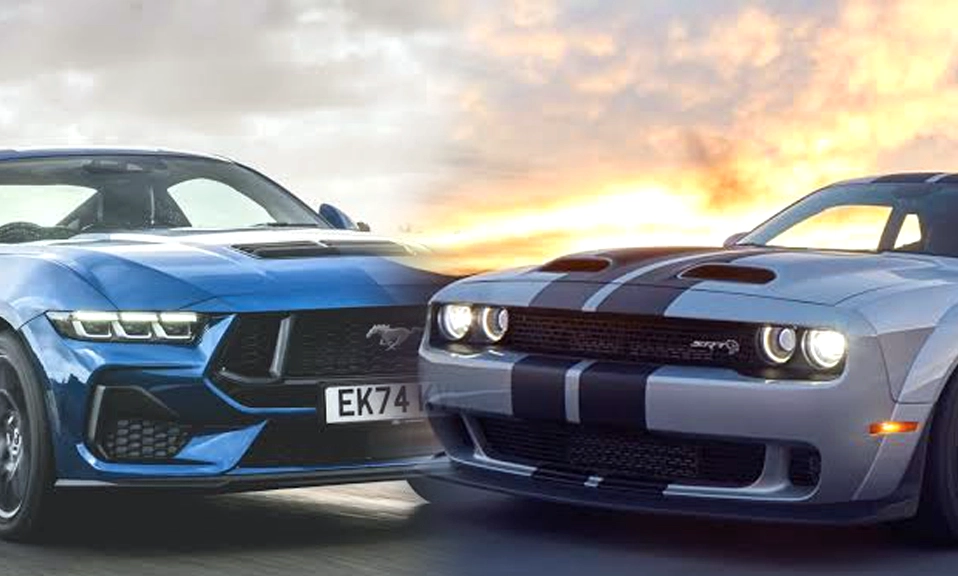
Few rivalries ignite passion among car enthusiasts quite like Ford Mustang vs. Dodge Challenger SRT Hellcat. On one side, you have the original pony car, a legend that invented the segment in 1964 and has continuously evolved for over six decades. On the other, you have a brute-force monster that resurrected the classic muscle car formula with one outrageous goal: more horsepower than anyone thought sensible. Both are icons of American engineering, but they take wildly different paths to performance. Let’s break down this epic clash of thunder.
The Contenders
Ford Mustang (S550/S650 Generation)
Manufacturer: Ford
In Production: 1964–present (six decades and counting)
Variants: EcoBoost, GT (5.0L V8), Dark Horse, GT500 (supercharged)
Key Model: Mustang GT Dark Horse — 500 hp naturally aspirated 5.0L Coyote V8
Flagship: Shelby GT500 (2020–2021, 760 hp supercharged 5.2L Predator V8)
Dodge Challenger SRT Hellcat
Manufacturer: Dodge (Stellantis)
In Production: 2015–2023 (discontinued, now a collectible)
Variants: Hellcat (717 hp), Hellcat Redeye (797 hp), Hellcat Redeye Widebody (up to 807 hp in Jailbreak models)
Engine: 6.2L supercharged HEMI V8
Legacy: The car that reignited the modern horsepower war
Head-to-Head Comparison
Category | Ford Mustang GT | Dodge Challenger Hellcat |
|---|---|---|
Engine | 5.0L naturally aspirated V8 | 6.2L supercharged HEMI V8 |
Horsepower | 486–500 hp | 717–807 hp |
Torque | 418–418 lb-ft | 656–707 lb-ft |
0–60 mph | ~4.2 seconds | ~3.6–4.0 seconds |
Quarter Mile | ~12.3 seconds | ~11.5–12.0 seconds |
Top Speed | ~163 mph | ~199 mph |
Curb Weight | ~3,800 lbs | ~4,400+ lbs |
Transmission | 6-speed manual / 10-speed auto | 6-speed manual / 8-speed auto |
Seats | 4 (tight rear) | 5 (spacious, true muscle proportions) |
Price (New) | ~$45,000 (GT) | ~$72,000+ |
Driving Feel | Sharp, agile, track-ready | Straight-line brute, drag-strip king |
Note: Figures vary by model year, trim, and testing conditions. Upgrading to the Shelby GT500 changes the equation entirely — 760 hp and track-focused handling that rivals supercars.
Performance: Power vs. Precision
The Hellcat’s Philosophy: Overwhelming Force
The Hellcat doesn’t do subtlety. Its supercharged 6.2L HEMI delivers power in an avalanche, with that unmistakable whine of the supercharger and a soundtrack best described as apocalyptic. It’s a drag-strip weapon built to annihilate tires and quarter-mile times. The tradeoff? At nearly 4,400 pounds, it’s a heavyweight, and twisty backroads are not its natural habitat.
The Mustang’s Philosophy: The Complete Package
The Mustang GT, especially in Dark Horse trim, is a driver’s car. Its naturally aspirated Coyote V8 revs freely to 7,500+ rpm, the chassis is balanced, and the steering is communicative. It’s equally comfortable carving canyon roads, lapping a track, or cruising the boulevard. Modern independent rear suspension (since 2015) transformed it into a genuine corner carver.
The Verdict:
Straight-line acceleration: Hellcat (especially Redeye/Jailbreak)
Track performance: Mustang (and it’s not close)
Everyday drivability: Mustang (lighter, more efficient, more agile)
Theater and drama: Hellcat, by a landslide
Design and Character
Ford Mustang
Evolution: Modern, aggressive, and aerodynamic — clearly a 21st-century machine with heritage cues.
Interior: Driver-focused cockpit with digital gauge cluster, premium materials in higher trims.
Presence: Sleek and athletic — a predatory look that says “I handle.”
Dodge Challenger Hellcat
Retro design: Deliberately faithful to the 1970s original — long hood, wide stance, unmistakable silhouette.
Interior: Spacious and comfortable, old-school muscle proportions, room for the whole family.
Presence: Nothing on the road looks meaner. Widebody flares and a functional hood scoop make it look engaged and furious even at a standstill.
Sound and Emotion
Let’s be honest — this is a huge part of muscle car ownership:
Mustang GT: A raspy, high-revving V8 howl with a crisp bark. The Coyote engine sounds refined yet aggressive, especially with an active exhaust in Track mode.
Hellcat: A deep, supercharged thunderstorm. The 6.2L HEMI’s idle alone shakes windows, and full-throttle acceleration sounds like the end of the world. It’s arguably the greatest factory exhaust note of the modern era.
Practicality and Ownership
Consideration | Mustang | Hellcat |
|---|---|---|
Fuel Economy | Better (relatively!) — ~15/24 mpg (GT) | Brutal — ~13/22 mpg, and much worse when driven enthusiastically |
Rear Seats | Cramped | Genuinely usable for adults |
Trunk Space | Good (13.5 cu ft) | Excellent (16.2 cu ft) |
Insurance Costs | High | Very high |
Tire Budget | Moderate | Plan on frequent replacements |
Future Collectibility | Strong for special editions | Already appreciating — the Hellcat is now discontinued |
The Verdict: Which One Wins?
Choose the Mustang if you want:
A car that handles as good as it accelerates
Track days and canyon carving
Better daily livability and fuel economy
A more modern driving experience
Continuously evolving performance (the S650 generation and upcoming electric/pony variants)
Choose the Hellcat if you want:
Raw, unfiltered power and straight-line domination
The most outrageous engine note ever fitted to a production car
Retro muscle car styling with modern reliability
Real-world practicality (it’s a genuinely comfortable cruiser)
A piece of history — the Hellcat is now out of production and values are climbing
The Mustang is the better car
— more refined, more agile, more complete. The Hellcat is the better experience — an unapologetic sledgehammer that turns every drive into an event. The Mustang respects your driving skill and rewards it; the Hellcat bludgeons physics into submission and laughs while doing it.
In the great American tradition, there’s no wrong answer here. One perfected the pony car formula over 60 years; the other took the muscle car to its logical, 807-horsepower extreme.
So, which side are you on?
Team Mustang — precision, heritage, and corner-carving balance? Or Team Hellcat — supercharged fury and quarter-mile violence?