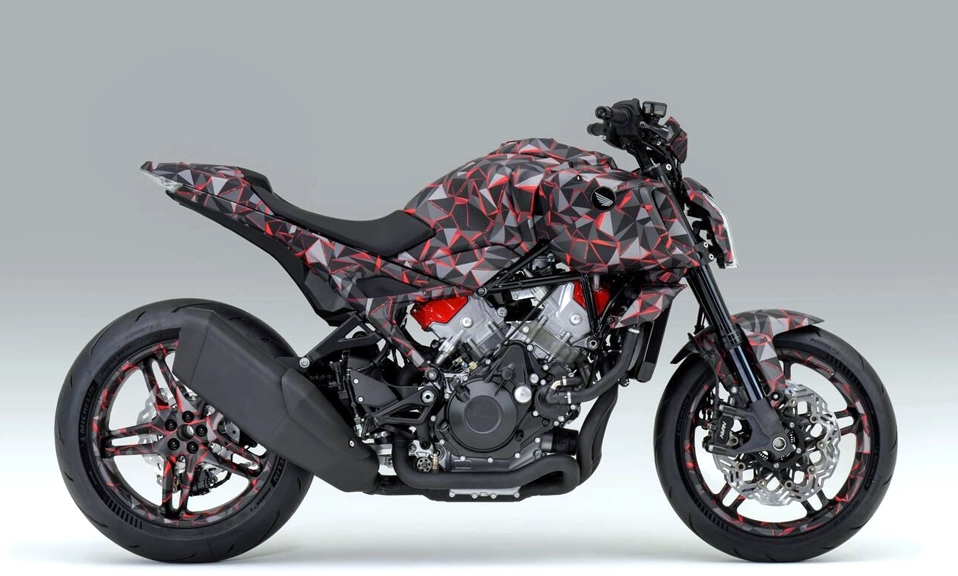
The motorcycle engine as we know it is being rethought from first principles. Honda has unveiled the V3R 900 E-Compressor at EICMA 2026, a production-ready machine built around a 900cc V3 engine and the world’s first electronically controlled compressor on a motorcycle. Forget everything you know about turbos and superchargers—this is a fundamentally different approach to forced induction, and it could signal the future of high-performance combustion.
🚀 The Core Innovation: Boost Without the Lag
Traditional forced induction has always involved compromise. A turbocharger relies on exhaust gases, meaning it takes time for the engine to build enough pressure to spool up—the dreaded turbo lag. A mechanically driven supercharger, like those on Kawasaki’s H2, is tied directly to engine speed, so boost builds linearly with revs.
Honda’s system is decoupled from engine speed entirely. The compressor is driven by an electric motor, managed by the ECU. This means the bike can deliver full boost pressure instantly, even from idle, providing strong, predictable torque at low revs without waiting for the engine to spin up.
The patent documents reveal another clever twist: the compressor is not always active. Under light loads, the system bypasses the blower entirely, allowing the engine to run as a normally aspirated unit for efficiency. When the rider demands power, the electric motor spools the compressor up in an instant.
🏍️ The Result: 900cc Performance, 1200cc Punch
The headline claim is bold: Honda says the V3R 900 delivers performance comparable to a 1,200cc engine, while retaining the compact dimensions and agility of a 900. The engine itself is a liquid-cooled, 75-degree V3—a layout that is narrower than an inline-four but offers more character and smoothness than a parallel-twin.
The compressor also eliminates the need for an intercooler, saving weight and simplifying packaging. Honda has positioned the blower centrally, between the frame rails and just behind the steering head, centralising mass and minimising the length of the intake ducting. The result is a motorcycle that should handle with the agility of a middleweight while delivering the thrust of a litre-class machine.
🔮 Not Just a Naked Bike: A New Engine Family
The V3R 900 E-Compressor is the first model to wear Honda’s new wing emblem, which the company says will identify future flagship motorcycles. But the real significance is what lies beneath. Honda has made it clear that this engine and compressor technology is not a one-off.
Patent filings show the electric compressor adapted to a range of engine layouts, including flat-six, parallel-twin, V-twin, and inline-four configurations. Reports suggest Honda is even developing a naturally aspirated version of the V3 for a future supersport machine, potentially replacing the CBR600RR with a lighter, more compact middleweight sportbike.
There is also speculation about a V3R 900RR—a full-fairing sports derivative—that could use the e-compressor to deliver superbike-rivalling performance from a smaller, more efficient package.
🛠️ The Production Reality
The machine shown at EICMA 2026 is described as having “final design lines” and is close to production. Design filings from Australia show a road-ready bike with mirrors, indicators, and a license plate holder, indicating Honda is preparing for homologation. The production version features a titanium fuel tank and exhaust, along with an evolved Honda RoadSync system that includes AI-assisted voice control.
Honda has not yet announced final power, torque, weight, price, or an exact launch date, but development is proceeding rapidly. A 2027 market introduction is widely expected.
💎 Is This the Future?
The V3R 900 E-Compressor is not just another fast motorcycle. It is a philosophical statement about the future of the internal combustion engine.
As emissions regulations tighten, manufacturers face a difficult choice: downsize engines and lose performance, or add complex hybrid systems and gain weight. Honda’s e-compressor offers a third path. It allows a smaller, lighter, more efficient engine to deliver the performance of a larger one when required, and to run as a frugal, clean unit when it is not. It is a technology that is as much about efficiency and emissions compliance as it is about outright speed.
Whether it becomes the template for future superbikes depends on cost, complexity, and whether riders embrace a engine note and power delivery that is shaped by software as much as by mechanical engineering. But on the evidence of the V3R 900, Honda has built something genuinely new—and it has the potential to change what we expect from a performance motorcycle.
The age of the electronically boosted combustion engine has begun.