The theory that Queen Nefertiti’s lost tomb is hidden behind the burial chamber of King Tutankhamun is one of the most tantalizing—and contested—hypotheses in modern Egyptology. For nearly a decade, it has been dismissed, revived, and dismissed again. But in September 2026, a new geophysical survey published in Nature has given the theory its most substantial boost yet, pointing to a hidden complex of corridors and chambers extending 25 to 30 meters beyond the north wall of Tutankhamun’s tomb, KV62. The question now is whether this is the breakthrough of the century or another false dawn in the Valley of the Kings.
The Theory: A Tomb Built for a Queen, Repurposed for a Boy King
The hypothesis was first proposed in 2015 by British Egyptologist Nicholas Reeves. His argument was elegantly simple: Tutankhamun’s tomb is too small. For a pharaoh, KV62 is anomalously modest—four chambers, with only the burial chamber decorated, a layout that Reeves argues “conforms to the architectural grammar of neither a private nor a kingly monument” but rather follows the plan of an Eighteenth Dynasty queen.
Reeves suggested that KV62 was originally built for Nefertiti, the wife of Akhenaten and possibly Tutankhamun’s mother or stepmother. When Tutankhamun died unexpectedly at 19, the tomb was hastily adapted for his burial, and the deeper chambers intended for Nefertiti were sealed off and hidden behind plastered walls.
The evidence he cited included lines and cracks in the north wall of the burial chamber, hasty alterations to the paintings, and high-resolution 3D scans that suggested the presence of two sealed doorways behind the plaster. Howard Carter, the tomb’s discoverer, had himself suspected something similar: he secretly reinvestigated the tomb in 1932, only to find a solid stone wall.
The New Evidence: “Tantalizing” Anomalies Beyond the North Wall
The 2026 study, led by former Egyptian antiquities minister Mamdouh Eldamaty, is the most comprehensive geophysical investigation of KV62 to date. It combined ground-penetrating radar (GPR), microgravity measurements, and electrical resistivity tomography to map the subsurface without invasive excavation.
The results point to a two-meter-wide corridor packed with rubble extending from the burial chamber deeper into the hillside. Microgravity data revealed a series of low-density anomalies—structures with right angles that are parallel to the north wall, consistent with man-made chambers rather than natural fractures.
The most intriguing finding is “Anomaly 7”—a large low-density area containing a roughly square high-density zone. George Ballard, the structural engineer who analyzed the data, suggested this could be a chamber filled with objects. The team also noted that these hidden chambers appear to have no connection to any known entrance, meaning that if they exist, they have been sealed since antiquity.
Eldamaty has been effusive about the implications. “Should such an extension eventually be confirmed,” he said, “it would represent not merely the most important discovery in the Valley of the Kings since the uncovering of Tutankhamun’s tomb in 1922. It could potentially rank among the most transformative archaeological discoveries of the modern era”.
The Skeptics: “More Probable” That It Was Ay’s Tomb
Not everyone is convinced. The most prominent voice of caution is Dr. Zahi Hawass, the former antiquities minister and one of Egyptology’s most recognizable figures.
Hawass told Arab News that he considers it “highly unlikely” that Tutankhamun was buried inside Nefertiti’s tomb. “It is more probable that KV62 was originally a small tomb intended for Ay,” he said—Ay being the ancient Egyptian official who became pharaoh after Tutankhamun’s death. “Given Tutankhamun’s sudden death, it was adapted and expanded for his burial”.
Hawass cited architectural evidence: the floor level of the burial chamber shows that the doorway into the Treasury was originally created at a height of 60 to 75 centimeters above the current floor, and was later lowered—along with the entire floor—to accommodate the height of Tutankhamun’s shrines. For Hawass, this is evidence of adaptation, but not of a hidden queen’s tomb behind the walls.
Other scholars have raised the possibility that even if hidden chambers exist, they may not be a royal burial at all. Ray Johnson of the Luxor Institute of Ancient Culture suggested they could simply be storage rooms. Kara Cooney of UCLA, while convinced that undiscovered chambers exist, cautioned that even if Nefertiti’s remains were found, the burial might be modest—many scholars believe Nefertiti’s funerary treasures were later moved to equip Tutankhamun’s funeral.
The history of the search also counsels caution. In 2018, a radar survey found no evidence of hidden chambers, appearing at the time to put the theory to rest. A series of Japanese and Italian surveys produced conflicting results. The 2026 study is not the first to claim evidence; it is the latest in a long line of attempts that have yet to produce definitive proof.
The Next Step: An 8-Centimeter Hole
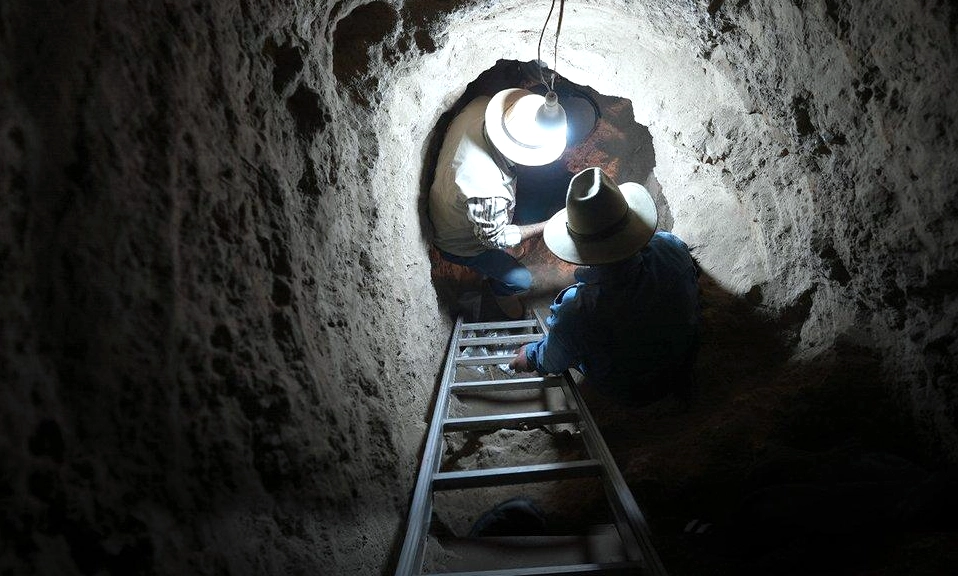
The debate cannot be settled by geophysics alone. The team has applied to the Egyptian Supreme Council of Antiquities for permission to drill an 8-centimeter borehole through the limestone above the tomb, allowing a miniature camera to see what lies inside the suspected chambers.
It is a minimally invasive procedure, but it is still a physical intervention into one of the world’s most sensitive archaeological sites. The approval process is likely to be rigorous, and the outcome is uncertain. As Selima Ekram of the American University in Cairo told Arab News, “It would be good to use the same technology but have a different group carry out the work to see if they come up with the same results”.
If the borehole confirms a void, the next step would be a full excavation—a prospect that would ignite global interest and, potentially, reshape our understanding of the late Eighteenth Dynasty. If it finds solid rock, the theory that has captivated Egyptology for a decade may finally be laid to rest.
A Theory on the Brink
The question in the headline—is Nefertiti’s lost tomb hiding behind King Tut’s burial chamber? —remains unanswered. But the 2026 survey has done something important: it has moved the hypothesis from the realm of speculation to the realm of testable science.
The evidence is suggestive but not conclusive. The anomalies are real, the corridor is real, and the architectural oddities of KV62 are real. But the interpretation—that these features represent a hidden royal tomb built for Nefertiti—is still a hypothesis, and the skeptics have legitimate reasons to doubt it.
What is clear is that the search is entering its decisive phase. The borehole, if approved, will provide the first direct look at what lies beyond the north wall in nearly a century. And if the chambers are there, and if they contain what Reeves and Eldamaty believe they contain, the discovery would be one of the most significant in the history of archaeology.
For now, the Valley of the Kings holds its breath. The Queen is still hidden. But for the first time in years, we may be close to knowing whether she is there at all.