The numbers are grim. Monitored wildlife populations have declined by an average of 73% since 1970, and around one million plant and animal species now face extinction. The threats—habitat loss, poaching, climate change—are vast, fast-moving, and relentless. Conservation has always been a game of catch-up, played by humans with limited resources against problems that never sleep.
Artificial intelligence is changing that equation. Not by replacing the people who do the work, but by giving them something they have never had before: the ability to see, hear, and predict at a scale that was previously impossible. In 2026, AI is no longer a promising experiment in wildlife conservation. It is a deployed tool, operating in rainforests, deserts, oceans, and the frozen Arctic. And in some cases, it is already delivering results that would have seemed unimaginable a decade ago.
Here is how AI is protecting endangered animals—and where it still falls short.
1. Seeing the Invisible: Camera Traps That Identify Individuals
The camera trap is one of conservation’s oldest tools. But a camera trap is only as useful as the human who reviews its images—and that human is drowning.
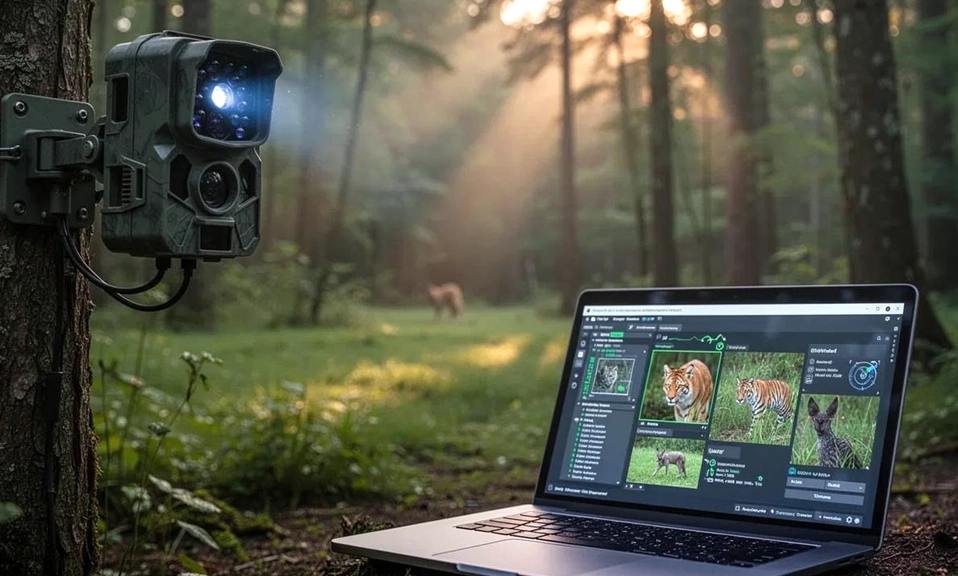
A single survey can generate hundreds of thousands of photographs. Most of them are empty. Some of them are of the same animal, passing the same tree, a hundred times. Reviewing them manually is slow, expensive, and error-prone. AI changes that by automating the detection and identification process, turning a mountain of images into a stream of actionable data.
Tech4Nature Mexico, a partnership between IUCN and Huawei, is one of the most striking examples. In the Dzilam de Bravo Nature Reserve in Yucatán, the project deployed 26 camera traps and 60 acoustic monitoring devices. The AI-powered system processed more than 100,000 images and 600,000 audio recordings, identifying 147 species—40 of them endangered. Crucially, it identified 16 individual jaguars, giving researchers unprecedented insight into their behaviour, distribution, and habitat use. The data informed conservation planning and contributed to the expansion of the protected area from 69,000 to 104,000 hectares.
The technology is also becoming more accessible. In 2026, researchers released HBID24K, the largest annotated camera-trap dataset for houbara bustard conservation—more than 24,000 high-resolution images collected over 13 years across Morocco, Kazakhstan, and Uzbekistan. The dataset was used to benchmark ten object-detection models, with YOLOv10 performing best at distinguishing the endangered bird from foxes, livestock, and other intruders.
And the models are getting faster. Microsoft’s SPARROW platform uses solar-powered edge computing and satellite connectivity to process images and audio directly in the field, transmitting only the insights back to researchers. It has already operated continuously for a year without maintenance and processed more than one billion images and acoustic recordings across 11 countries on five continents.
2. Hearing the Forest: Acoustic AI and the Fight Against Poaching
For every animal that can be photographed, there are ten that can only be heard. Bioacoustics—the use of sound to study wildlife—has become one of the most powerful tools in the conservation arsenal, and AI is what makes it scalable.
The Elephant Listening Project at Cornell University has deployed almost 100 acoustic units across nearly 2,000 square kilometres of Central African rainforest. These recorders capture the low-frequency rumbles that forest elephants use to communicate across kilometres, allowing researchers to detect and study the critically endangered species without ever seeing it. The same recorders also pick up gunshots—and that is where AI becomes a weapon against poaching.
The challenge is noise. A jungle is not quiet. Rain, wind, breaking branches, falling raindrops, and even other monkey species can sound like a gunshot. Traditional detection algorithms generate thousands of false positives, forcing humans to review every alert. That is the bottleneck AI is now closing.
RAPTOR (Rapid Alert and Patrol Tracking for Operational Rescue) is a hybrid audio-visual system built on a Raspberry Pi 5. It uses Mel-spectrogram and MFCC-based CNN classifiers to detect elephant distress calls and gunshots, while YOLOv8 analyses visual frames for suspicious activity. A decision-fusion model combines the audio and video judgements to reduce false positives. When a threat is detected, RAPTOR logs the location and sends a notification to authorities, improving response times for rangers.
Forestguard takes a similar edge-AI approach, designed for remote reserves where patrols are resource-intensive and camera traps are easily stolen or destroyed. It detects anomalies—gunshots, distressed animals, human intruders—in real time, without requiring a constant connection to the cloud.
And then there is the human story. In 2026, a 17-year-old high school student named Naveen Dhar built a neural network that picks out gunshots from jungle noise with high accuracy, without flagging the breaking branches and raindrops that confuse existing systems. His model was profiled by Scientific American as a potential breakthrough for real-time poaching detection in rainforests.
3. Predicting the Poacher: AI That Forecasts Before the Shot Is Fired
The most ambitious application of AI in conservation is not detection. It is prediction.
A paper published in the Proceedings of the AAAI Conference on Artificial Intelligence in 2026 introduced a generative AI approach called Latent Composite Flow Matching for forecasting poacher behaviour. The model learns patterns from past poaching incidents and predicts where and when poaching is likely to occur, allowing patrols to be deployed proactively rather than reactively.
The logic is simple, even if the mathematics is not: poaching is not random. It follows patterns shaped by geography, access routes, animal density, and ranger patrol schedules. If you can model those patterns, you can anticipate them. The same principle is being applied to autonomous drone-based anti-poaching systems, which use AI-driven detection and adaptive deterrence mechanisms to respond to threats in real time.
The goal is not to replace rangers. It is to give them the element of surprise—to be waiting where the poachers are going, rather than arriving after they have gone.
4. Watching from Space: Satellite AI and the Big Picture
Camera traps and acoustic sensors are powerful, but they are local. Satellite imagery offers something different: a view of the entire landscape, updated regularly, without anyone needing to set foot in the field.
GAIA (Geospatial Artificial Intelligence for Animals), developed by NOAA’s Northeast and Alaska Fisheries Science Centers in partnership with Microsoft AI for Good and the U.S. Geological Survey, uses very high-resolution satellite imagery to detect whales and other marine mammals from space. The system integrates cloud computing, geospatial analysis, and machine learning to build a scalable, automated detection platform. Its initial focus is on endangered North Atlantic right whales and Cook Inlet belugas—species whose survival depends on knowing where they are, so that shipping lanes and fishing grounds can be managed to avoid them.
The U.S. Geological Survey has applied the same approach to polar bears on land. A 2026 study used deep learning models to detect polar bears in very high-resolution satellite imagery collected along the Beaufort Sea coast of Alaska. The best-performing model, using Pléiades Neo imagery, achieved 90% average precision in validation—and while precision dropped to 35% when applied to new imagery, recall was 100%, meaning the model found every bear that was there. That is a powerful first pass for a species that is increasingly spending time on land as sea ice retreats.
In the United Kingdom, the University of Cambridge has developed an AI foundation model that tracks changes in land usage from satellite imagery—even through cloud cover—to identify threats to hedgehog habitats. And in China’s Beichuan River Source region, an AI recognition system is being developed to identify snow leopards, blue sheep, and other alpine species from camera-trap and aerial data.
5. The Caveats: What AI Still Can’t Do
The achievements are real. The limitations are equally real.
Accuracy is contextual. A model that performs brilliantly on a giraffe in open savanna may fail on a rare, near-identical species in dense forest. “In a dense forest or in poor weather, machine learning predictions can be far less reliable,” says Sara Beery of MIT. “As you expand the problem space, you end up with more species that are easily confused”.
Training data is biased. AI learns from what it is shown. If the training data is skewed toward certain species, habitats, or lighting conditions, the model will be skewed too. “You need training data for every species you’re interested in,” Beery notes—and for many endangered species, that data does not exist.
Each sensor sees only a piece of the puzzle. Satellite views cannot penetrate the forest canopy. Camera traps struggle to capture birds. Acoustic recorders miss whatever stays silent. Combining data streams into a holistic picture—the goal of platforms like Microsoft’s SPARROW and AI2’s EarthRanger—is still a work in progress.
AI does not address the root causes. Poaching is driven by poverty, inequality, and demand for illegal wildlife products. AI can help rangers intercept poachers, but it cannot eliminate the economic incentives that drive them. “It’s a very complex problem,” says Daniela Hedwig of the Elephant Listening Project, “where poaching needs to be tackled from multiple angles”.
A Tool, Not a Saviour
Can artificial intelligence save endangered animals? No. But it can buy them time.
The scale of the biodiversity crisis is too vast, and its causes too deeply embedded in human systems, for any technology to solve on its own. AI is not a silver bullet. It is a force multiplier—a way to make the people who protect wildlife more effective, more responsive, and better informed than they have ever been.
A jaguar that would never have been identified is now known. A gunshot that would have gone unheard is now detected. A whale that would have been invisible from space is now found. A poacher who would have struck in the dark is now predicted.
These are not abstract victories. They are lives—animal lives, and the human lives of the rangers and researchers who dedicate themselves to protecting them. AI is giving those people a fighting chance.
The technology will keep improving. The models will get faster, the sensors will get cheaper, and the datasets will get richer. But the outcome will not be determined by the technology alone. It will be determined by whether we choose to use it—and whether we address the human forces that make it necessary in the first place.