The electric vehicle conversation has spent years framing the future as a binary choice: keep burning gasoline, or commit fully to a battery-electric car. In 2026, that binary is breaking down. A third option is gaining serious momentum—one that promises the electric driving experience without the range anxiety, the charging anxiety, or the price premium of a long-range battery pack. It is called the Extended-Range Electric Vehicle, or EREV, and it may be the most pragmatic bridge between the world we have and the world we are trying to build.
But is an EREV actually better than a traditional electric car? The honest answer depends on what you need a car to do—and on whether you see the onboard gasoline generator as a clever safety net or a complicated compromise. Here is how EREVs work, how they compare to BEVs, and why the world’s biggest automakers are suddenly betting on them.
What Is an EREV, and How Does It Work?
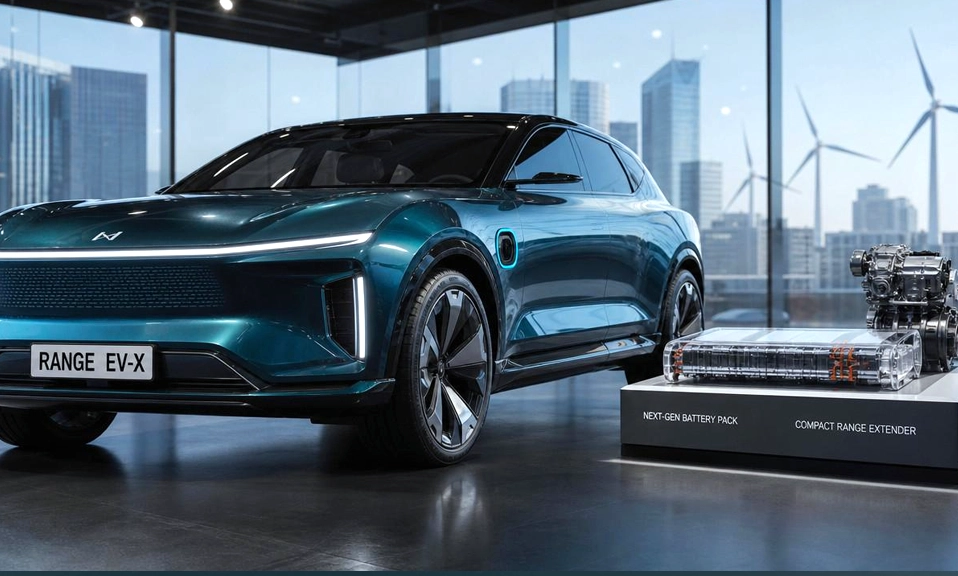
An EREV is, at its core, an electric vehicle. The wheels are driven exclusively by electric motors. There is a battery, a charging port, and all the instant torque and smoothness that define the EV experience. What sets it apart is a small gasoline engine on board whose only job is to generate electricity when the battery runs low. It is not connected to the wheels. It does not drive the car. It is a generator, a backup power plant carried with you.
This is the critical distinction between an EREV and a Plug-in Hybrid (PHEV). In a PHEV, the gasoline engine can drive the wheels, either alone or alongside the electric motor. In an EREV, the engine has no mechanical link to the drivetrain. It runs at its most efficient speed to produce electricity, sending power to the motors or recharging the battery, while the electric motors handle all the actual propulsion.
The result is a vehicle that behaves like an EV in daily use—silent, smooth, and cheap to run on electricity—but can keep going for hundreds of miles on a tank of gasoline when you need it to. When the battery drops below a preset threshold, typically around 20–30 per cent, the range extender fires up automatically. The engine drives a generator, part of the electricity goes directly to the motors, and surplus energy recharges the battery.
The Case for EREVs: Weight, Cost, and Confidence
The appeal of an EREV over a pure BEV comes down to three pillars: weight, cost, and confidence.
Weight. To achieve 400 miles of range, a BEV needs a massive battery pack—sometimes 100 kWh or more—which adds thousands of pounds to the vehicle. That weight spiral demands beefier suspension, bigger brakes, and more robust tires, creating a cycle of inefficiency. An EREV can achieve the same total range, and often much more, with a battery half the size. This makes the vehicle lighter, more agile, and significantly cheaper to produce.
Cost. A smaller battery is a cheaper battery. The EREV’s onboard generator and fuel tank cost far less than the additional battery capacity needed to match its total range. For automakers struggling to build affordable EVs at scale, the EREV is a way to deliver a compelling electric experience without pricing the car out of the mainstream market.
Confidence. This is the emotional core of the EREV proposition. Range anxiety is not just a number on a spec sheet; it is the fear of being stranded, the stress of planning routes around charging stops, the uncertainty of whether a charger will be working when you arrive. An EREV eliminates that fear. You can drive it like an EV for your daily commute and plug it in at home, and you can drive it like a gasoline car for a holiday road trip without ever hunting for a charger. As one analysis put it, EREVs solve the range anxiety problem “not with larger, heavier batteries, but with the elegance of a backup plan”.
There is also a practical environmental argument. Data suggests that EREVs are “electric-first” by design, often covering more than 70 per cent of miles in all-electric mode, unlike parallel hybrids that rely heavily on their gas engines. For families making the switch from gasoline to electricity, an EREV can deliver the majority of the emissions and running-cost benefits of an EV, while removing the barrier that stops many buyers from taking the plunge.
The Case Against: Complexity, Highway Efficiency, and the Long-Term Question
None of this makes the EREV a universal solution, and the technology has real drawbacks that buyers should weigh carefully.
Complexity. An EREV still has a combustion engine, a fuel tank, an exhaust system, and all the maintenance requirements that come with them. It is a more complex machine than a BEV, with more parts that can fail and more systems that need servicing. As one analysis bluntly noted, prospective buyers must be aware of “complex maintenance”—unlike a BEV, an EREV still has an engine.
Highway efficiency. When the battery is depleted and the engine is generating electricity for sustained high-speed cruising, the EREV’s efficiency advantage can evaporate. Because energy has to be converted from gasoline to electricity to motion—two conversion steps rather than one—highway fuel consumption can be higher than a conventional gasoline car or a well-integrated parallel hybrid. One Chinese analysis found that at 120 km/h with a depleted battery, an EREV could consume 7–9 litres per 100 km, worse than both PHEVs and pure gasoline vehicles.
The depreciation question. The EREV is widely seen as a bridge technology. In five to seven years, as battery costs fall and charging infrastructure improves, a late-model, high-range BEV may be viewed as the more desirable and more future-proof used car. An EREV, with its combustion engine and smaller battery, could face steeper depreciation as the market moves beyond the transition period.
It is not a pure EV. For buyers who want the simplicity, the silence, and the zero-tailpipe-emissions purity of a full electric car, the EREV’s engine—even if it rarely runs—is a philosophical compromise. The early BMW i3 REx is often cited as a cautionary tale of a well-intentioned EREV that was let down by poor execution.
The Market Moment: Why EREVs Are Having a Breakthrough
The EREV is not a new idea, but 2026 is the year it became a genuine market force—particularly in China, where the technology has found its most receptive audience.
Chinese brands like Li Auto have built their entire identity around range-extended SUVs, and the formula is working. The Li Auto L9, the benchmark of the category, pairs a 72.7 kWh battery with a range extender for 350 km of WLTC electric range and a combined range of 1,370 km. It also offers 5C fast charging, 800V architecture, rear-wheel steering, and a level of technology and comfort that has made it a family favourite. The AITO M9 brings luxury and technology, the Leapmotor D19 EREV offers one of the largest batteries in the segment, and the XPENG GX REEV combines fast charging with strong performance.
The XPENG GX illustrates how far the technology has come. Its 63.3 kWh battery delivers up to 430 km of pure-electric range on the CLTC cycle, while a 60-litre fuel tank extends total range to 1,585 km. Its 800V architecture supports 5C charging that can go from 10 to 80 per cent in around 12 minutes, and XPENG claims the GX can maintain stable cruising at 150 km/h regardless of battery state of charge—addressing the old EREV weakness of reduced power when the battery is low. The company has also worked hard on refinement: optimised vibration paths, active cylinder-stop control, and active noise cancellation keep the engine’s operation to a cabin noise increase of no more than 0.5 decibels.
The Western market is moving more slowly, but the direction is clear. Stellantis is leading the charge with the Ram 1500 Ramcharger, a full-size pickup with a 92 kWh battery, a 130 kW onboard generator powered by a 3.6-litre V6, and a targeted total range of around 690 miles. It is, by many accounts, the most significant EREV yet conceived for the American market—a vehicle that offers the instant torque of an electric truck with the towing and hauling confidence of a gasoline one. Toyota plans to begin EREV production in China in April 2027, targeting 200,000 units in 2027 and 400,000 in 2028, before potentially expanding the technology to other markets. Genesis is expected to offer an EREV variant of its GV90 luxury SUV by 2027, targeting a 700-mile total range.
The market data reflects this momentum. The global EREV market was valued at $11.44 billion in 2024** and is projected to reach **$53.11 billion by 2033, growing at a compound annual rate of 18.6 per cent. This is no longer a niche experiment. It is a strategic bet by some of the world’s largest automakers that the transition to electric mobility will not be a single leap, but a series of pragmatic steps.
So, Are EREVs Better Than Traditional Electric Cars?
The answer depends on who you are and how you drive.
An EREV may be better for you if:
You want to drive electric for daily commuting but regularly make long journeys where charging infrastructure is unreliable or inconvenient.
You live in an area where home charging is difficult or public charging is sparse.
You are not ready to commit to a pure EV because of range anxiety, cost, or the pace of infrastructure rollout.
You need a large vehicle—an SUV or a pickup—where the weight and cost penalties of a long-range BEV battery are most acute.
A BEV may be better for you if:
You have reliable home charging and do mostly shorter, predictable journeys.
You want the simplest, lowest-maintenance vehicle possible, with no engine, no oil changes, and no exhaust system.
You value the environmental purity of zero tailpipe emissions and are willing to plan around charging stops on longer trips.
You are buying for the long term and want a vehicle that will not be seen as a transitional technology as the market matures.
The EREV is not a better electric car. It is a different answer to a different question. A BEV asks: how do we build the best possible electric vehicle? An EREV asks: how do we get more people driving electric, today, without asking them to change their lives before the infrastructure is ready?
The EREV is the pragmatic
bridge of the electric transition. It offers the electric driving experience for the majority of daily miles, without the range anxiety, the charging dependency, or the price premium of a long-range battery. It is heavier and more complex than a BEV, and it is likely to be a transitional technology rather than a permanent one. But for millions of drivers—and for automakers trying to sell EVs to a mainstream audience that is not yet ready to go fully electric—that transition is exactly what is needed.
The binary choice between gasoline and electric was always a simplification. The real world is messier, and the EREV is a machine built for that messiness. It is not the destination. It is the bridge that helps people get there.