Apple spent two years promising a smarter Siri and a deeper integration of AI across the iPhone. In 2026, that promise finally became a product. But the real story is not just that Siri got better. It is that Apple has quietly laid the groundwork for a fundamental shift in how iPhone apps work—one where the assistant becomes the primary interface, third-party developers plug directly into its brain, and the app icon on your home screen matters a little less every day.
The evidence is no longer speculative. iOS 27, released in September 2026, brought a rebuilt Siri, more than 20 new Apple Intelligence features across the system’s core apps, and a dedicated Siri app that syncs conversation history across devices. Then, in early November 2026, Apple opened the floodgates: a developer preview of iOS 27.3 gave any app the ability to bring its content and actions directly into Siri AI, using an expanded App Intents framework. Developers can now teach Siri to perform custom actions, chain multiple steps into a single request, and surface data that previously lived locked inside individual apps.
This is the beginning of something bigger than a voice assistant upgrade. It is Apple’s answer to the question that has haunted the smartphone for a decade: if AI can understand what you want and act on it across every app, why do you need to open an app at all?
The New Siri: From Voice Command to Context Engine
The Siri AI that shipped in iOS 27 is not an incremental update. It is a ground-up rebuild for the large language model era, and the feature list reflects a different ambition entirely.
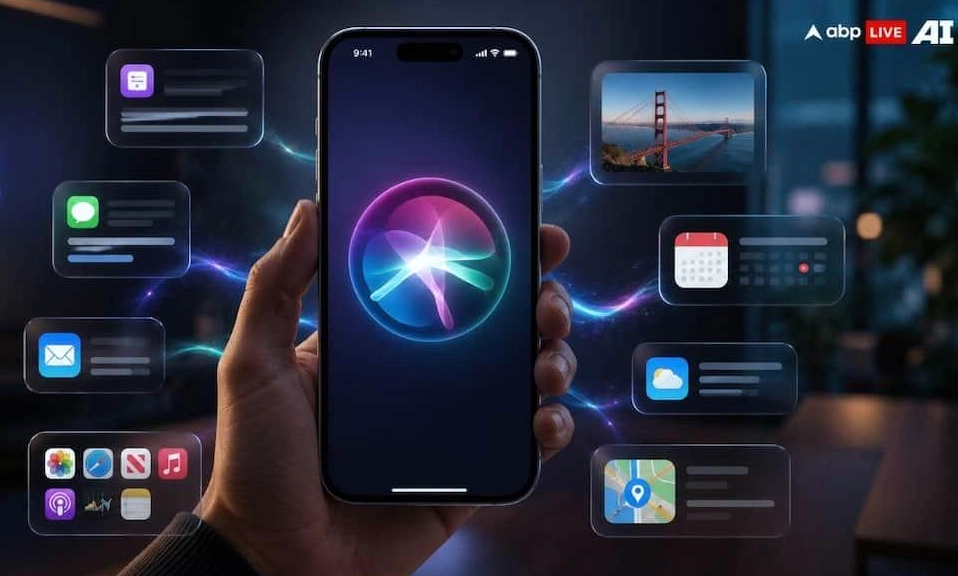
Siri AI now has broad world knowledge, the ability to answer almost any question. It has personal context understanding, allowing it to search across Messages, Mail, Calendar, Notes, and Reminders to find what you need. It has onscreen awareness, meaning it can see what is on your display and act on it. And it can perform app actions—sending messages, creating events, and completing tasks across your installed apps without you switching between them.
Apple also introduced a standalone Siri app that syncs your conversation history across iPhone, iPad, and Mac via iCloud, and a “Write with Siri” feature that can generate drafts, edit your writing, and give feedback virtually anywhere you type. The assistant is no longer a utility you summon for a timer. It is a context-aware layer that sits on top of your digital life.
The App-Level AI Wave: More Than 20 Features Across the System
The second pillar of Apple’s strategy is embedding intelligence directly into the apps you already use. iOS 27 brought a wave of AI features across the system’s core applications, and the breadth is striking.
Photos gained Spatial Reframing, Extend, and an improved Clean Up tool. Messages got Personalized Smart Reply. Calendar and Reminders now let you create events and tasks by describing them in natural language. Mail offers suggestions and personalized replies. Safari can notify you when a page changes, organize your tabs by topic, and even describe an extension in plain language to create it. Shortcuts can be built by describing what you want in natural language. Image Playground was redesigned with more photorealistic generation and wallpaper creation. And Files can suggest intelligent file and folder names.
TechCrunch described the update as Apple teaching the iPhone to “finish your sentences, your photos, and your workflows”. The Safari tab management, one-tap password updating, cross-app context awareness, and AI-powered shortcut creation are all examples of the same principle: the AI is not a separate destination. It is woven into the fabric of the apps themselves.
The Developer Floodgates: App Intents, Skills, and the End of the App Silo
The most consequential development for the long-term future of iPhone apps came in November 2026, when Apple released a developer preview of iOS 27.3 that dramatically expanded what third-party apps can do with Siri AI.
The mechanism is App Intents, a framework that lets developers expose their app’s content and actions to Siri. Previously, this was limited to a narrow set of predefined categories. Now, developers can build custom actions for almost any task—booking a restaurant reservation, checking a delivery, placing an order, or sending a product to a friend—all through a natural language request to Siri.
Apple also introduced Skills, which let developers teach Siri how to combine multiple actions into a single request. In the example Apple gave, you could find a pair of sneakers in a shopping app, tell Siri to share them with a friend, and Siri would locate the product, figure out who you meant, and send it through Messages—without you opening either app. Siri can now also surface any entity in the Spotlight semantic index, not just those that fit a pre-existing schema, meaning app content that was previously invisible to the assistant can now be found and acted upon.
Macworld was blunt about the significance: “Once released and widespread, it can change the way we use our iPhones, iPads, and Macs forever”. That is not hyperbole. If Siri can reliably execute multi-step tasks across apps, the app silo—the fundamental organisational unit of the smartphone for fifteen years—starts to erode.
The Gemini Gamble: Apple’s Admission and Its Consequences
No discussion of Apple’s AI strategy in 2026 is complete without addressing the partnership that made it possible. At WWDC 2026, Apple confirmed that the new Siri AI is powered in part by Google Gemini, integrated into the Apple Intelligence stack to compensate for Apple’s own models not being ready on schedule.
This was a significant admission. Apple, the company that has built its brand on controlling every layer of its products, chose a partner over continued delays. PYMNTS framed it sharply: “It signals that Apple could not close the capability gap on its own timeline and chose a partner over continued delays”.
The partnership is structured to preserve Apple’s privacy narrative. Craig Federighi said at the keynote that “privacy in AI is nonnegotiable,” and the Gemini integration is framed around on-device processing and Apple’s Private Cloud Compute, with Google not having access to user interaction data. Reports suggest Apple pays Google around $1 billion annually for the arrangement, though Apple has not confirmed the figure.
The strategic implication is that Apple’s AI capabilities are now partly dependent on a competitor. That is a vulnerability. But it is also a pragmatic recognition that the alternative—shipping a Siri that could not compete—was worse.
The Privacy Paradox: A Feature and a Constraint
Apple’s emphasis on privacy is not just marketing. It is a genuine architectural choice that shapes what the company can and cannot do with AI. Most Siri AI processing happens on-device, using Apple’s AFM 3 Core models—a 3-billion-parameter on-device model and a 20-billion-parameter advanced model that activates only a fraction of its parameters per request. Complex tasks are routed to Apple’s Private Cloud Compute, where data is used only to process the request and is not stored or used for training.
This architecture is a competitive advantage in a market increasingly concerned about data exploitation. But it is also a constraint. On-device models are smaller and less capable than cloud-based frontier models. The Gemini partnership exists precisely because Apple’s on-device models cannot do everything. The privacy-first approach means Apple will always be making a trade-off between capability and control—and in 2026, it chose to supplement its own models rather than compromise on its principles.
The App Is No Longer the Destination
Apple’s next big move is not a single feature or a single product. It is a re-architecture of the iPhone experience around an AI layer that understands context, acts across apps, and learns from developers what it can do.
The Siri AI overhaul made the assistant capable. The app-level AI features made the system intelligent. The App Intents and Skills framework made the ecosystem extensible. And the Gemini partnership made it all possible on a timeline that Apple could not achieve alone.
The long-term implication is that the app icon—the grid of squares that has defined the smartphone since 2007—may gradually become less important. If you can ask Siri to book a table, check a delivery, and send a product to a friend without opening a single app, the app becomes a backend service rather than a destination. That is not the end of apps. It is the end of apps as the primary interface.
Apple is not the first company to pursue this vision. Google has been building its own cross-app AI layer with Gemini and the Connected Apps Platform. But Apple controls the device, the operating system, and the default assistant on over a billion iPhones. As PYMNTS put it, “the device determines the defaults, the defaults determine the distribution, the distribution determines the usage and the usage determines the revenue”.
The AI-powered iPhone app revolution is not coming. It is already here, in beta, in the hands of developers, waiting for the rest of us to update. The question is not whether it will change how we use our phones. It is how quickly we will stop noticing the apps at all.