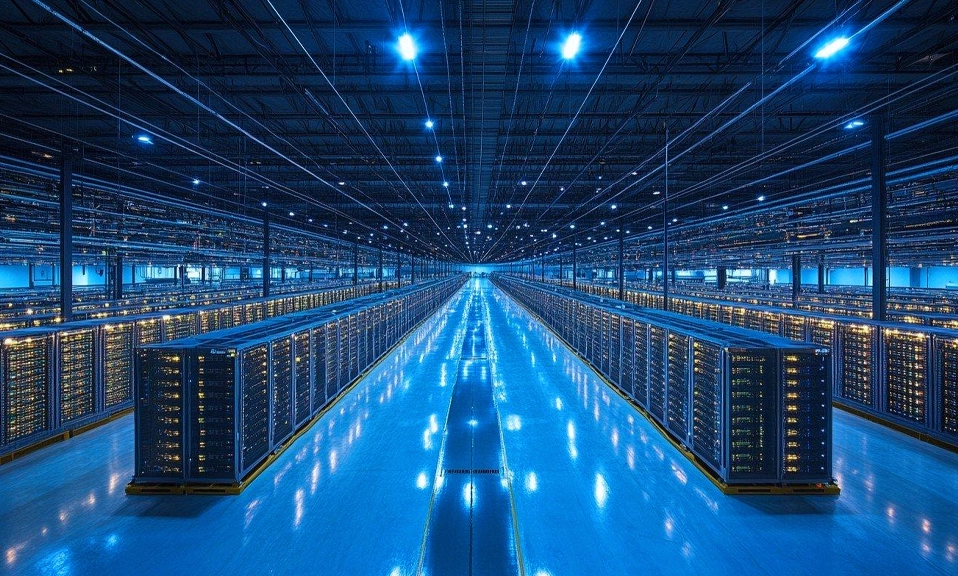
The numbers are staggering. Google’s parent company, Alphabet, has raised its 2026 capital expenditure guidance to as much as $205 billion—more than double what it spent in 2025. Across the four largest hyperscalers—Alphabet, Amazon, Microsoft, and Meta—combined 2026 capex is now guided toward a staggering $720 billion to $745 billion. This is not a bubble. It is the largest infrastructure buildout in the history of computing, and it is being driven by a single, insatiable demand: the need for more AI computing power.
At the center of this race is Google. On November 5, 2026, the company announced a $17 billion investment to build its first data center in Laramie County, Wyoming. It is a project that illustrates both the ambition and the complexity of the AI infrastructure era. The facility will be powered in part by a 702-megawatt natural gas fuel cell system from Bloom Energy, equipped with carbon capture and storage technology, and cooled using air cooling to minimize strain on local water resources. Google has committed to paying 100% of the power costs it incurs, a response to growing local concerns about data centers driving up electricity prices. It is a template for how AI infrastructure will be built in the years ahead: fast, power-hungry, and politically sensitive.
Why Big Tech Needs So Much Computing Power
The simple answer is that AI has become a capacity business. As a 2026 white paper from the AI Inflection Series put it, “software-level capability depends on an underlying stack of electricity, chips, data centers, networking, cooling, inference throughput, and workload economics. Constraints at any layer surface commercially through pricing volatility, delayed deployment, vendor concentration, degraded reliability, and margin pressure”.
The demand is coming from three directions.
Training. Building frontier AI models requires massive clusters of specialized chips running for weeks or months at a time. Google’s own TPUs—now in their eighth generation—are central to this effort, and the company has begun selling TPU systems to external customers, turning what was once an internal tool into a revenue line. The company has signed deals to provide TPUs to Anthropic and Meta, and it is building a joint venture with Blackstone to operate AI data centers with a target of 500 megawatts of capacity.
Inference. Every time a user interacts with an AI model—asking a question, generating an image, summarizing a document—the model must run inference, and inference consumes compute. As AI products scale to hundreds of millions of users, inference demand becomes continuous and enormous. Google’s Gemini app has reached 950 million monthly active users, and every one of those interactions requires compute capacity that must be available in real time.
Reasoning and agents. The latest generation of AI models use test-time scaling—spending more compute to work through problems step by step—and long-context inference, which requires processing far more information per request. Nvidia’s CEO has warned that these trends are “pushing infrastructure to its limits”. The more capable AI becomes, the more compute it consumes.
The Constraint: Power, Not Chips
For years, the bottleneck in AI infrastructure was the supply of advanced chips. In 2026, the bottleneck has shifted to electricity and the grid.
Google’s own CFO has acknowledged that the company is “supply-constrained” even as it ramps up capacity. The constraint is not just chips—it is the ability to deliver power to the data centers that house them. Global data center electricity consumption is projected to rise from approximately 485 TWh in 2025 to 950 TWh by 2030, equivalent to 3% of global demand. Capital expenditure on data centers worldwide is forecast to rise from roughly $800 billion per year in 2026 to $1.8 trillion per year in 2050.
The grid cannot keep up. AI data centers can be deployed in two to five years, but transmission networks often require more than a decade due to planning and permitting constraints. The UN Economic Commission for Europe has warned that AI data centers can have “disproportionate effects on voltage and frequency stability due to their rapid demand variability,” and that in extreme cases this can lead to “voltage oscillations, unintended disconnections, and cascading failures”. Local opposition is growing: a University of Wyoming poll found that only 30% of residents supported allowing the construction of more large AI data centers in the state.
This is why Google’s Wyoming project is so instructive. By using on-site fuel cells and carbon capture, Google is bypassing the interconnection queue and the transmission bottleneck. By committing to pay 100% of power costs and air-cool the facility, it is trying to preempt the local opposition that has derailed projects elsewhere. It is a model of how AI infrastructure will have to be built: self-contained, politically defensible, and willing to pay for the externalities it creates.
The Strategic Imperative: Compute as Competitive Advantage
The scale of the spending reflects a strategic calculation: compute is the new oil, and control over compute is control over the future of AI.
Alphabet’s Google Cloud division has a **backlog of $514 billion in contracted work**, up from $460 billion in the previous period, and its revenue grew 82% year-over-year in the second quarter of 2026. The company has gone from a distant third place in cloud computing to the provider with the “strongest momentum for AI workloads”. Every dollar spent on data centers and chips is a bet that the demand for AI compute will continue to outpace supply—and that the companies that control the infrastructure will capture the value.
The race is not without risk. Alphabet’s free cash flow has turned negative as it pours money into infrastructure. Investors have grown concerned about whether the returns on this unprecedented spending will materialize. But the alternative—falling behind in the AI race—is seen as a greater risk. As Google CEO Sundar Pichai put it: “We’ve been supply-constrained, even as we’ve been ramping up our capacity. Obviously, our capex spend this year is an eye towards the future”.
Google’s massive AI data
center expansion is not an isolated bet. It is part of a broader, industry-wide race to build the physical infrastructure of the AI economy. The numbers are staggering—hundreds of billions of dollars per year, hundreds of terawatt-hours of electricity, and a buildout that will reshape the power grid, the real estate market, and the geopolitics of technology.
The companies that win this race will not necessarily be the ones with the best models. They will be the ones that can secure the power, the land, the chips, and the political permission to build at scale. Google’s $17 billion Wyoming project is a test case for whether that is possible—whether a company can build fast enough, cleanly enough, and fairly enough to satisfy both its shareholders and the communities that host its infrastructure.
The AI revolution is not just about software. It is about steel, concrete, copper, and electricity. The world’s biggest tech companies are spending hundreds of billions to prove it.