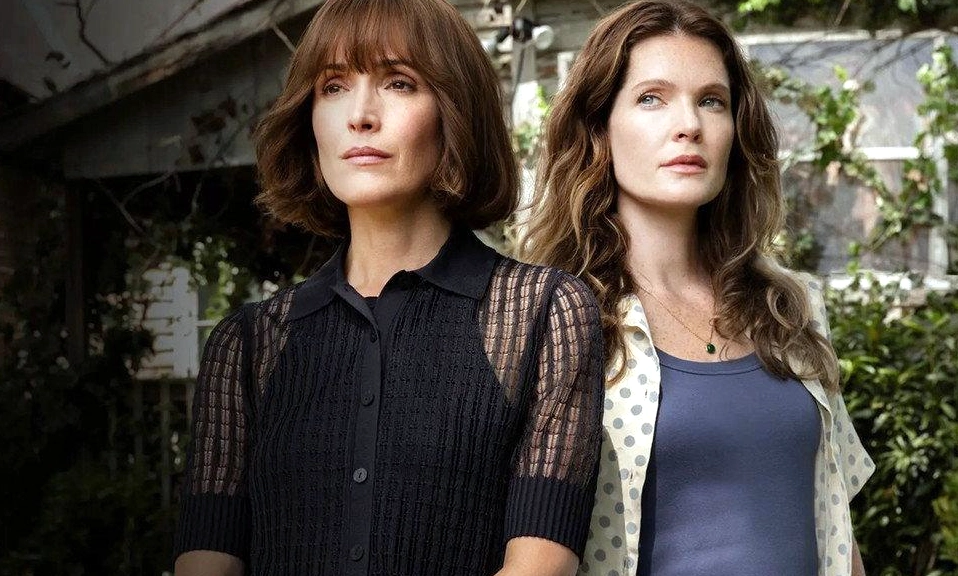
The Good Daughter arrives on Peacock on November 12, 2026, with all six episodes dropping at once—and it brings with it the kind of cast that demands attention. Rose Byrne and Meghann Fahy play estranged sisters Samantha and Charlotte Quinn, whose lives were shattered twenty years ago by a night of violence that killed their mother and left them briefly held hostage. When another attack rocks their hometown of Pikeville, Georgia, Charlotte—now a lawyer like her father—becomes the first witness on the scene, and the sisters are forced to confront the trauma they’ve spent two decades trying to escape.
It is a premise built for prestige television: a bestselling novel adapted by its own author, a six-episode limited series directed entirely by one filmmaker, and a cast stacked with Oscar nominees and Emmy winners. The question is whether it lives up to that promise.
What It Gets Right: The Cast Is the Reason to Watch
The critical consensus is nearly unanimous on one point: Rose Byrne and Meghann Fahy are exceptional.
Fahy, coming off her riveting turn in The White Lotus, plays Charlotte as a “foul-mouthed loose cannon” who stayed in Pikeville, working as a public defender and carrying the weight of a family legacy she never asked for. The AV Club called her “the undisputed MVP,” praising her “aching portrayal of a chaotic woman who feels burdened to hold on to her only surviving parent, no matter what—if only to make her trauma make sense”. Byrne, as the older sister who fled to New York and built a polished, professional life, delivers what TheWrap described as a “devastatingly brittle” physical performance, all controlled surfaces and buried pain.
Brendan Gleeson anchors the series as Rusty Quinn, the defense attorney father whose controversial career set the family on its collision course with violence. He is, as TheWrap put it, “an excellent Brendan Gleeson”—gruff, charming, and infuriating, a man who refuses to stop drinking or joking his way out of situations even when his daughters are drowning. Olivia Williams, Harper Steele, and Michael Dorman round out a supporting cast that The Hollywood Reporter described as “committed” and “emotionally exposed”.
The creative team behind the camera is equally notable. Karin Slaughter adapted her own 2017 novel for the screen, and Steph Green (Watchmen, The Americans) directed all six episodes—a rarity in television that gives the series a visual consistency it might otherwise lack.
What It Gets Wrong: Trauma Without the Emotional Heft
For all its star power, the series has drawn sharp criticism for how it handles its heavy subject matter.
The AV Club was blunt, calling it a “tedious” adaptation that “squanders its promise.” The review argues that Slaughter’s novel examined “the repercussions of multiple violent and emotional ordeals” in vivid detail, but the series “sacrifices that depth in favor of simply getting the characters from point A to point B.” The result, it says, is a show that is “always in a rush to move on to the next big turn” without sitting with the gravity of what its characters have endured.
ScreenRant went further, describing the series as a “trauma-saturated mess” that “revels way too much in female trauma” and wastes its stellar cast on a “tonally chaotic thriller”. The Hollywood Reporter was more measured but noted that the show is “instigated by a school shooting and pushed forward by multiple instances of sexual violence,” all in service of a mystery that is “barely mysterious—at least until the characters all sit down to explain everything in a series of weakly staged monologues”.
There is also the matter of familiarity. The Hollywood Reporter noted that The Good Daughter is “interchangeable, in terms of title, plot or structure,” with a dozen recent limited series, “most conspicuously” Amazon’s The Better Sister and Netflix’s His & Hers. TheWrap acknowledged that the show “mostly succeeds” but “wobbles into tired tropes and lofty, unearned platitudes” along the way.
The Verdict: A Flawed but Compelling Binge
Is The Good Daughter November’s must-watch thriller? The honest answer is: it depends on what you’re looking for.
If you want a tightly plotted, emotionally rigorous exploration of trauma and family—the kind of show that earns its darkness—this is not it. The series prioritizes twists over depth, shock value over genuine catharsis. The critics who found it tedious or exploitative are not wrong about its shortcomings.
But if you want a well-acted, compulsively watchable mystery with a cast that commits fully to the material, The Good Daughter delivers. The Hollywood Reporter admitted that despite its “tropes I find tedious or annoying,” the show “somehow ends up being compulsively entertaining,” a tribute to Slaughter’s “gift for characterization and dialogue,” Green’s “confident hand,” and the “committed, emotionally exposed and often funny performances” of its leads. TheWrap called it a “tense thriller that mostly succeeds,” praising the performances of Fahy and Byrne as “stellar”.
The decision to drop all six episodes at once is also a factor. This is a show built for the binge—a series that pulls you from one revelation to the next, even if the revelations don’t always hold up to scrutiny. It is not a slow burn. It is a page-turner, translated to the screen with all the momentum and all the compromises that entails.
The Good Daughter
is not the flawless prestige thriller its cast might lead you to expect. It is a show at war with itself—a serious drama about trauma that occasionally devolves into a pulp mystery, a showcase for two extraordinary actresses that sometimes forgets to give them the material they deserve.
But it is also, by nearly every account, watchable. It is a series that understands the value of a great performance and a well-timed twist, even if it doesn’t always earn the emotional weight it reaches for. Rose Byrne and Meghann Fahy are reason enough to press play. The rest is a matter of expectations.
The Good Daughter premieres November 12 on Peacock, with all six episodes available to stream immediately.