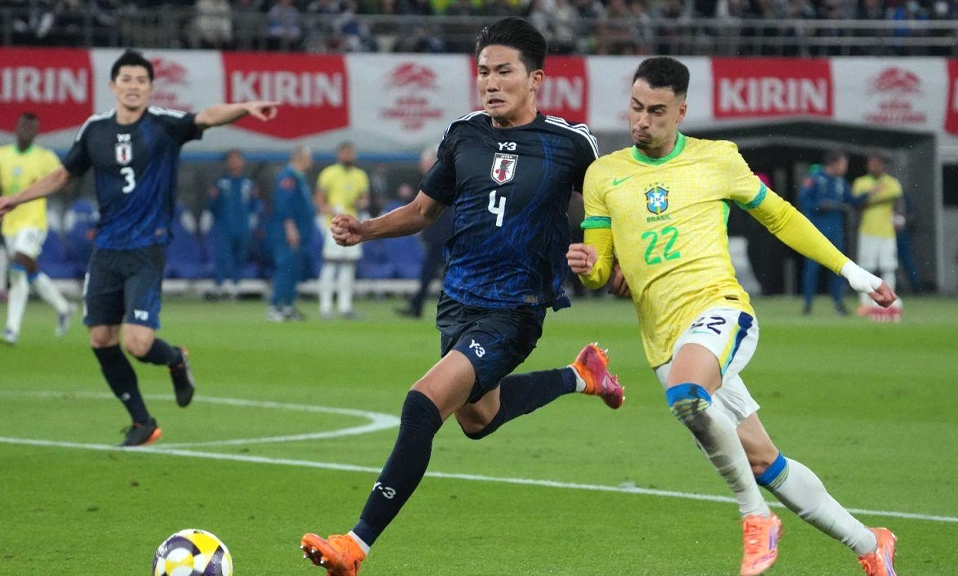
Japan have spent the last year proving they can beat football’s giants. They beat Brazil in October 2025. They beat England at Wembley. They arrived at the 2026 World Cup as a genuine dark horse. And then Brazil knocked them out in the Round of 32, a 2-1 defeat that ended their tournament and left a lingering question: can Japan actually beat Brazil when it matters most?
On Saturday, at the National Stadium in Singapore, they get another chance. It is a friendly, not a World Cup knockout. But for a Japan side still smarting from that summer defeat, and a Brazil side experimenting under Carlo Ancelotti, the stakes feel higher than the occasion suggests.
Here is how the two sides stack up—and whether Japan can finally claim a second win over the Seleção.
The Context: Revenge, Rebuild, and a Rare Opportunity
Japan are not the underdogs they once were. Since September 2025, they have lost just one of their last 15 international matches, winning 10 and drawing four. That solitary defeat was the World Cup loss to Brazil. Since then, they have gone four matches unbeaten, beating Uruguay 3-1, Venezuela 2-1, and New Zealand 2-1, with a 0-0 draw against Ecuador in between. They have scored in 14 of their last 15 games.
This is a team that believes it can compete with anyone. The 3-2 win over Brazil in October 2025—coming back from two goals down—was a historic first victory over the Seleção. It proved that the gap is not insurmountable.
Brazil, by contrast, are in transition. Carlo Ancelotti has used the post-World Cup friendlies to blood young players and experiment with formations. This squad is missing Alisson, Marquinhos, and Matheus Cunha, while João Pedro is injured. Raphinha captains the side, with Vinícius Júnior and teenager Estêvão expected to lead the attack. It is a talented group, but it is not Brazil at full strength.
The head-to-head record remains daunting: Brazil have won 12 of 15 meetings, with two draws and one Japan win. But the trend is shifting. Japan are no longer a side that hopes to compete. They expect to.
The Key Battles: Where the Game Will Be Won
1. Japan’s Press vs. Brazil’s Experimental Backline
Japan’s greatest strength is their collective organisation and the speed of their transitions. Under Hajime Moriyasu, they have developed a high-pressing system that suffocates opponents and creates chances from turnovers.
Brazil’s defence, however, is fresh and relatively untested. With Wesley, Jair Cunha, Gabriel Magalhães, and Douglas Santos forming the backline, there is quality but limited cohesion. If Japan can press aggressively and force mistakes, they can create the kind of chances that win games.
The key man is Takefusa Kubo. The Real Sociedad playmaker is Japan’s creative hub, responsible for breaking lines with dribbling, through balls, and quick combinations. If he finds space between Brazil’s midfield and defence, Japan have a path to goal.
2. Vinícius Júnior vs. Japan’s Three-Man Defence
Brazil’s most dangerous weapon is Vinícius Júnior. His pace, dribbling, and finishing ability can decide a match on their own, and he will be targeting Japan’s wing-backs and the channels between their centre-backs.
Japan are expected to line up with a three-man defence of Ko Itakura, Ayumu Seko, and Hiroki Ito, shielded by goalkeeper Zion Suzuki. Itakura’s recovery pace and positioning will be crucial. If Japan’s back three can contain Vinícius—or at least limit his impact—they can keep the game within reach.
3. The Midfield Duel: Sano vs. Guimarães
The battle in the centre of the park will determine which team controls the tempo. Ao Tanaka and Daichi Kamada will look to absorb pressure and recycle possession for Japan. Bruno Guimarães and Andrey Santos will try to dictate play for Brazil.
The wildcard is Kaishu Sano, who has been identified as the player tasked with disrupting Brazil’s attacking buildup before the ball reaches Vinícius and Raphinha. If Sano can win the ball in midfield and launch quick counters, Japan’s transition game becomes lethal.
The Team News: Injuries and Absences That Could Tilt the Balance
Japan’s injury crisis is real. Brighton winger Kaoru Mitoma, versatile defender Takehiro Tomiyasu, and first-choice striker Ayase Ueda are all unavailable. Ueda is a particularly significant loss—he has been Japan’s most reliable scorer, and his physical presence would have been valuable against Brazil’s centre-backs. Koki Ogawa is expected to start up front in his place.
Brazil’s absences are more about experimentation than crisis. Ancelotti has deliberately left out several veterans to evaluate younger players. The squad still contains world-class talent in Vinícius, Raphinha, and Guimarães. But the lack of experience in defence and the unfamiliarity of the lineup could be exploited by a well-drilled Japan side.
The Prediction: A Narrow Brazil Win, But Japan Are Close
The consensus among analysts is that Brazil are favourites, but the margin is slim. One AI prediction gives Japan a 30% chance of winning, with a predicted score of 1-2. Another analysis expects Brazil to win by a single goal, with a scoreline of 1-2 or 2-3. The betting odds imply a 53% probability of a Brazil win, with a draw at 24% and a Japan win at 23%.
The logic is straightforward. Brazil have superior individual quality, particularly in attack. Vinícius, Raphinha, and Estêvão can create something from nothing, and Japan’s defence—while organised—may struggle to contain that kind of firepower for 90 minutes. Brazil have scored at least two goals in 12 of the 15 meetings between the sides, and they have scored four goals in each of their last two away matches.
But Japan are not the same team that lost 12 of 15. They are unbeaten in their last five home matches, and they have shown that they can compete with—and beat—elite opposition. The 3-2 win over Brazil in 2025 was not a fluke. It was the product of a system that works.
The most likely outcome is a Brazil win, but a narrow one. Japan will press, create chances, and score. But Brazil’s individual brilliance, particularly from Vinícius, should be enough to edge it.
Can Japan Defeat Brazil?
Yes, they can. But they probably won’t—not this time.
Japan have the organisation, the belief, and the tactical blueprint to beat Brazil. They have done it before, and they will do it again. But this Brazil side, even in experimental form, has too much attacking quality to be kept quiet for 90 minutes. Japan’s injury absences—particularly Mitoma and Ueda—remove some of the firepower they would need to outscore the Seleção.
The gap between these two teams is smaller than it has ever been. Japan are no longer a side that hopes for a miracle. They are a side that expects to compete. A win on Saturday would be another statement, another step toward the day when beating Brazil is no longer an upset but an expectation.
For now, the prediction is a 1-2 Brazil win. But Japan will make them work for it. And the next time they meet—perhaps at a World Cup, perhaps in a final—the balance may have shifted further.
Kick-off is at 10:15 AM BST on Saturday, 14 November, at the National Stadium in Singapore.