Xiaomi just did something no one saw coming.
It did not just launch a new flagship. It launched two flagships with the exact same cameras, the exact same rear screen, the exact same privacy trick, and then made you choose between a phone that fits in one hand and a phone that lasts two days.
And the price gap is only €200.
So which one is actually worth your money? The compact powerhouse, or the big daddy?
Let us settle it.
The Quick Verdict
Buy the Xiaomi 18 Pro if you want a true flagship that you can actually use with one hand, you hate heavy phones, and you still want 95% of the Max experience.
Buy the Xiaomi 18 Pro Max if you want the biggest battery Xiaomi has ever put in a global flagship, the absolute best camera with LOFIC HDR, the biggest screen, and you do not mind carrying 229g every day.
If you only care about photos, both will make you happy. If you care about battery and screen, the Max wins. If you care about your pocket and your wrist, the Pro wins.
Here is why.
At A Glance: Xiaomi 18 Pro vs Xiaomi 18 Pro Max
Xiaomi 18 Pro | Xiaomi 18 Pro Max | |
|---|---|---|
Display | 6.4-inch, 2436 x 1120 OLED | 6.9-inch, 2624 x 1208 OLED |
Rear Display | 2.7-inch AMOLED, 120Hz | 2.9-inch AMOLED, 120Hz |
Chip | Snapdragon 8 Elite Gen 6 | Snapdragon 8 Elite Extreme Gen 6 |
Cameras | 200MP main + 200MP periscope + 50MP ultrawide | 200MP main with LOFIC + 200MP periscope + 50MP ultrawide |
Front Camera | 50MP | 50MP |
Battery (Global) | 6,000mAh | 7,050mAh |
Battery (China) | 7,000mAh | 8,500mAh |
Charging (Global) | 90W wired, 50W wireless | 100W wired, 50W wireless |
Size / Weight | 151.8 x 72 x 8.46mm, 198g | 163.39 x 77.6 x 8.39mm, 229g |
Software | Android 17, HyperOS 4 | Android 17, HyperOS 4 |
Price (Global) | From €1,399 | From €1,599 |
Price (China) | From CNY 5,999 | From CNY 6,999 |
The Xiaomi 18 Pro Max is the big daddy of the pair, measuring in at 163.39 x 77.6 x 8.39mm for three of the four colours (Cosmic Blue is thicker at 8.47mm). It weighs 229g (234g for Cosmic Blue).
The Xiaomi 18 Pro measures 151.8 x 72 x 8.46mm (8.56mm in Cosmic Blue) and weighs 198g (203g in Cosmic Blue).
The Xiaomi 18 Pro Max has a 6.9-inch 2624 x 1208 OLED around front, while the Xiaomi 18 Pro goes with a 6.4-inch 2436 x 1120 equivalent.
That 31g difference does not sound like much on paper. In your hand after 2 hours of scrolling, it feels like a brick vs a feather.
1. Design: One-Hand Phone vs Two-Hand Tablet
This is the biggest difference, and the one most reviews skip.
The 18 Pro is a compact flagship in 2026, which is rare. 6.4 inches, 72mm wide, 198g. You can reach the top of the screen with your thumb. You can type with one hand on a bus. You can put it in a jeans pocket and forget it is there.
The 18 Pro Max is a Max in every sense. 6.9 inches, 77.6mm wide, 229g. It is a mini tablet. If you have small hands, you will need two hands. If you put it in a tight pocket, you will feel it.
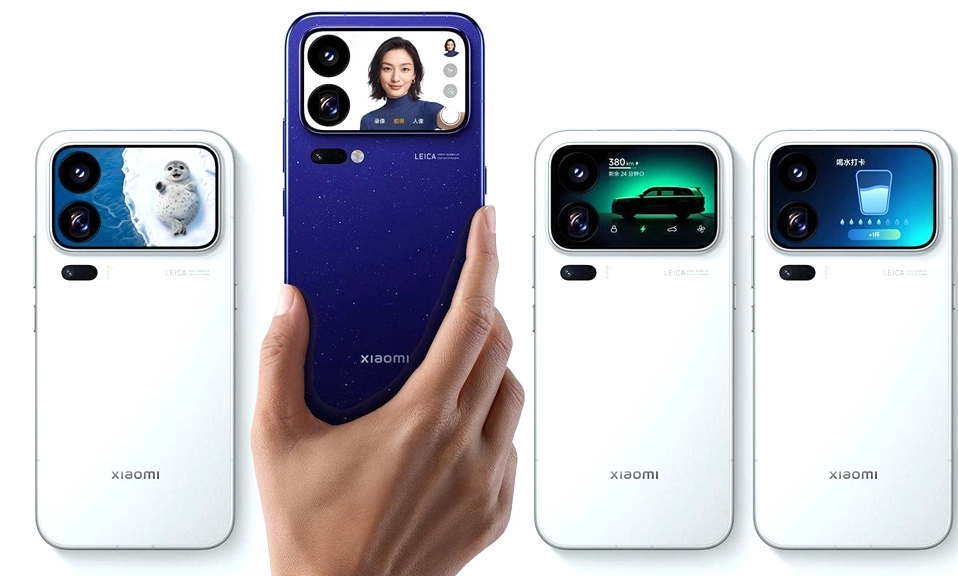
Both have the same design language: a huge square camera island on the back, with a small second screen built right into it, Leica branding, and four colors including a deep blue starry finish that twinkles in light. One hands-on video showed four color options fanned out — pink, white, gray, and a deep blue ‘starry’ finish that twinkles in light — plus a special transparent red edition revealing internal components.
Both are also built like tanks: IP66 / IP68 / IP69 ratings, Dragon Crystal Glass 3.0, up to 16GB RAM and 1TB storage.
So ask yourself: Do you want a phone that disappears, or a phone that dominates?
2. Display: Same Tech, Different Size
Xiaomi did not cheap out on the smaller phone. Both use the same panel tech.
The Xiaomi 18 Pro features a 6.4-inch 1.5K TCL M11 Super Pixel 2.0 Real RGB LTPO OLED display with a 120 Hz refresh rate, 2,160 Hz PWM Dimming, and up to 4,000 nits of peak brightness.
The Xiaomi 18 Pro Max, on the other hand, boasts a larger 6.9-inch 1.5K TCL M11 Super Pixel 2.0 Real RGB LTPO OLED display with a 2624 x 1208-pixel resolution.
Both go up to 4,000 nits. That means you can read them in direct sunlight in Kampala at noon. Both are 1-120Hz LTPO, so they drop to 1Hz when you are reading to save battery, and jump to 120Hz when you scroll.
The Max just gives you more of it. More screen for YouTube, more screen for split-screen multitasking, more screen for gaming.
The Pro gives you a sharper pixel density because the same resolution is squeezed into a smaller screen. Text looks a tiny bit crisper on the Pro.
3. Performance: Gen 6 vs Extreme Gen 6
While the Xiaomi 18 Pro is powered by the Snapdragon 8 Elite Gen 6, the Pro Max gets the more powerful Snapdragon 8 Elite Extreme Gen 6.
Both are 2nm chips from Qualcomm. Both will run anything in 2026 and 2027 without breaking a sweat: Genshin Impact on max, 8K video editing, AI photo editing, 20 Chrome tabs.
The difference is the Extreme version in the Max is binned higher and can hit 5GHz. The phone is the first to ship with Qualcomm’s newest 2nm silicon, the Snapdragon 8 Elite Extreme Gen 6, and features an improved telephoto sensor with a larger sensor compared to last year.
In real life, you will not feel the difference in Instagram or WhatsApp. You will feel it in 30 minutes of sustained gaming, or exporting a 4K video. The Max stays cooler for longer because it has more space to dissipate heat.
For 95% of people, the Pro is already overkill. The Max is overkill for overkill.
4. Cameras: The Same, Except For One Secret Weapon
Here is where Xiaomi shocked everyone. Usually the Max gets a better camera. This time, almost not.
Unlike some rivals, Xiaomi gives both Pro models the same Leica-tuned camera system. It includes a 200 MP main camera with a large 1/1.28-inch Light Hunter 960 sensor, a 200 MP periscope telephoto camera with 3.2x optical zoom, and a 50 MP ultrawide camera with a 102-degree field of view.
Both models feature a Leica-branded triple-camera system with a 200MP main sensor, a 200MP periscope telephoto camera and a 50MP ultra-wide camera.
Break it down:
- Main Camera: 200MP Light Fusion 960L sensor (1/1.28-inch) with an f/1.67 aperture, 23mm focal length, dual-pixel PDAF, LOFIC high dynamic range technology, and Optical Image Stabilization (OIS).
- Periscope Telephoto: 200MP sensor (1/1.56-inch) with an f/2.4 aperture, 75mm focal length, PDAF, OIS, 3.2x optical zoom, and 12cm telemacro focus.
- Ultrawide: 50MP, 102-degree field of view, with autofocus for macro shots.
- Selfie: 50MP on the front, but you will rarely use it. Why? Because of the rear screen.
Its high resolution also enables in-sensor zoom at 150mm, while a minimum focusing distance of 12 cm allows for close-up photography.
So what is the one difference?
The Pro Max has an additional imaging advantage: its 200MP Light Fusion 960L main sensor supports LOFIC HDR technology and a claimed dynamic range of up to 16.2 EV.
LOFIC is a new sensor tech that preserves detail in very bright and very dark parts of the same photo. Think: sunset photo where the sky is blown out but the face is dark. The Pro Max will keep both. The Pro will be very good, but not quite that good.
If you shoot a lot of backlit portraits, HDR landscapes, or concerts with harsh lights, the Max wins. If you shoot food, friends, and travel photos in good light, you will not see the difference.
Both shoot 8K video, both have Leica Summilux lenses and Leica color science. Both will make your iPhone friends jealous.
5. Battery: The Big Trap You Must Know About
This is the section that has fans angry on social media, and for good reason.
There are TWO versions of these phones: China and Global. And the batteries are NOT the same.
The international Xiaomi 18 Pro comes with a 6,000 mAh silicon-carbon battery, compared with 7,000 mAh in the Chinese model. The Xiaomi 18 Pro Max has a 7,050 mAh battery globally, down from 8,500 mAh in China.
Both global models support wireless charging at up to 50 W, while wired charging is rated at 90 W for the Pro and 100 W for the Pro Max.
The global Xiaomi 18 Pro packs a 6,000 mAh battery, whereas the Xiaomi 18 Pro Max comes with a 7,050 mAh juice pack. In China, the Xiaomi 18 Pro comes with a 7,000 mAh battery, while the 18 Pro Max is fueled by an 8,500 mAh battery.
The global Xiaomi 18 Pro Max has the same charging speed as the Chinese model: 100W wired and 50W wireless. The global Xiaomi 18 Pro also supports 50W wireless charging like its Chinese counterpart, but wired charging is slower: 90W vs. 100W.
Fans noticed immediately. One comment on a hands-on video summed it up: “but this is not fair 18 pro bettery in china 7000mah/globle 6000”
So what does this mean for you?
- Global Pro: 6,000mAh = still a full day and a half for most people, 2 days if you are light user. 90W = 0 to 100% in about 35 minutes.
- Global Max: 7,050mAh = 2 full days easily, even with heavy gaming. 100W = 0 to 100% in about 30 minutes.
- China Max: 8,500mAh = almost 3 days. But you will have to import it, deal with Chinese software, and lose warranty.
Even with the smaller global battery, the Max still beats the Pro by 1,050mAh. That is about 17% more battery life.
If battery is your No. 1 priority, the Max is the clear winner, even in its global form.
6. The Two Features That Make Both Phones Feel Like The Future
A. The Rear Display – Not A Gimmick
This is the coolest thing Xiaomi has done in years.
The Xiaomi 18 Pro also features a 2.7-inch secondary AMOLED display beside its rear cameras, while the Pro Max has a larger 2.9-inch rear screen.
These secondary screens can display notifications, incoming calls, reminders, timers, boarding passes, and other information. They also work as viewfinders for taking selfies with the rear cameras.
Xiaomi has introduced customizable widgets, AI-generated wallpapers, and interactive application cards for the rear displays.
The rear screen also provides a live preview when recording 8K video.
Users can pin a boarding pass or QR code to the rear screen or use it to check directions and ride updates. An interpreter feature uses both screens during face-to-face translation.
Translation: You can take a selfie with the 200MP main camera, not the 50MP selfie camera. The quality difference is insane. You can also show your boarding pass without unlocking the phone, or show a translation to someone facing you.
The rear display can be used as a viewfinder with the main camera, and the phone automatically switches to ultra-wide angle when more than three people are detected in a group selfie.
The Pro Max rear screen is 0.2 inches bigger. That is barely noticeable. Both are 120Hz, both hit 4,000 nits.
B. The Privacy Display – Goodbye, Privacy Films
Xiaomi launched the 18 Pro and 18 Pro Max in Paris on Nov. 17, with rear screens that let users see themselves when taking selfies or recording video with the main camera. Both phones also have a privacy mode that makes the front screen harder to read from the side.
Another major display feature is Privacy Display, which limits screen visibility from side angles.
The built-in Privacy Display is a notable addition, though Samsung got there first with the Galaxy S26 Ultra (review). Samsung’s implementation lets users apply privacy protection to selected apps, password entry and notification pop-ups. Xiaomi also offers controls for individual apps, notifications and split-screen views, but adds a feature called Privacy Notice. It can detect when someone nearby is looking at the screen and alert the owner through vibrations or HyperIsland.
Pixel-level Xiaomi Privacy Display: instead of relying on dim stick-on privacy films, the OLED panel alternates standard wide-angle pixels and microscopic light-shielded privacy pixels in a 1:1 ratio.
In plain English: Someone sitting next to you on a plane sees a dark screen. You see everything perfectly. And if someone peeks over your shoulder, the phone vibrates to warn you.
This is hardware privacy, not software. It is built into the screen itself. It is the end of those ugly privacy screen protectors.
7. Price: The Global Markup Is Real
In China, the pricing is aggressive:
Slide 1 details the 18 Pro specifications: Snapdragon 8 Elite Gen 6 processor, 6.4-inch LTPO AMOLED display, 2.7-inch rear AMOLED, Leica triple camera system (200MP main, 200MP periscope, 50MP ultra-wide, 50MP selfie), 7,000mAh battery, 100W wired charging, Android 17 with HyperOS 4, and a China price of CNY 5,999 (~₹86,000).
Slide 2 covers the 18 Pro Max with a 6.9-inch display, 2.9-inch rear display, Snapdragon 8 Elite Extreme Gen 6, 8,500mAh battery, IP68/IP69 titanium alloy build, and a China price of CNY 6,999 (~₹1,00,000).
Globally, it is a different story:
Prices are listed in red: starting at €1399 (~₹1.45 lakh) for the Pro and €1599 (~₹1.64 lakh) for the Pro Max.
That is roughly $1,599 for the Pro Max 12GB/256GB in global markets.
You are paying more for less battery. That is the EU tax and regulation reality. Fans in the Philippines already warned: Comments show excitement about high-end specs like 200MP cameras and large batteries, while many users caution that the listed Philippine peso prices are direct conversions from Chinese yuan and will increase with taxes and duties.
So is the Max worth €200 more?
You get: 0.5-inch bigger screen, 0.2-inch bigger rear screen, Extreme chip, 1,050mAh more battery, 10W faster charging, LOFIC HDR camera.
For most people, yes, €200 is worth it if you like big phones. If you do not like big phones, no amount of battery makes it worth carrying a phone you hate.
Who Should Buy Which?
Buy the Xiaomi 18 Pro if you:
- Want a flagship you can use one-handed
- Travel light, hate heavy phones, have smaller hands
- Want 90% of the Max for €200 less
- Charge your phone every night anyway
- Shoot photos mostly in good light
Buy the Xiaomi 18 Pro Max if you:
- Want the longest battery life possible in a global flagship
- Watch a lot of video, game a lot, multitask with split-screen
- Shoot a lot of HDR, sunset, concert, or backlit photos where LOFIC matters
- Have big hands or do not mind a big phone
- Want the absolute best Xiaomi makes, no compromises
Buy neither if you:
- Already have a Xiaomi 17 Pro Max. Fans are already debating it: Several users state they will stick with the 17 Pro Max, citing minimal differences aside from the 200 MP main sensor on the 18.
- Need eSIM in some regions, Xiaomi still has limited eSIM support in some markets
- Hate HyperOS. The comment section is active with tech enthusiasts asking about price, launch dates in India, UK, Canada, USA, and Australia, and debating whether to switch from iPhone. Many praise the Leica camera and starry blue design, while others criticize Xiaomi software, image processing, and past overheating issues.
If I had to pick
one for most people, I would pick the Xiaomi 18 Pro.
Why? Because most people do not need a 6.9-inch phone. They think they do, until they try to use it one-handed on a boda boda, or put it in a pocket with keys.
The Pro gives you the same 200MP + 200MP cameras, the same rear display, the same privacy display, the same HyperOS 4, the same 120Hz 4,000-nit screen, in a body that actually fits your life.
But if you are a power user, a creator, a gamer, or someone who forgets to charge their phone, the Pro Max is the real flagship. That 7,050mAh global battery + LOFIC camera + Extreme chip is the closest thing to a no-compromise Android phone in 2026.
Xiaomi did not make one phone better than the other. It made one phone for your hand, and one phone for your battery anxiety.