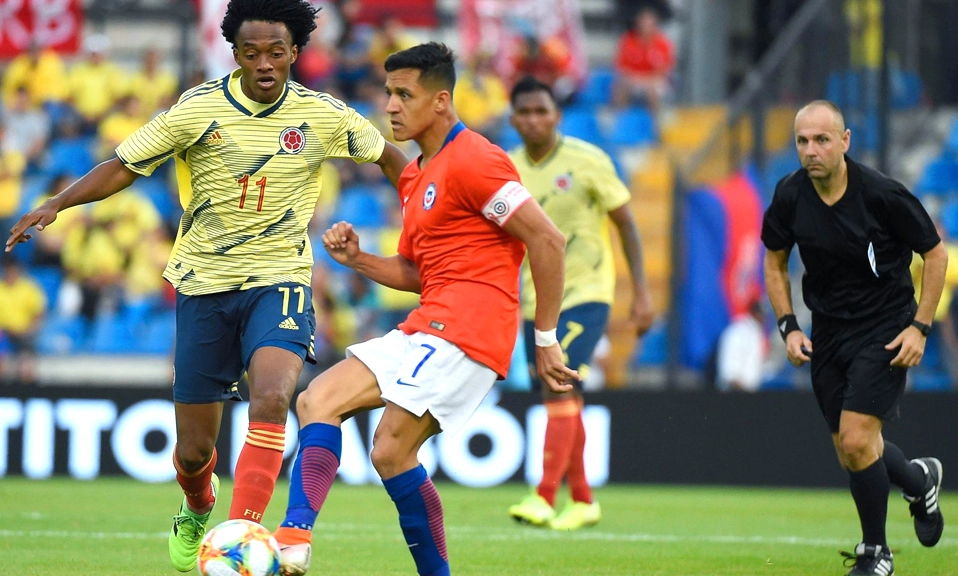
The scoreline says Colombia 1, Chile 0. The story says something far more damning: Chile didn’t lose to a better team. They lost to an own goal, and then they lost themselves.
On a humid night in Cali, Nicolás Córdova’s transitional Chile side produced a first half that was disciplined, organised, and genuinely promising. They pressed high, created the better chances, and hit the woodwork. Then Vicente Pizarro lost the ball in midfield, Colombia broke at speed, and Guillermo Maripán turned a cross into his own net. What followed was not a response. It was a collapse—not of effort, but of ideas. Chile had no Plan B, no creative spark, and by the end, no shots on target. The defeat was narrow. The diagnosis is not.
Here is what went wrong for Chile in Cali.
The Turning Point: One Mistake, One Own Goal, One Broken Plan
The match was decided in the 35th minute, and it was decided by a chain of small failures that Chile could not recover from.
Vicente Pizarro lost possession in midfield. It was a simple turnover, the kind that happens dozens of times in any match. But against Colombia, in Cali, with Néstor Lorenzo’s side set up to counter, it was fatal. Luis Suárez spread the ball wide, Daniel Muñoz delivered a low cross, and Maripán—attempting to intercept—deflected it past Lawrence Vigouroux.
Córdova’s assessment was blunt: “Memo la rozó y terminó en gol. Vigouroux la iba a controlar y el roce terminó en gol”. It was a stroke of bad luck. But the bigger problem was what happened next.
Before the goal, Chile had been the more dangerous side. Maximiliano Gutiérrez had a shot deflected wide, then struck a free-kick against the post. Diego Ulloa had a chance blocked on the line by Davinson Sánchez. The plan—a flexible 3-4-3 in possession, a 5-4-1 out of it, pressing Colombia’s build-up and attacking the space behind—was working.
After the goal, it stopped working. And Chile had no alternative.
The Offensive Void: No Shots on Target, No Ideas
The most damning statistic of the night is this: Chile did not register a single shot on target.
That is not a typo. A national team, chasing a game for 55 minutes, failed to test the opposition goalkeeper once. Ben Brereton Díaz’s backheel and Lucas Cepeda’s wildly inaccurate effort were the only notable attacking moments in the second half.
Córdova identified the problem himself: “Tenemos que mejorar en la generación de juego, en el último tercio para tener mejores ocasiones de gol”. The defensive structure, he said, “se vio de buena manera”—but the attack did not.
The reasons are layered. Chile’s front three of Gutiérrez, Darío Osorio, and Gonzalo Tapia caused problems early, but they lacked a focal point. Brereton, introduced later, offered a physical presence but no service. The midfield—Pizarro, Rodrigo Echeverría, and the returning Charles Aránguiz—was industrious but not creative. There was no one to unlock a compact Colombian defence, no one to produce the moment of individual brilliance that the situation demanded.
La Tercera put it simply: “Chile careció de un plan B”. They had no second gear.
The Physical Gap: “They Cover the Pitch in Two Strides”
Córdova was candid about the physical disparity between the two sides. His explanation was one of the most revealing quotes of the night.
“Es una selección muy fuerte en casa… Acá físicamente es muy difícil competirle a Colombia, ellos cubren la cancha con dos zancadas, nosotros tenemos que meter tres. El desgaste físico que uno va generando es mucho mayor”.
Colombia’s athleticism—their ability to cover ground, recover possession, and launch counterattacks—was a decisive advantage. Chile’s players had to work harder to achieve the same spatial coverage, and by the second half, the fatigue was visible. Passes went astray. Pressing lost its intensity. The team that had been so organised in the first half became disjointed and reactive.
Gabriel Suazo acknowledged the issue, pointing to the humidity in Cali and the difficulty of maintaining precision when “las piernas no te responden como uno quisiera”. But the physical gap was not just about the climate. It was about the profiles of the players on the pitch. Colombia had pace, power, and directness. Chile had effort, but not the same athletic ceiling.
The Lack of Fluidity: “No Associations, No Individual Spark”
La Tercera’s match report was scathing in its assessment of Chile’s second-half performance: “Chile adolecía de fluidez, no había asociaciones, ni siquiera un arrebato individual que rompiera la monotonía”.
That sentence captures the essence of the problem. Chile’s attacking play was not just ineffective—it was disconnected. The midfield and attack operated as separate units. There were no combinations, no one-twos, no sustained periods of pressure. The ball moved sideways and backwards, but rarely forward with purpose.
Córdova made substitutions—Nils Reichmuth came on at half-time, Brereton and Cepeda later—but the changes “no alteraron el trámite del duelo”. The structure remained the same. The ideas did not.
The Transition Paradox: Progress and Stagnation at the Same Time
The most difficult aspect of this defeat for Chile is that it comes during a period of genuine renewal.
Chile failed to qualify for the 2026 World Cup. Córdova, in interim charge, has been tasked with blooding a new generation. Players like Gutiérrez, Tapia, and Osorio are getting minutes they would not have received under a more results-focused coach. The defensive organisation in the first half was evidence that the work on the training ground is having an effect.
But the transition has a ceiling, and Cali exposed it. The young players who are being integrated are not yet at the level required to break down a team like Colombia. The experienced players who remain—Aránguiz, Suazo, Maripán—cannot carry the creative burden alone. And the coaching staff, for all their organisational discipline, have not yet found a way to generate goals against well-drilled opposition.
Colombia’s own coach, Néstor Lorenzo, offered a generous assessment: “Chile ha demostrado que está bien trabajado… sabíamos que íbamos a enfrentar a un equipo que presionaba”. He meant it as a compliment. But “well-worked” and “hard to play against” are not the same as “dangerous”. Chile were difficult to break down for 35 minutes. They were never difficult to hold at bay.
A Narrow Defeat With a Wide Diagnosis
Chile lost 1-0 to Colombia in a friendly. On another night, Gutiérrez’s free-kick goes in instead of hitting the post, or Ulloa’s chance isn’t cleared off the line, and the narrative is different. Fine margins decide football matches.
But the margins were not the problem in Cali. The problem was what happened after the margins went against Chile. A team with a plan and no alternative. A team with effort and no invention. A team that could organise but could not create.
Córdova has time—the return match against Colombia is on Tuesday, and the transition project extends beyond this FIFA window. But he knows, and the Chile fans know, that the hardest work lies ahead. The defensive foundation is being laid. The attacking identity is not.
“El juego sigue al debe,” La Tercera wrote. The game is still owed. Chile have not yet paid their debt to the style and substance that their supporters expect. Cali was another instalment on an account that remains stubbornly in the red.
The scoreline was 1-0. The diagnosis is far wider than that.
What do you think—is Chile’s transition on the right track despite the defeat, or does the lack of attacking identity signal a deeper problem?