The pitch for digital products has never been simpler: make a file once, sell it forever, keep almost pure profit. No inventory, no shipping, no returns desk. In 2026, that pitch is still true—but the ground beneath it has shifted in a way that makes most beginner guides dangerously outdated.
The old advice was to make more and list more. The new reality is the opposite. AI tools can now generate a “decent checklist in seconds,” which means the barrier to creating a digital product has collapsed. That sounds like an opportunity. In practice, it has made the market harder to win, because buyers can often make a generic version themselves. Etsy responded in October 2026 by banning AI-generated patterns, recipes, and instructions, and prohibiting bot-made listings, saying that AI-generated listings were “eroding buyer trust”. The signal is unmistakable: volume no longer wins. Proof does.
That is the lens through which every decision in this guide should be read. Making a product is the easy part. Being believed is the hard part.
The 2026 Shift: Why Proof Beats Volume
For years, the digital product playbook was simple: pick a popular niche, create a dozen files, list them on a marketplace, and wait. That playbook is now a losing strategy for three reasons.
AI has flooded the bottom of the market. A buyer who wants a generic checklist, a basic meal plan, or a simple template can ask an AI and get something passable in seconds. The products that still sell are the ones that pass the “prompt-it-yourself test”: could a buyer get most of this from one prompt? A generic list of tips will fail. A tested sequence, a decision tool, or a checklist built from real cases will pass.
Platforms are enforcing originality. Etsy’s October 2026 rules require listings for functional guides—patterns, recipes, instructions—to show a real result made from the seller’s own instructions. Bot-generated listings with no human involvement are removed. AI-generated art is still allowed when the seller plays a clear creative role and discloses AI use, but the era of anonymous mass-uploading is over.
Trust has become the scarce resource. The FTC took action against a self-publishing program over its income claims in April 2026, and sales pages that promise a daily or monthly figure are now a liability. Buyers are more skeptical, platforms are more vigilant, and the products that win are the ones that can demonstrate a real result, a real method, or a real voice.
Step 1: Choose a Product You Can Prove
The best digital product is not the one you can make fastest. It is the one you can credibly deliver—where you can show that it works because you have used it, tested it, or built it from real experience.
The Formats That Still Sell
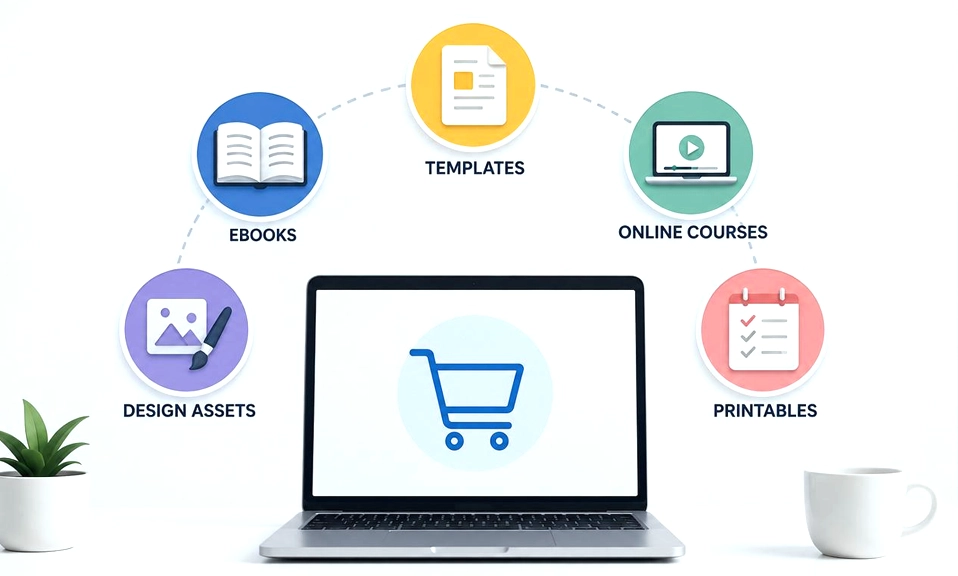
The categories with steady demand in 2026 are consistent across marketplace guides: printable planners, templates (Canva, Notion, spreadsheets), ebooks and guides, online courses, and design assets. Within those categories, the winners are specific.
Templates that slot into a routine are the strongest category. A weekly planner, a habit tracker, a budget sheet, or a Notion dashboard is not something a buyer reads once and forgets. It is something they use weekly, which means it has repeat value and is harder to replace with a one-off AI prompt.
Tested systems and decision tools outperform generic information. A fitness guide that helps a buyer choose between strength training and cardio for their goals, a financial workbook that helps a couple build a budget together, or a pet care checklist that prevents a specific problem—these are products built from a method, not a list.
Bundles are particularly effective in 2026 because they solve a fee problem. On a $10 sale, Etsy takes about $1.40 (14%) before ads, and Gumroad’s direct-sale rate plus card processing takes about $2.09 (21%). Four $5 downloads sold separately pay four sets of fixed fees. One $20 bundle pays one set, while increasing the perceived value to the buyer.
The “Proof” Checklist
Before you build anything, run your idea through this filter:
| Question | Weak answer | Strong answer |
|---|---|---|
| Could a buyer get most of this from one prompt? | A generic list of tips | A tested sequence, a decision tool, or a checklist built from real cases |
| Is there proof it works? | “Trust us” claims | A real result, a sample page, a before-and-after, or your own use |
| Where does a human show up? | Nowhere visible | Your method, data, edits, voice, or a named reviewer |
| What does the buyer do next? | Read it once and forget it | Use it weekly: a template, tracker, or planner |
Source: AliDropship’s prompt-it-yourself test
If your idea cannot answer the third and fourth questions convincingly, it is not a product. It is a prompt output.
Step 2: Validate Before You Build
The biggest mistake beginners make is spending weeks building a product nobody wants. Validation is not asking your friends if they would buy it. It is checking whether people are already spending money to solve the problem you are targeting.
Go to the places where your potential buyers already gather—Reddit, niche Facebook groups, X, or the search bar on Etsy or Pinterest. Are people asking for help with a specific task? Are they complaining that existing tools are too expensive or too complicated? Are there similar products already selling? Competition is a good sign: it means there is a proven market. You do not need to be the first person to sell a Notion template for freelancers. You just need to make one that solves a specific pain point better than the generic options.
A simple validation test: create a one-page description of your product—what it is, who it is for, and what result it delivers—and share it in a community where your buyer hangs out. If people ask where they can buy it, you have a product. If they scroll past, you have a signal to refine or move on.
Step 3: Choose Where to Sell—and Understand the Trade-Off
The platform decision is not about finding the lowest fees. It is about matching your product to where buyers already search, and accepting the trade-off that comes with each option.
Marketplaces: Built-In Audience, Rented Relationship
Etsy is the default starting point for most beginners. It reported about 87 million active buyers for the 12 months ending June 2026, and its search and browse pages make the introductions that a new seller cannot make on their own. The fees are a $0.20 listing fee, a 6.5% transaction fee, and 3% plus $0.25 in US payment processing, with Offsite Ads adding 12% or 15% when an ad drives a sale. On a $10 sale, Etsy leaves about **$8.60** after fees.
Gumroad is better for creators who already have an audience. It has no monthly fee, charges **10% plus $0.50 on direct sales**, and a flat **30%** when its Discover marketplace brings the buyer. On a $10 sale, Gumroad’s direct-sale rate plus card processing leaves about $7.91. Gumroad acts as merchant of record, so it handles sales tax and VAT for you—a significant administrative advantage for a solo seller.
The critical limitation of any marketplace is that you are a tenant. The platform owns the buyer relationship, sets the fees, and can change the rules overnight. Etsy’s October 2026 AI policy is a reminder that a product line can be ended by a policy update. Sellers who want their own customer list eventually add a store of their own.
Your Own Store: Control, But You Find the Traffic
Shopify or Payhip give you control over pricing, branding, and the buyer relationship, but they leave the work of finding visitors to you. On a $15 file, platform and card fees across Etsy, Gumroad, Payhip, and Shopify take about 5% to 18% before tax, and the lowest rate is not automatically the best fit—a marketplace that sends buyers can be worth more than a lower rate on a page nobody visits.
The pragmatic path for most beginners is to start on a marketplace to learn what sells and build proof, then add your own store once you have a product that converts and an audience to send to it.
Step 4: Price for the Fee Structure, Not Just the Product
Pricing a digital product is not about what the file is worth. It is about what the buyer keeps after the platform takes its share, and what the buyer perceives they are getting.
On a $10 sale, Etsy takes about $1.40 and Gumroad takes about $2.09. On a $15 file, fees take about 5% to 18% before tax, leaving roughly $12.25 to $13.75. The fixed component of those fees hurts cheap products most, which is why bundles are not just a marketing tactic—they are a fee-management strategy.
The pricing principle that works in 2026 is price for the transformation, not the format. A buyer is not paying for a PDF. They are paying for the result the PDF provides—a clearer financial picture, a calmer morning routine, a more organized closet. A $27 budgeting workbook that helps a couple have a difficult conversation is not competing with a $3 checklist. It is competing with the cost of not solving the problem.
Avoid income promises on your sales page. The FTC’s April 2026 action against a self-publishing program over income claims is a warning: never promise a daily or monthly figure. Sell the method, the proof, and the result—not the fantasy.
Step 5: Drive Traffic With the Channels That Actually Work
A product does not sell itself. The three most effective channels for digital product stores in 2026 are SEO-optimized blog content, Pinterest, and TikTok. Each serves a different function.
Pinterest is the evergreen engine. It is the only major platform where content lasts years rather than minutes, and pins rank in Google Images, giving you an SEO double-dip. Create pins that link directly to your product page, use the search bar as a keyword tool, and build seasonal boards months ahead—Pinterest searches peak 30 to 45 days before a holiday. For visual products like planners, templates, and printables, Pinterest is the highest-leverage channel.
TikTok is the discovery engine. Treat it like visual YouTube: script content around specific search queries, use exact search phrases in on-screen text and captions, and optimize for watch time and replays, because TikTok’s search ranking heavily reflects engagement. A short demonstration of your product in use—a template being filled in, a planner being set up, a before-and-after of a decluttered room—can drive more qualified traffic than a polished ad.
SEO-optimized blog content is the slow burn. A page that answers a specific question your buyer is already asking, with your product as the next step, can compound for years. The key is to write for the problem, not the product: “how to build a budget when you and your partner have different spending habits” will outrank “buy my budgeting template” every time.
The Reality Check: What “Passive” Actually Means
The passive income narrative is seductive, and there are real examples of it working. Kyle Fowler built simple no-code apps that generated $10,000 a month passively for two straight years** while he traveled and studied, and his two apps now pull **$41,000 in monthly recurring revenue with zero VC funding. Julia Starr, a career coach, built an AI tool that mimics her framework and now serves as both a passive income stream and a marketing funnel.
But these are outcomes, not starting points. The early months of a digital product business are not passive. They are research, creation, validation, listing optimization, content production, and customer support. The passivity comes later, when a product has proven demand and a traffic system is in place. Treating the first six months as a proof-building phase—where the goal is to learn what converts, not to replace your income—is the difference between a sustainable business and a abandoned side project.
Selling digital products
online in 2026 is still one of the most accessible ways to start an online business. The economics are real: near-zero marginal cost, no inventory, and the ability to sell the same file to buyers anywhere in the world. But the game has changed. AI has flooded the market with generic content, platforms are enforcing originality, and buyers are more skeptical than ever.
The path that works is not the one that produces the most files. It is the one that produces the most proof: a product built from a real method, validated by real demand, priced for the result it delivers, and marketed through channels where buyers are already searching. The margin is not the whole story. Platform fees, taxes, and the time you spend finding buyers all come out of what you keep. A product that costs almost nothing to copy still costs real effort to design, describe, and promote.
Start with one narrow problem, one product, and one channel. Prove it works. Then scale. The opportunity has not disappeared. It has moved from making more to proving more.