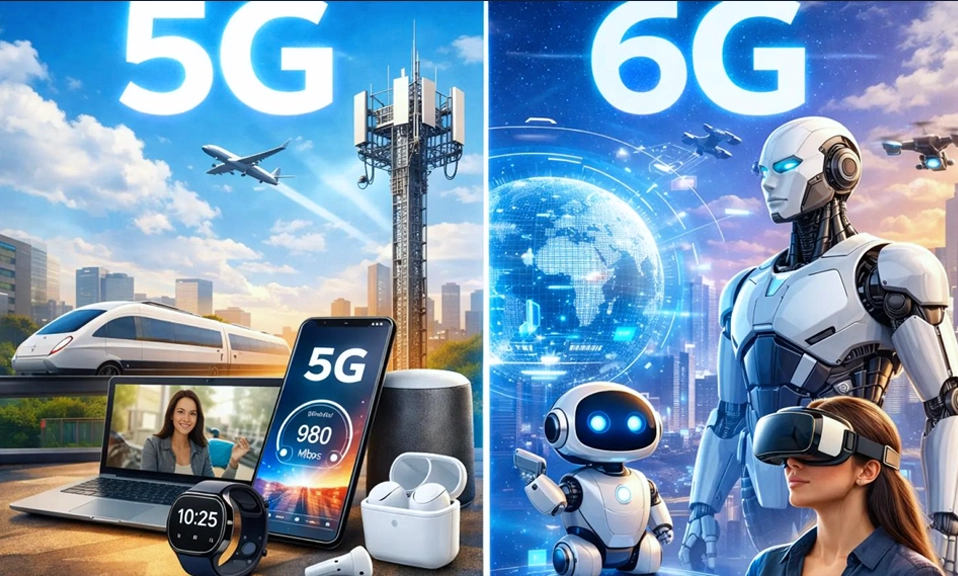
Just as we’ve finally gotten used to seeing the “5G” icon in the corner of our phones and enjoying buffer-free 4K streaming on the go, the tech world is already shifting its gaze to the next horizon.
Enter 6G.
If you’ve heard whispers about 6G, you might be wondering: Didn’t 5G already promise to change everything? Do we really need another “G”?
The short answer is yes. While 5G was about connecting people and things faster, 6G is about seamlessly merging the physical and digital worlds. We are currently in the advanced research and standardization phase of 6G (with commercial rollout expected around 2030), and the specifications being developed are nothing short of science fiction becoming reality.
Let’s break down the massive differences between 5G and 6G, and explore exactly how the next generation of mobile networks will transform our lives.
📶 1. The Baseline: What 5G Actually Delivered
To understand the leap, we have to look at the baseline. 5G was a massive upgrade over 4G LTE, built on three main pillars:
- Enhanced Mobile Broadband (eMBB): Speeds up to 10–20 Gbps (theoretically), making multi-gigabit downloads possible.
- Ultra-Reliable Low Latency Communications (URLLC): Latency dropped to around 1 millisecond, enabling things like remote surgery and autonomous vehicles.
- Massive Machine-Type Communications (mMTC): The ability to connect up to 1 million devices per square kilometer, fueling the current IoT (Internet of Things) boom.
5G was the foundation. But 6G is the skyscraper built on top of it.
🚀 2. The 6G Leap: By the Numbers
The technical specifications for 6G are being finalized by global bodies like the ITU and 3GPP, but the targets are already clear. The leap from 5G to 6G is exponential, not incremental.
Feature | 5G (Current Standard) | 6G (Target for ~2030) |
|---|---|---|
Peak Speed | 10 – 20 Gbps | 1 Terabit per second (Tbps) (100x faster) |
Latency | ~1 millisecond | 0.1 milliseconds (100 microseconds) (10x lower) |
Frequency Band | Sub-6 GHz & mmWave | Sub-THz & Terahertz (THz) spectrum |
Connection Density | 1 million devices / km² | 10 – 100 million devices / km² |
AI Integration | Add-on / Optimized | AI-Native (Built into the core architecture) |
🌍 3. How 6G Will Actually Change Your Life (The Use Cases)
Faster speeds are great, but what do they actually enable? Here is how 6G will change the way we interact with technology:
🧊 A. True Holographic Communication
Forget flat 2D video calls. 6G’s terabit speeds and microsecond latency will make real-time, high-fidelity, 3D holographic communication a reality. Imagine sitting in your living room and seeing a life-size, 3D hologram of a colleague or loved one sitting on the couch across from you, rendered in real-time without any lag or motion sickness.
🖐️ B. The “Internet of Senses”
5G connects our eyes and ears (video and audio). 6G aims to connect all our senses. Through advanced haptic feedback suits, smart wearables, and ultra-low latency, 6G could allow a surgeon in New York to “feel” the tissue resistance of a patient in Tokyo during a robotic surgery. It could let you “feel” the texture of a fabric while shopping online or experience the physical sensations of a virtual reality game.
🧠 C. AI-Native, Self-Healing Networks
In 5G, AI is used as a tool to optimize the network. In 6G, AI is the network. The infrastructure will be “AI-native,” meaning it will use machine learning to predict traffic spikes before they happen, automatically reroute data to avoid congestion, and “self-heal” hardware failures in milliseconds without any human intervention. It will also dynamically manage energy consumption to make the network vastly more sustainable.
🏙️ D. Hyper-Realistic Digital Twins
A “digital twin” is a virtual, real-time replica of a physical object or system. 6G will provide the bandwidth and latency required to create millimeter-accurate, real-time digital twins of entire cities, factories, or even human organs. Urban planners could simulate traffic changes in real-time, and doctors could test treatments on a digital twin of a patient’s heart before performing actual surgery.
⚠️ 4. The Reality Check: The Challenges Ahead
It sounds amazing, but 6G is not without massive hurdles. The biggest challenge is the Terahertz (THz) spectrum.
While THz waves offer unimaginable speeds and bandwidth, they have a major physical limitation: they are incredibly fragile. They can be blocked by a single wall, a tree, or even heavy rain.
To make 6G work, the industry will have to solve this through:
- Ultra-Dense Infrastructure: Millions of tiny, invisible antennas integrated into streetlights, buildings, and furniture. is Non-Terrestrial Networks (NTN): Deep integration with Low Earth Orbit (LEO) satellite constellations (like Starlink) to provide seamless, global coverage, ensuring you never lose a signal, even in the middle of the ocean or a remote desert.
- Advanced AI: Using AI to predict and instantly route around physical blockages in the environment.
📅 5. When Is 6G Actually Coming?
Don’t expect to buy a “6G iPhone” next year. The timeline for mobile generations is rigid:
- 2024–2026: Research, early prototyping, and defining the technical requirements (where we are now).
- 2028–2029: Standardization (3GPP Release 21) and early field trials.
- 2030: The expected start of commercial rollout in major global markets.
Until then, 5G-Advanced (often called 5.5G) will continue to roll out, bridging the gap by introducing early versions of AI network optimization and improved IoT capabilities.
From Connecting Things to Merging Worlds
5G was about building a faster, more reliable highway for data. It connected our phones, our cars, and our smart homes.
6G is about erasing the boundary between the physical and digital worlds entirely. It won’t just be a faster network; it will be an intelligent, sensing, immersive fabric that surrounds us, enabling technologies we are only just beginning to imagine.
We are still a few years away from the 6G revolution, but the blueprint is being drawn right now. And when it arrives, it will make the leap from 4G to 5G look like a minor software update.