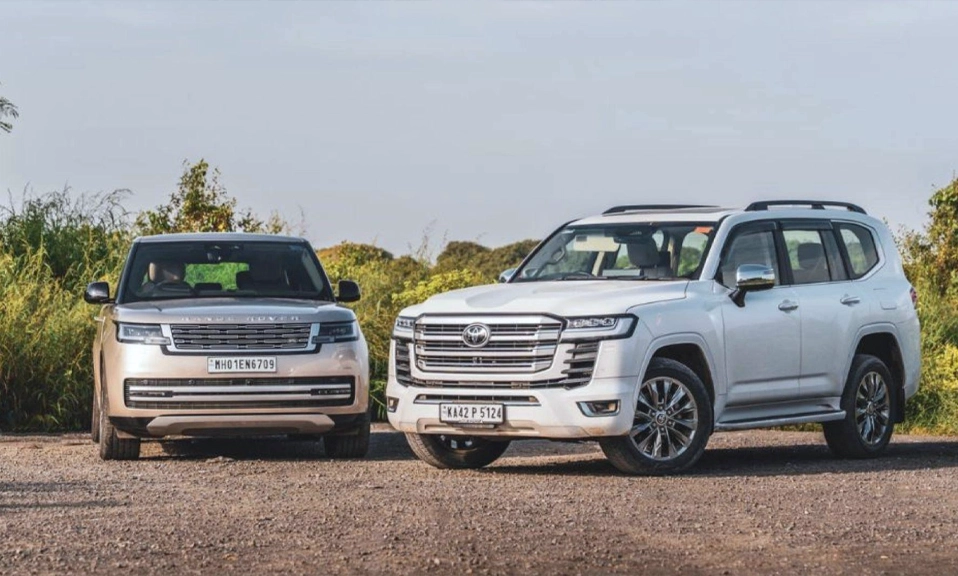
One is the car the UN drives into a war zone. The other is the car a billionaire drives into a ski resort.
Both will climb a mountain. Both will cross a river. Both cost more than a house in many countries.
But only one of them will get you home if it breaks in the middle of nowhere.
The Toyota Land Cruiser says: I will never leave you stranded.
The Range Rover says: You will never feel the mountain.
So which one is the ultimate off-roader? The answer depends on what you mean by ultimate.
First, Which Land Cruiser Are We Talking About?
This is important, because there are two different Land Cruisers in 2026.
In the US: You get the Land Cruiser 250 Series, also called the Prado in other markets. It starts at $57,200, uses a 2.4L turbo hybrid with 326 hp, and is smaller and cheaper.
The 2026 Land Cruiser comes in two grades. The base 1958 starts at $57,200 before Toyota’s $1,495 destination charge, and the better-equipped Land Cruiser trim opens at $63,275.
Every Land Cruiser uses Toyota’s i-FORCE MAX hybrid powertrain, pairing a turbocharged 2.4L with electric motors for 326 horsepower and 465 lb-ft of torque.
Outside the US, in Africa, Middle East, Australia: You get the Land Cruiser 300 Series. Bigger, tougher, with a 3.3L twin-turbo diesel or 3.5L twin-turbo petrol V6 with 409 hp. This is the one most people mean when they say “Land Cruiser” in Kampala, Nairobi, Dubai, or Sydney.
For this battle, we will compare both, because the Range Rover also has a huge price range.
The Quick Verdict
Buy the Land Cruiser if: You want the ultimate survivor. You drive where there are no dealers, no tow trucks, and no phone signal. You want a car that can be fixed with a spanner, that will run for 500,000 km, and that will hold its value like gold.
Buy the Range Rover if: You want the ultimate luxury off-roader. You want to cross a river in silence, climb a dune in leather seats, and arrive at a 5-star hotel feeling fresh. You have a dealer nearby, and you do not mind paying for maintenance.
If ultimate means “get me out alive from anywhere,” Land Cruiser wins.
If ultimate means “do it in maximum comfort,” Range Rover wins.
Head To Head
Toyota Land Cruiser 300 (Global) | Range Rover (Flagship) | |
|---|---|---|
Starting price | Around $70,000 to $90,000 depending on market | $115,450 to $241,050 in US |
Engine | 3.3L twin-turbo diesel, 227 kW / 700 Nm, or 3.5L twin-turbo petrol, 409 hp | 3.0L inline-6 mild hybrid 395 hp, or 4.4L twin-turbo V8 523 to 615 hp |
4WD system | Full-time 4WD, low range, locking centre and rear diffs | Permanent AWD, low range, locking diff, Terrain Response 2 |
Ground clearance | 231 to 235 mm | 205 to 295 mm with air suspension |
Approach / Departure | 32 degrees / 25 degrees | 34.7 degrees / 29.0 degrees |
Wading depth | 700 mm | 900 mm |
Towing | Up to 3.5 tonnes braked (diesel) | Up to 8,200 lbs / 3.7 tonnes |
0 to 60 mph | 6.7 seconds (petrol V6) | 4.4 seconds (V8 Autobiography) |
For the US Land Cruiser 250, the numbers are: Full-time four-wheel drive, low-range gearing, crawl control, Multi-Terrain Select, locking center and rear differentials, and a disconnecting front stabilizer bar. Towing capacity up to 6,000 pounds.
Its sole powertrain is the turbocharged i-Force MAX hybrid 2.4-liter four-cylinder producing about 326 horsepower and 465 lb-ft of torque, mated to full-time 4WD and low-range gearing for serious off-road performance.
Maximum towing capacity reaches 6,000 pounds, and 8.3 inches of ground clearance means you can confidently traverse fairly rough terrain.
For the Range Rover, pricing ranges from $115,450 to $241,050.
The 2026 Range Rover comes in four trims: SE from $113,300 MSRP with the 395-hp P400 six-cylinder, Autobiography from roughly $158,900 with the P550e plug-in hybrid, and the performance-flagship SV and SV Black, both built exclusively around the 606-607-hp P615 V8, starting near $219,200 and $238,600 respectively.
The P400 designation refers to a turbocharged 3.0-litre inline-six supported by a 48-volt mild-hybrid system. Output is rated at 395 horsepower and 406 lb-ft of torque, sent through an eight-speed automatic transmission and permanent all-wheel drive.
1. Off-Road Hardware: Old School Tough vs High-Tech Smart
Land Cruiser: Mechanical, simple, proven.
Locking differentials you can feel engage. Low range you can hear. Crawl Control that works like off-road cruise control with five speeds. A front stabilizer bar that disconnects to let wheels drop further into ruts.
In a famous Carwow test, the Land Cruiser won a slow downhill drag race because of that system. The Toyota driver explains he will use the vehicle’s crawl control system to achieve very low speed. He engages the system, releases the brake, and lets the car descend automatically. He then stands up through the open sunroof, steering with his foot while the vehicle creeps down the slope. The Toyota ultimately wins the slow race by about half a car length, with the driver commenting on how steady and controlled the crawl control is.
Commenters called it “the best Crawl Control system in the world.”
Range Rover: Electronic, intelligent, almost magic.
Terrain Response 2 is standard across the range, automatically sensing the surface the Range Rover is traversing and optimizing chassis, gearbox, and traction systems accordingly.
It has low range, locking differential, Terrain Response 2, All Terrain Progress Control, electronic air suspension, hill descent control, hill launch assist, and all-wheel steering.
On the Range Rover, you do not need to know what a differential is. You turn a dial to Sand, Mud, Rock, or Grass, and the car does the rest. It raises itself, softens itself, and figures out grip for you.
Which is better? If you are an expert off-roader, you will love the Land Cruiser’s control. If you are a beginner, the Range Rover will make you look like an expert.
2. Numbers That Actually Matter Off-Road: Clearance, Angles, Wading
On paper, the Range Rover actually beats the Land Cruiser on pure geometry.
Range Rover: Off road stats include obstacle clearance of up to 295.5mm, a wading depth of 900mm, an off road approach angle of 34.7 degrees and a departure angle of 29.6 degrees.
Maximum ground clearance 295mm, maximum articulation 510mm, approach angle 34.7 degrees, breakover angle 27.7 degrees, departure angle 29.0 degrees, wading depth 900mm.
Air suspension is the headline act, adjusting between 205mm and 294mm of ground clearance and dropping 50mm at standstill for easier ingress.
Land Cruiser 300: Ground clearance 235 mm, wading depth 700 mm, approach angle 32 degrees, departure angle 25 degrees.
The 2026 Toyota LandCruiser 300 Performance Hybrid retains the same 700mm wading depth as its diesel counterparts. Ground clearance is trimmed slightly to 231mm.
So the Range Rover can go deeper, climb steeper, and clear bigger rocks, on paper.
But here is the catch: The Range Rover does that with air suspension and electronics. The Land Cruiser does it with steel springs, solid engineering, and no air to leak.
If an air suspension bag fails in the bush, you are stuck low. If a Land Cruiser spring fails, it almost never does.
That is why in real-world tests on sand, mud, and jungle tracks, the Land Cruiser often wins, even with worse numbers.
In a Carwow uphill drag race on a steep, sandy dirt track, the Land Cruiser won both runs. After the first run, the Land Cruiser wins, prompting laughter and the comment ‘that’s 1-0 to me.’ The drivers agree to switch sides for fairness and run a second race, which the Land Cruiser also wins decisively, with commentary noting it ‘hooks up so well.’
Comments were overwhelmingly pro-Land Cruiser, praising its off-road ability and durability compared to the Range Rover. Multiple users note the tire mismatch as unfair, suggesting the Range Rover’s road tires disadvantaged it. Others joke about reliability, claiming the Range Rover broke down.
In a muddy jungle climb, the Toyota gains momentum and pulls ahead, reaching the top and becoming airborne over the lip of the hill while the Range Rover continues climbing behind it.
Tires matter, driver matters, but the pattern is clear: On rough, unpredictable terrain, the Land Cruiser hooks up and keeps going.
3. On-Road: This Is Where The Range Rover Fights Back, Hard
Off-road, it is close. On-road, it is not close at all.
The Range Rover is quieter, smoother, faster, and more luxurious than any Land Cruiser. It feels like an S-Class that can climb a mountain.
One infographic that compared the 2025 Land Cruiser 300, Lexus LX 600, and Range Rover Autobiography summed it up perfectly: The Land Cruiser prioritizes durability and terrain capability, the LX 600 adds Japanese luxury to the same platform, and the Range Rover emphasizes road comfort and premium craftsmanship.
The Range Rover Autobiography in that comparison was listed with a 4.4L Twin-Turbo V8, 523 hp, 553 lb-ft, 8-speed auto, AWD, 0-60 in 4.4s, versus the Land Cruiser 300 with 3.5L Twin-Turbo V6, 409 hp, 10-speed auto, 4WD, 0-60 in 6.7s.
In the city, in traffic, on a highway, the Range Rover is a better car. Better seats, better sound insulation, better stereo, better ride.
The Land Cruiser, especially the US 250 Series, is louder, slower, and more bouncy on road. It feels like a truck, because it is a truck. The Range Rover feels like a limousine.
If you spend 90 percent of your time on tarmac and 10 percent off-road, the Range Rover makes more sense. If you spend 50 percent off-road, the Land Cruiser makes more sense.
4. Reliability And The “Get Home” Factor: The Real Ultimate Test
This is the section that decides the title.
A Land Cruiser is the car aid workers, armies, safari operators, and farmers choose, not because it is fancy, but because it does not break, and when it does, anyone can fix it.
In comment after comment, owners repeat the same line: If you want to get out of the bush, take a Land Cruiser. Others defend the Range Rover’s ride, interior, and lack of rust, noting electronic faults.
One viral graphic titled “THE ULTIMATE RIVALRY” described the Land Cruiser as emphasizing durability, off-road capability, and dependability, while the Range Rover emphasizes luxury, refinement, and technology. Commenters overwhelmingly favor the Toyota Land Cruiser, citing durability and lack of regret.
And in classic comparisons, the same split appears again and again: For luxury and comfort, Range Rover, but for reliability, Toyota.
That is not a myth. Land Cruisers hold value better than almost any SUV on earth. A 10-year-old Land Cruiser in East Africa can sell for more than it cost new. A 10-year-old Range Rover, even a beautiful one, can lose 70 to 80 percent of its value because of repair fears.
A montage of heavily modified beige and white Toyota Land Cruiser 79-series double-cab pickup trucks driving on dusty African bush tracks shows exactly why: Lead truck kicking up dust near a termite mound, navigating sandy terrain, convoy shots on red dirt roads, with comments praising the Land Cruiser as a ‘beast’ and sharing experiences with the V8 and 2.8L diesel.
If you live in Kampala, Nairobi, or rural Australia, and your nearest dealer is 500 km away, the Land Cruiser is not just better, it is the only rational choice.
If you live in London, Dubai, or Los Angeles, with a Land Rover dealer 20 minutes away, the Range Rover’s maintenance cost is annoying, but not dangerous.
5. Luxury And Interior: No Contest
The Range Rover interior is in a different league.
Full leather, open-pore wood, suede headliner, massaging seats, 23-speaker Meridian sound, rear screens, and a cabin so quiet you can whisper at 120 km/h.
The Land Cruiser 250 interior is nice, but it is practical nice, not palace nice. Hard plastics in places, smaller screens, simpler seats. The 300 Series ZX is much better, with leather and wood, but still not Range Rover level.
If you want your passengers to say “wow,” buy the Range Rover.
If you want your passengers to say “we made it,” buy the Land Cruiser.
Who Should Buy Which?
Buy the Toyota Land Cruiser if you:
- Drive off-road often, in remote areas, or on bad roads
- Need a car that will last 15 to 20 years with basic maintenance
- Want the best resale value in the world
- Need diesel torque for towing and long range
- Live where service is scarce and parts must be simple
Buy the Range Rover if you:
- Want the most luxurious SUV that can also go off-road
- Spend most time on road, with occasional off-road trips
- Want the best wading depth, 900 mm, and best approach angles
- Want the fastest, quietest, most comfortable ride
- Have a good dealer nearby and can afford maintenance
Who Is The Ultimate Off-Roader?
If ultimate means the most capable, most comfortable, most high-tech off-roader you can buy today, the Range Rover wins on paper. It wades deeper, clears higher, and does it in silence.
If ultimate means the off-roader that will go anywhere, survive anything, and bring you home every single time, the Land Cruiser wins in real life.
That is why the Land Cruiser is called the King. Not because it is the fanciest, but because it never quits.