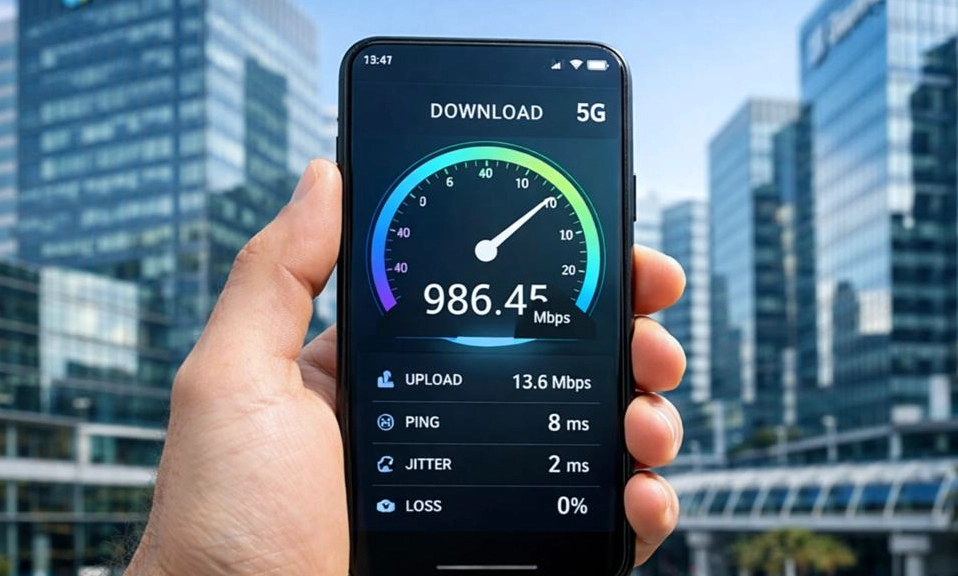
You think your 5G is fast?
In the UAE, people are downloading a full HD movie in 8 seconds. On their phone. On mobile data.
In the US, that same download takes 40 seconds. In India, it takes over a minute.
The gap is not small. It is massive. And in 2026, the fastest mobile networks in the world are not where you think they are.
It is not South Korea. It is not the US. It is not China.
According to Ookla’s Speedtest Global Index, the fastest mobile internet on earth isn’t in South Korea or the United States, it is in the United Arab Emirates, by a landslide.
Here are the 10 fastest mobile networks in the world in 2026, based on Ookla’s Speedtest Global Index, with real median speeds, why they are so fast, and what it means for you.
First, How Fast Is “Fast” In 2026?
The global median mobile download speed reached 200.12 Mbps in Ookla’s July 2026 Speedtest Global Index, with latency at 29 ms.
Read that again. The average phone in the world now downloads at 200 Mbps. That was home broadband speed 5 years ago.
And if you are on 5G Standalone, it is even faster. Globally, 5G SA availability reached 17.6% in Q4 2025. The headline global median SA download speed of 269.51 Mbps now represents a 52% premium over non-standalone networks.
5G Standalone means your phone connects directly to a 5G core, not through an old 4G core. It is faster, lower latency, and more reliable.
The countries at the top are not just a little faster. They are 3 times faster than the global average.
The 10 Fastest Mobile Networks In 2026
All speeds are median mobile download speeds from Ookla’s Speedtest Global Index in 2026. Speeds change month to month, so think of these as ranges, not exact promises.
Rank | Country | Median Mobile Speed | Why It Is Fast |
|---|---|---|---|
1 | UAE | ∼675 to 761 Mbps | 5G Advanced, few operators, huge spectrum |
2 | Qatar | ∼536 to 600 Mbps | Same Gulf playbook, World Cup legacy |
3 | Kuwait | ∼400 to 442 Mbps | Gulf investment, dense small cells |
4 | South Korea | ∼265 to 377 Mbps | First 5G country, dense cities |
5 | Bahrain | ∼303 to 332 Mbps | Gulf, small country, easy to cover |
6 | Singapore | ∼240 to 260 Mbps | Tiny, dense, perfect 5G lab |
7 | Denmark | ∼245 to 285 Mbps | Best in Europe, clean spectrum |
8 | Saudi Arabia | ∼275 to 299 Mbps | Massive Vision 2030 investment |
9 | Norway | ∼232 Mbps | Best in Nordics, 5G everywhere |
10 | Vietnam | ∼206 Mbps | Surprise riser, new 5G rollout |
Let’s break down each one.
1. UAE: The Undisputed King At ∼675 Mbps
The United Arab Emirates has the fastest mobile internet in the GCC and in the world, with a median download speed of 675.51 Mbps in Ookla’s August 2026 Speedtest Global Index. Qatar ranks second globally at 535.94 Mbps and Kuwait third at 399.92 Mbps.
In another month, the UAE was even faster. The United Arab Emirates, about 761 Mbps, Qatar, about 600 Mbps.
And on 5G Standalone alone, it is insane. The UAE recorded a median 5G standalone download of 1.24 Gbps in the fourth quarter of 2025, ahead of every other market.
The UAE had the highest median 5G standalone download speed in Ookla and Omdia’s country comparison for Q4 2025: 1.24 Gbps.
Why? The secret: massive 5G investment, contiguous mid-band spectrum split among just a few operators, and 5G Advanced deployments. The UAE hit a median of 1.24 Gbps on standalone 5G networks in late 2025.
The UAE only has two main operators, e& and du. They get huge blocks of spectrum. No fragmentation. And they have money to build everywhere.
e& UAE is the Fastest 5G Network in the World, Q1-Q2 2026.
And the fastest cities prove it. Four cities ranked ahead of Hanoi: Abu Dhabi in the United Arab Emirates, with 702.28 Mbps; Al-Rayyan in Qatar, with 625.63 Mbps; Doha in Qatar, with 532.09 Mbps; and Dubai in the UAE, with 522.64 Mbps.
If you live in Abu Dhabi, your phone is faster than most people’s home Wi-Fi.
Best carrier: e& UAE
2. Qatar: The Small Country That Punches Way Above Its Weight At ∼536 Mbps
Qatar ranked second for the month of September 2026 in mobile internet speeds, registering a median download speed of 526.41 Mbps and maintaining the same high placement worldwide since August of last year.
Qatar is tiny, rich, and flat. That makes it perfect for 5G. One operator, Ooredoo, can cover the whole country with high-quality 5G.
Qatar also built its network for the World Cup. Those stadiums needed to handle 80,000 people all livestreaming at once. That infrastructure stayed.
Best carrier: Ooredoo Qatar
3. Kuwait: The Gulf’s Third Power At ∼400 Mbps
Kuwait is often forgotten, but it should not be.
Kuwait is at about 442 Mbps in one ranking, and 399.92 Mbps in August 2026. Either way, it is third in the world.
Kuwait has the same Gulf playbook: few operators, lots of money, small geography, and a government that wants to be a tech hub.
Best carrier: Zain Kuwait
4. South Korea: The Original 5G Pioneer At ∼265 to 377 Mbps
South Korea was the first country in the world to launch 5G in 2019. It still has one of the densest 5G networks on Earth.
In one ranking, South Korea is at about 377 Mbps. In another, it is at 244.33 Mbps. The difference is whether you measure all mobile, or just 5G, and which month you pick.
Either way, South Korea is the fastest non-Gulf country in the world.
Why? Seoul has 10 million people in a tiny area. You can put a 5G tower on every block. And Koreans use more mobile data than anyone. They demand speed, so operators deliver it.
Best carriers: SK Telecom, KT, LG U+
5. Bahrain: The Tiny Island With Big Speeds At ∼303 to 332 Mbps
Bahrain is the smallest Gulf country, and that is its superpower.
Bahrain is at 303.21 Mbps in one ranking, 304.36 Mbps in another, and 332.47 Mbps in a third.
When your whole country is 780 square kilometers, you can cover it with 5G in a year. No mountains, no deserts to cover, just one island.
Best carrier: Batelco
6. Singapore: The Perfect 5G Lab At ∼240 to 260 Mbps
Singapore is not the fastest anymore, but it is the most consistent.
Singapore is at 199.70 Mbps in one snapshot, 238.83 Mbps in another, and 259.41 Mbps in a third. It moves around, but it is always top 10.
Singapore is 734 square kilometers, totally flat, totally urban. It is the perfect place to test 5G. Every operator has 5G Standalone here.
Why is Singapore not #1 like the UAE? Because it has 4 operators competing, not 2. Spectrum is split into smaller pieces. Still fast, but not Gulf-fast.
Best carrier: Singtel
7. Denmark: The Best In Europe At ∼245 to 285 Mbps
Denmark is the fastest country in Europe for mobile.
Denmark is at 182.32 Mbps in one snapshot, 250.21 Mbps in another, and 284.83 Mbps in a third.
Denmark wins because it has clean spectrum, good regulation, and a small, flat country. It also has some of the best 5G Standalone coverage in Europe.
If you are in Europe and you want the fastest mobile, go to Copenhagen.
Best carrier: TDC NET
8. Saudi Arabia: The Biggest Investor At ∼275 to 299 Mbps
Saudi Arabia is at 216.03 Mbps in one ranking, 297.86 Mbps in another, and 274.90 Mbps in a third.
Saudi Arabia is spending billions on Vision 2030 to become a tech hub. That includes 5G everywhere, even in the desert for NEOM, the futuristic city they are building.
Saudi is not as fast as UAE or Qatar yet, because it is huge. Covering Riyadh is easy. Covering the entire Empty Quarter desert is hard.
But it is catching up fast.
Best carrier: STC
9. Norway: The Nordic Leader At ∼232 Mbps
Norway is at 232.26 Mbps in one snapshot.
Norway is cold, mountainous, and spread out. That should make 5G hard. But Norway has 98% 5G coverage, even in fjords, because the government made coverage a priority.
Norway also has some of the lowest latency in the world, because its fiber backhaul is excellent.
Best carrier: Telenor
10. Vietnam: The Surprise Riser At ∼206 Mbps
This is the story of 2026.
Vietnam has entered the world’s top 10 for mobile internet speed for the first time, climbing 10 places and overtaking both the United States and China in Ookla’s latest Speedtest Global Index.
The July 2026 index placed Vietnam 10th globally for mobile internet, with a median download speed of 205.58 Mbps.
The United States ranked 12th at 189.21 Mbps, while China was 13th with 179.80 Mbps.
Vietnam jumped 10 places in one year. How? It launched 5G late, but it launched it right. It skipped old 5G Non-Standalone and went straight to 5G Standalone with new spectrum.
And Hanoi is now one of the fastest cities in the world. According to Ookla’s August 2026 Speedtest Global Index, Hanoi recorded a median mobile internet download speed of 493.37 Mbps.
If you think Vietnam is still a slow internet country, you are 2 years out of date.
Best carrier: Viettel
What About The US, China, And India?
You are probably wondering where the big countries are.
The United States ranked 12th at 189.21 Mbps. China was 13th with 179.80 Mbps.
According to Ookla, India currently ranks 26th globally for median mobile download speed, reaching 133.51 Mbps, improving three spots from its previous ranking.
Why are they not top 10?
US: Huge country, 4 operators, fragmented spectrum, rural areas drag down the median. In New York, you can get 800 Mbps on 5G. In rural Montana, you get 10 Mbps on 4G. The median is 189 Mbps.
China: Huge country, huge population, lots of users sharing each tower. In Shanghai, 5G is amazing. In rural China, it is still 4G.
India: Huge country, lowest data prices in the world, so everyone uses a ton of data. That congestion drags down speeds. But India jumped 3 spots to 26th, which is impressive for 1.4 billion people.
Why Does The Gulf Win So Much?
Ookla’s August 2026 Speedtest Global Index hands the entire mobile podium to the GCC.
The Gulf Cooperation Council delivered the world’s fastest 5G SA median download speeds in Q4 2025 at 1.13 Gbps, nearly five times that of Europe.
Three reasons:
1. Few operators: UAE has 2, Qatar has 2, Kuwait has 3. In the US, you have 4 plus dozens of MVNOs. Fewer operators means each one gets a bigger chunk of spectrum, which means faster speeds.
2. Small geography: UAE, Qatar, Bahrain are tiny. You can cover the whole country with 5G in 12 months. The US is 9.8 million square kilometers. It takes 10 years.
3. Money and will: Gulf governments see 5G as national pride. They invest billions, they give operators free spectrum, and they want to be #1. It works.
What Does This Mean For You?
If you are a traveler, download your maps and movies before you go to a slow country. If you are in the UAE, you do not need to download anything. Just stream it.
If you are building an app, do not assume everyone has 600 Mbps. The global median is 200 Mbps. Design for 50 Mbps, and your app will work everywhere.
If you are choosing where to live as a digital nomad, Vietnam is now a top 10 mobile country, and it is 10 times cheaper than Dubai.
And if you are in the US or India and you feel slow, you are not imagining it. You are 3 times slower than the UAE.
But here is the good news: 5G Standalone is spreading. The headline global median SA download speed of 269.51 Mbps represents a 52% premium over non-standalone networks. As more countries move to Standalone, like Vietnam did, speeds will jump.
The fastest mobile networks
in the world in 2026 are not in the US, China, or South Korea. They are in the Gulf.
UAE at ∼675 Mbps, Qatar at ∼536 Mbps, Kuwait at ∼400 Mbps. Then South Korea, Bahrain, Singapore, Denmark, Saudi Arabia, Norway, and the surprise riser, Vietnam.
The US is 12th. China is 13th. India is 26th.
Speed is not about population. It is about spectrum, investment, and geography. Small, rich, focused countries win.