Your friend says, “Just get 5G, Wi-Fi is dead.”
Your ISP says, “Just get fiber and Wi-Fi 7, 5G is a toy.”
Your carrier says, “Just get our 5G Home Internet, it replaces both.”
Who is right?
Nobody. Because they are comparing three different things.
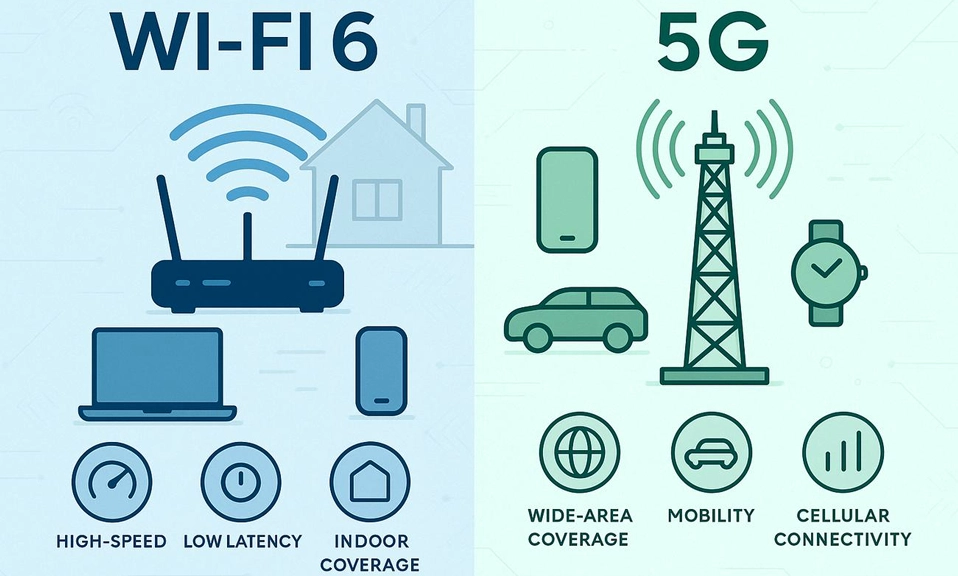
People ask whether 5G beats Wi‑Fi. That question misses the point. 5G is built for wide-area mobility, while Wi‑Fi is built for short-range access and dense device sharing.
Wi-Fi is not internet. 5G is not Wi-Fi. And 5G Fixed Wireless Access, FWA, is not mobile 5G.
Once you understand what each one actually does, the answer becomes obvious. And for most people, the best answer is not one of them. It is all three, working together.
What Are We Actually Comparing?
Let’s clear up the confusion first, because 90% of arguments online come from this.
Wi-Fi: Wi‑Fi is local networking inside or near a building; it usually connects to the internet through a router or modem.
Wi-Fi connects your phone to your router. Your router connects to the internet through fiber, cable, or 5G FWA. Wi-Fi by itself gives you zero internet. It is just the last 30 meters.
5G Mobile: Mobile broadband uses cellular networks such as 4G LTE and 5G NR.
5G connects your phone to a cell tower, wherever you are. It is for mobility. You walking down the street, driving, traveling.
5G Fixed Wireless Access (FWA): Fixed Wireless Access (FWA) uses cellular radio (LTE/5G) to reach a home: an outdoor or indoor 5G gateway becomes the household’s WAN connection.
Regular Wi-Fi connects your devices to a router inside your home. This router gets internet through cables like fiber or cable. Fixed Wireless Access (FWA) is different. Here, the router gets internet wirelessly from a nearby cell tower.
FWA is a box that sits in your house, does not move, and uses 5G to get internet from a tower, then shares it inside your house via Wi-Fi.
So FWA uses 5G, and uses Wi-Fi. It is not a competitor to Wi-Fi. It is a competitor to fiber and cable.
The Side-By-Side Comparison
Feature | Wi-Fi 6 / 7 | 5G Mobile | 5G FWA |
|---|---|---|---|
What it is | Local wireless inside a building | Cellular for moving devices | 5G to your home, then Wi-Fi inside |
Speed | Wi-Fi 6: 500 to 2,000 Mbps, Wi-Fi 7: 1 to 5 Gbps | 5G sub-6: 100 to 1,000 Mbps | 100 to 1,000+ Mbps, operator dependent |
Range | ∼30m indoors | Cell-tower coverage, kilometers | Tower to house, then 30m via Wi-Fi |
Latency | Wi-Fi 6: 5 to 20ms, Wi-Fi 7: 1 to 10ms | 10 to 30ms | 20 to 40ms, spikes evenings |
Setup time | Days to weeks | ~Days, active | Same day, plug in box |
Best for | Laptops, phones at home/office | Phones on the go | Home internet where fiber is slow or missing |
Moves with you? | No | Yes | No, fixed to one address |
Wi-Fi 6/7 dominates indoors for laptops and phones. 5G (and 4G) covers outdoors and wide-area mobile use.
Wi-Fi 6 (ax): 500–2,000 Mbps, ∼30 m indoors, 5–20 ms, Office Wi-Fi, dense user environments.
Wi-Fi 7 (be): 1–5 Gbps, ∼30 m indoors, 1–10 ms, High-throughput offices, AR/VR, dense venues.
5G (sub-6): 100–1,000 Mbps, Cell-tower coverage, 10–30 ms, Mobile, FWA.
Wi-Fi: The King Indoors
Wi-Fi is unbeatable inside a building.
Why? Because Wi-Fi uses unlicensed spectrum, it is free, and you can put 5 access points in your house for the price of one 5G tower. It is designed for dense, high-throughput, short-range use.
Wi-Fi 7 can do 1 to 5 Gbps in your living room. No 5G phone can do that reliably indoors, through walls.
Wi-Fi is also cheap. Once you pay for fiber, Wi-Fi is free. No per-GB charge. No SIM card. You can connect 50 devices, stream 4K on 3 TVs, and your bill does not change.
Wi-Fi weakness: It dies after 30 meters. It hates walls, especially concrete. It hates moving fast. Try using Wi-Fi while driving at 80 km/h, it will drop every 10 seconds.
Wi-Fi is not internet. If your fiber goes down, your Wi-Fi is useless, even with full bars.
5G Mobile: The King Outdoors
5G is unbeatable when you move.
Globally, 5G subscriptions is now close to 3.3 billion, and half of the world’s mobile data traffic is carried over 5G.
The latest Ericsson Mobility Report said 162 million new 5G subscriptions were added globally during the first quarter of 2026. This brought the total to 3.1 billion subscriptions.
5G gives you internet anywhere there is a tower. On the bus, in a park, in another city. Wi-Fi cannot do that.
5G weakness: It is shared. You share the tower with thousands of people. At 7pm, when everyone is streaming, your 5G speed can drop 50%. And it is expensive per GB. Streaming Netflix on mobile 5G all day will cost you a fortune and drain your battery.
5G is also worse indoors. A 5G signal has to go through walls. Your Wi-Fi router is 5 meters away. Your 5G tower is 500 meters away.
5G FWA: The New Challenger For Home Internet
This is where it gets interesting. FWA is exploding.
Ericsson counted 185 million fixed wireless access (FWA) connections worldwide at the end of 2025 and forecasts 350 million by 2031, with about 85% of them running on 5G (Ericsson Mobility Report, June 2026).
FWA connections are forecast to grow from 185 million at the end of 2025 to 350 million by the end of 2031.
FWA connections are expected to reach 350 million by 2031, effectively serving broadband to approximately 1.4 billion people worldwide.
Fixed Wireless Access (FWA) adoption is increasing, with around 70 percent of FWA service providers offering the service over 5G.
The share of FWA service providers offering services over 5G reached 71%, up from 57% a year earlier.
Most of the market is now 5G. The share of FWA providers offering the service over 5G has reached 71 percent, the biggest annual increase in four years.
In the US alone, it is now mainstream.
Ookla found that 5G fixed wireless access (FWA) connections topped 17 million in the first quarter of 2026, which represents nearly 14 percent of the 124 million home broadband subscriptions in the United States.
U.S. 5G fixed wireless access (FWA) connections from Verizon, T-Mobile, and AT&T topped 17 million in Q1 2026, capturing 13.74% of the nation’s 123.75 million home broadband subscriptions, according to the U.S. Census Bureau’s January 2026 American Community Survey.
T-Mobile ended 2025 with 8.5 million 5G broadband customers after adding 1.9 million in the year.
Verizon had 6.208 million FWA connections at June 30, 2026, up 21.4% year over year.
T-Mobile US closed 2025 with 8.5 million FWA connections, subsequently raising its long-term target to 15 million by 2030.
And it is not just the US. New 5G FWA launches have been recorded across Algeria, Argentina, Bangladesh, Morocco, Taiwan, Türkiye, and Vietnam.
TRAI’s September 2026 data counts 13.61 million 5G FWA connections in India plus 5.58 million on an unlicensed-band radio (UBR) version, against 48.89 million wired broadband lines.
5G FWA uses the operator’s licensed 5G spectrum, while UBR FWA uses unlicensed-band radio.
Why is FWA growing so fast?
Because fiber is expensive to lay. To connect a rural house 5 km from town with fiber, you need to dig 5 km of trench. That costs $10,000. To connect it with FWA, you need a $200 box and a tower that already exists.
FWA is cheaper to deploy than fiber in low-density areas.
Fixed Wireless Access (FWA) has surpassed DSL/cable broadband to become the most widely adopted residential connectivity model in greenfield deployments, with 58% share in 2024–2025.
And in cities, people love it because it is instant. No waiting 2 weeks for a technician. You go to the store, get a box, plug it in, you have internet in 10 minutes.
Analysis of Ookla Speedtest Intelligence data indicates that approximately 70% of Q2 2026 FWA test samples originated from urban users, versus 30% from rural areas. FWA was supposed to be a rural fix. Urban users are embracing it too, because it is cheaper and faster to set up than fiber.
Real Speeds: FWA vs Fiber
This is the question everyone asks: Can FWA replace fiber?
Here is the honest answer.
T-Mobile Home Internet led in median download speeds of 239.5 Mbps in Q1 2026.
T-Mobile dominated its competitors in Q2 2026 with a median download speed of 222.7 Mbps, 38.4% higher than AT&T Internet Air and 76% higher than Verizon 5G Home.
Verizon 5G Home Internet trailed its competitors with a median download speed of 143.64 Mbps in Q1 2026, according to Ookla’s Speedtest Intelligence data.
5G FWA commonly delivers hundreds of megabits per second, and top-tier plans and mmWave deployments reach into gigabit territory.
Compare that to fiber:
Fiber Broadband: 100–1000 Mbps consistent, Latency 5–10 ms stable.
5G Home Internet (FWA): 200–300 Mbps (drops 30–50% at peak hours), Latency 20–40 ms (spikes to 80–150 ms evenings).
So FWA is fast enough for 95% of homes. 200 Mbps can handle 4K streaming on 3 TVs, Zoom calls, and gaming at the same time.
But fiber is more consistent. FWA shares a tower with your neighbors. At 8pm, when everyone is streaming, your FWA speed can drop by half. Fiber does not drop, because it is a dedicated line to your house.
For gaming, fiber wins. A ping spike from 30ms to 120ms on FWA can cost you a game. Fiber stays at 8ms.
Jio AirFiber vs Mobile Hotspot: Why FWA Is Not A Hotspot
Many people think FWA is just a big mobile hotspot. It is not.
Jio AirFiber beats a mobile 5G hotspot for home Wi-Fi and Smart TVs because it pairs a roof-mounted outdoor directional antenna with a dedicated Wi-Fi 6 indoor router.
A mobile hotspot uses your phone’s tiny antenna, inside your house, behind walls. It fluctuates.
FWA uses an outdoor antenna on your roof, pointed directly at the tower. It gets a much stronger signal, and it does not move.
Jio AirFiber: Download Speed Locked to plan tier (30 / 100 / 300 Mbps).
Jio 5G Mobile Hotspot: 40 to 450 Mbps (fluctuates heavily indoors).
FWA gives you a stable, locked speed. Hotspot gives you a speed that jumps up and down.
And FWA comes with Wi-Fi 6E/Wi-Fi 7 CPE that carries the wireless link into the home. That is, the FWA box itself is a Wi-Fi 7 router. So you get the best of both: 5G outside, Wi-Fi 7 inside.
Which Is Best For You? The Decision Guide
Choose Fiber + Wi-Fi 7 if:
- You have fiber available in your area
- You are a gamer, streamer, or work from home with video calls all day
- You need rock-solid, low latency
- You have a big family with 20+ devices
- You can wait 1 to 2 weeks for installation
This is still the gold standard. Nothing beats fiber for consistency.
Choose 5G FWA if:
- Fiber is not available, or it will take months to install
- You rent and cannot drill holes for fiber
- You need internet TODAY, not in 2 weeks
- You live in a rural area, or a new building with no fiber yet
- You want a cheaper plan and you are okay with occasional evening slowdowns
- You want to take your internet with you if you move houses
FWA is perfect for renters, students, and rural homes.
Choose 5G Mobile Only if:
- You are always on the move, no fixed home
- You use less than 50GB per month
- You are a digital nomad, truck driver, or traveler
- You do not need to connect a Smart TV or a desktop
Do NOT try to run a whole house on a mobile hotspot. It will overheat, throttle, and cost you a fortune.
Choose Wi-Fi Only? You cannot. Wi-Fi needs an internet source. Wi-Fi without fiber, cable, or FWA is just a local network with no internet.
The Best Setup In 2026: All Three Together
Here is what smart homes do in 2026:
- Fiber or 5G FWA brings internet into your house.
- Wi-Fi 7 spreads it inside your house to your laptops, TVs, and smart home devices.
- 5G Mobile covers you when you leave the house.
They are not competitors. They are a team.
Your phone automatically switches from Wi-Fi 7 at home, to 5G on the street, to Wi-Fi 7 at the office. You never notice. That is the point.
5G is the newest mobile network technology. It offers faster speeds and lower delays than older networks like 4G. With 5G FWA, homes and businesses get fast internet without cables.
Wi-Fi vs 5G vs FWA
is the wrong question. It is like asking, “Which is best, roads, cars, or garages?” You need all three.
Wi-Fi wins indoors. 5G wins outdoors. FWA wins when you need home internet fast and fiber is not there.
If you have fiber, keep it, add Wi-Fi 7, and use 5G on your phone. You are set.
If you do not have fiber, get 5G FWA today. It will give you 200+ Mbps in 10 minutes, and it is now used by 17 million homes in the US alone, and 185 million worldwide.
In 2031, 350 million homes will be on FWA. It is not a temporary fix anymore. It is a real third option for home internet.