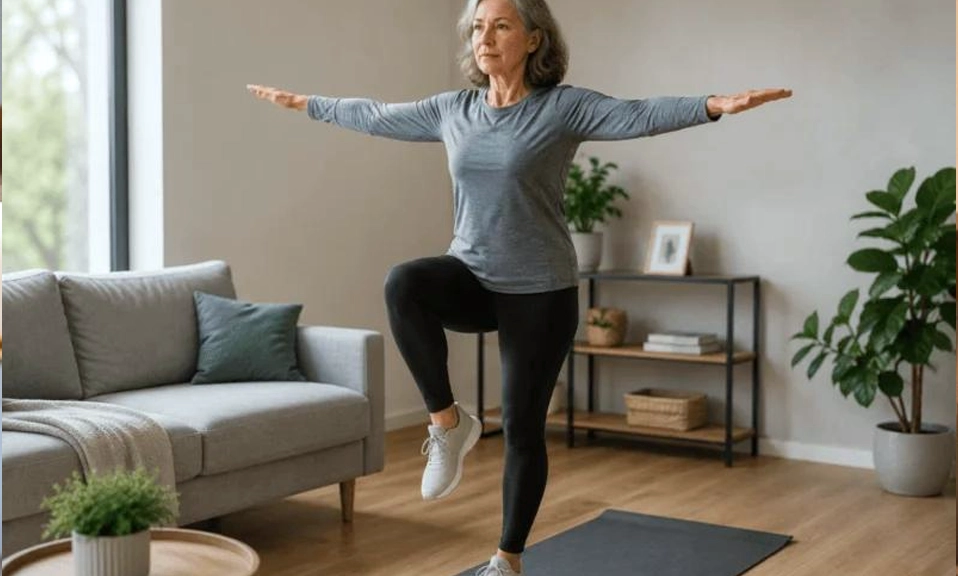
There is a quiet, unspoken fear that creeps into most people’s lives somewhere in their 50s, 60s, or 70s. It’s not the fear of getting older. It’s the fear of falling.
Maybe it started subtly. You stepped off a curb and felt a momentary wobble. You walked on an icy sidewalk and your heart raced. You caught yourself reaching for a wall when you stood up too quickly from the couch.
These moments feel embarrassing. But they are also your body sending you a very clear message: your balance system needs attention.
Here is the uncomfortable statistic: one in four adults over the age of 65 will experience a fall each year. Falls are the leading cause of injury-related death in older adults, and they are the single biggest threat to independence. Once you fall, the fear of falling again can cause you to move less, which makes you weaker, which makes another fall even more likely. It’s a vicious, dangerous cycle.
But here is the incredible news: balance is not a fixed trait. It is a trainable skill.
Whether you are 45, 65, or 85, you can rebuild your balance, strengthen your stabilising muscles, and dramatically reduce your risk of falls. You don’t need a gym. You don’t need fancy equipment. You just need 15 minutes a day and a sturdy kitchen counter.
Here are 10 simple, progressive exercises to help you stay strong, steady, and independent for decades to come.
🧠 Why Balance Declines (And Why You Can Fix It)
Before we get to the exercises, it helps to understand what’s actually happening. Your balance isn’t controlled by one thing—it’s a complex system that relies on three inputs:
- Your eyes (visual input)
- Your inner ear (the vestibular system)
- Your proprioception (the sensors in your joints, muscles, and feet that tell your brain where your body is in space)
As we age, all three of these systems naturally decline. Reaction times slow. The sensors in our feet become less sensitive. The muscles in our ankles and hips get weaker.
But here’s the beautiful part: the nervous system is adaptable. Through targeted practice, you can retrain your brain to process balance signals more efficiently, strengthen the muscles that catch you when you stumble, and rebuild the confidence to move through the world without fear.
🛑 Safety First: The Golden Rules
Before you start, follow these non-negotiable safety rules:
- Always have a sturdy support nearby. A kitchen counter, a heavy table, or the back of a solid chair. Never balance next to something that can roll or tip.
- Wear supportive footwear. Do these barefoot if you have good foot sensation, or in flat, grippy shoes. Never do them in socks on a slippery floor.
- Clear your space. Remove rugs, cords, and clutter.
- Listen to your body. Dizziness or sharp pain means stop. Mild muscle fatigue is fine.
- Consult your doctor if you have a history of falls, vertigo, or significant joint issues before starting a new exercise program.
🦶 The 10 Balance & Stability Exercises
These exercises are arranged from easiest to most challenging. Master the earlier ones before moving on.
1. The Supported Single-Leg Stand
Targets: Ankle stabilisers, foot strength, basic balance. How to do it: Stand next to your kitchen counter, holding on lightly with one hand. Lift one foot a few inches off the floor. Hold for 10 to 30 seconds. Switch legs. Progression: As you get stronger, reduce your grip to just one or two fingers. Eventually, hover your hands just above the counter without touching it. Why it matters: This is the foundation of all balance work. It rebuilds the tiny stabilising muscles in your ankles that catch you when you trip.
2. The Tandem Stance (Heel-to-Toe)
Targets: Side-to-side stability, core engagement. How to do it: Stand near your support. Place the heel of one foot directly in front of the toes of the other foot, as if you’re standing on a tightrope. Hold for 20 to 30 seconds. Switch which foot is in front. Progression: Cross your arms over your chest. Eventually, try closing your eyes (only if you feel completely safe—keep your hands hovering near your support!). Why it matters: This narrows your base of support, forcing your body to make constant micro-adjustments. It’s the exact skill you need when walking on uneven ground.
3. Tandem Walking (The “Tightrope” Walk)
Targets: Dynamic balance, coordination. How to do it: Stand near a wall or countertop you can run your hand along for safety. Place one foot directly in front of the other and take 10 slow, deliberate steps forward. Turn around and go back. Progression: Try it without touching the wall, just hovering your hand nearby. Why it matters: This trains balance while you’re moving—the exact scenario where most real-world falls happen.
4. Clock Taps (Multi-Directional Balance)
Targets: Hip stability, ankle mobility, proprioception. How to do it: Stand on your left leg, hands lightly on your support. Imagine you’re standing in the centre of a clock. With your right foot, tap the floor at 12 o’clock (in front), 3 o’clock (to the side), and 6 o’clock (behind). Return to centre each time. Do 5 rounds, then switch legs. Progression: Tap further away from your body as you get stronger. Eventually, try it with your eyes closed. Why it matters: Real life isn’t predictable. You need to be able to balance in every direction, not just straight ahead.
5. Standing Hip Abduction (Lateral Leg Raise)
Targets: Gluteus medius (the side of your hip), pelvic stability. How to do it: Stand tall, holding your support. Keep your leg straight and your toes pointing forward. Slowly lift your leg out to the side, only as high as you can without leaning your torso. Lower with control. Do 10 to 15 reps per side. Progression: Let go of the support for the last few reps. Add a light ankle weight once bodyweight feels easy. Why it matters: A strong gluteus medius is the single most important muscle for preventing falls to the side. It’s what keeps your pelvis level when you walk.
6. Calf Raises (The Ankle Armour)
Targets: Calves, ankle stability, foot strength. How to do it: Stand at your support. Rise up onto the balls of your feet as high as you can. Pause for one second. Lower slowly. Do 12 to 15 reps. Progression: Do them on one leg at a time. Do them on the edge of a step for a deeper range of motion. Why it matters: Your calves and ankles are your body’s first line of defence against a fall. Strong calves give you the power to catch yourself when you stumble forward.
7. The Sit-to-Stand (The Functional King)
Targets: Quads, glutes, core, functional independence. How to do it: Sit in a sturdy chair. Cross your arms over your chest. Lean forward slightly and drive through your heels to stand up tall. Slowly sit back down with control. Do 8 to 12 reps. Progression: Use a lower chair. Hold a light weight at your chest. Do it without using your arms at all. Why it matters: This is the single most important movement for maintaining independence. If you can get off the toilet, out of a low car, and off the couch by yourself, you can live independently.
8. Supported Single-Leg Romanian Deadlift
Targets: Hamstrings, glutes, balance, hip stability. How to do it: Stand on your left leg, holding your support. Hinge at your hips, sending your right leg straight back behind you while lowering your torso toward the floor. Keep your back flat. Squeeze your left glute to return to standing. Do 8 to 10 reps per side. Progression: Reduce your grip on the support. Add light dumbbells. Why it matters: This trains the “hinge” pattern that protects your lower back, while simultaneously challenging your balance on one leg. It’s a two-for-one powerhouse.
9. Step-Ups (The Stair Master)
Targets: Quads, glutes, dynamic balance, confidence on stairs. How to do it: Find a low step (4 to 6 inches—a thick book or a bottom stair works). Stand in front of it, hands hovering near your support. Step up with your right foot, bringing your left foot to meet it. Step back down with your left foot, then your right. Do 8 to 10 reps, then lead with the other leg. Progression: Use a higher step. Remove the hand support. Add light weights. Why it matters: Stairs are a major fall-risk zone. This exercise builds the specific strength and coordination you need to navigate them safely.
10. Dynamic Weight Shifts (Tai Chi Style)
Targets: Full-body coordination, weight transfer, confidence. How to do it: Stand with feet wider than shoulder-width. Slowly shift your weight entirely onto your right leg, bending your right knee and straightening your left. Then shift to the left. Move like you’re doing a slow, controlled martial arts form. Continue for 60 seconds. Progression: Add arm movements. Close your eyes (only if you feel completely safe). Why it matters: This is the movement pattern used in Tai Chi, which has been proven in dozens of studies to reduce fall risk in older adults by up to 45%. It teaches your body to transfer weight smoothly and confidently.
📅 How to Build This Into Your Life
You don’t need to do all 10 exercises every day. Here are three simple ways to integrate them:
The “Kitchen Counter” Routine (5 minutes daily) While waiting for the kettle to boil or the microwave to finish, do:
- 30 seconds of single-leg stands (each leg)
- 30 seconds of calf raises
- 30 seconds of clock taps (each leg)
- 30 seconds of tandem stance (each foot position)
The Full 15-Minute Session (2 to 3 times a week) Go through all 10 exercises in order, doing 2 sets of each. This is your complete balance “workout.”
The “Habit Stack” Approach Attach balance practice to something you already do every day:
- Brush your teeth → do calf raises
- Watch the evening news → do single-leg stands during commercials
- Wait for the bus → practice tandem stance
🚫 3 Mistakes That Sabotage Your Progress
Mistake 1: Only Practicing Balance When You Feel Unsteady
- The Error: You only think about balance when you wobble. But by then, you’re in “survival mode,” not “training mode.”
- The Fix: Practice balance exercises when you are fresh, rested, and calm. This is how your nervous system actually learns.
Mistake 2: Always Using the Same Support
- The Error: You hold the kitchen counter with a death grip every single time, and never challenge yourself to let go.
- The Fix: Each week, reduce your support slightly. Two hands → one hand → one finger → hovering hands. Progressive challenge is how you improve.
Mistake 3: Ignoring Your Feet
- The Error: You do all your exercises in thick, cushioned slippers.
- The Fix: The sensors in your feet are your first line of balance defence. When it’s safe to do so, practice barefoot or in thin-soled shoes to give your brain better feedback from the ground.
🎯 The Bigger Picture: Confidence Is the Real Goal
The physical benefits of balance training are obvious: fewer falls, stronger muscles, better mobility. But the psychological benefits are even more profound.
When you trust your balance, you walk differently. You stand taller. You look up instead of down at your feet. You agree to go on that trip with the cobblestone streets. You play with your grandchildren without fear. You stop shrinking your world to avoid situations where you might fall.
Balance training isn’t just about preventing a physical accident. It’s about protecting your freedom.
Start Today, Not After the First Wobble
The best time to start balance training is in your 40s or 50s, before you’ve had a scare. The second best time is right now, no matter your age.
These 10 exercises are simple, but they are not easy. They require focus, patience, and consistency. But the payoff is enormous: a body that you can trust, a mind that feels confident, and a life that you can live fully, without looking over your shoulder at every step.
Find your kitchen counter. Take off your shoes. Lift one foot.
Your future self—the one who is still hiking, travelling, dancing, and living independently at 85—will thank you.