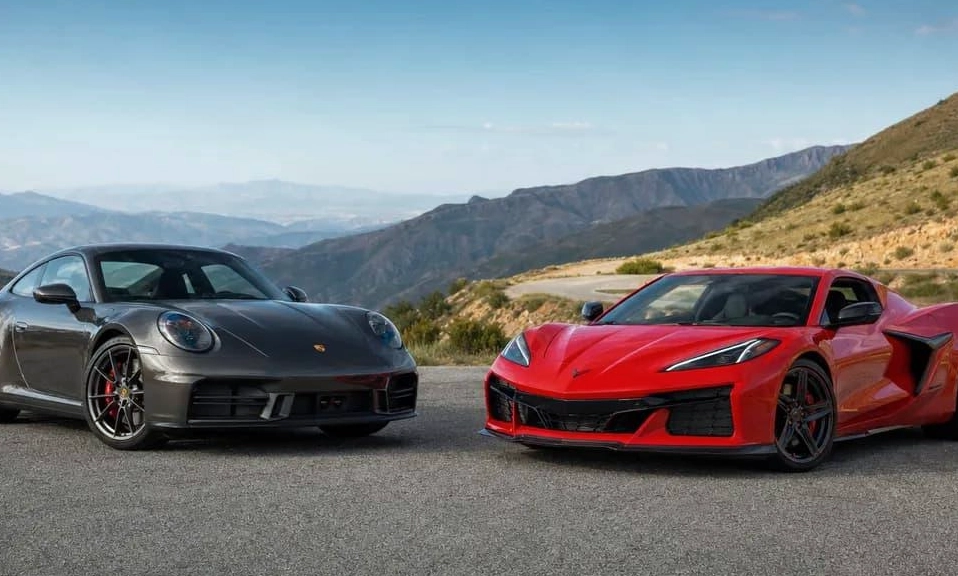
One is 60 years of evolution. The other is a revolution that finally put the engine in the middle.
One costs twice as much for less horsepower. The other gives you hypercar numbers for supercar money.
The Porsche 911 says: Precision beats power.
The Chevrolet Corvette says: Why not have both, for half the price?
So which one actually delivers more performance? It depends on whether you measure performance in horsepower, lap times, or smiles per mile.
The Quick Verdict
Buy the Corvette if: You want the most horsepower, the fastest acceleration, and the best performance per dollar on earth. You want a V8 that screams to 8,600 rpm.
Buy the Porsche 911 if: You want the most complete sports car. The best steering, the best brakes, the best build quality, the best resale value, and a car you can drive every day, on any road, in any weather, and still feel like a hero.
If performance means raw numbers, Corvette wins.
If performance means the whole driving experience, 911 wins.
Head To Head: Base vs Base, The Fair Fight
This is where the Corvette shocks everyone.
Porsche 911 Carrera | Chevrolet Corvette Stingray | |
|---|---|---|
Starting price | $132,300 to $137,850 | $71,995 |
Engine | 3.0L twin-turbo flat-6, rear-engine | 6.2L V8, mid-engine |
Power | 388 hp, 331 lb-ft | 495 hp, 470 lb-ft with Z51 |
0 to 60 mph | 3.9 seconds, 3.5 seconds in Edmunds testing | 2.9 seconds with Z51, 3.4 seconds in Edmunds testing |
Top speed | 183 mph | 194 mph |
Layout | RWD, 2+2 seats | RWD, 2 seats |
Gearbox | 8-speed PDK, manual available on some models | 8-speed dual-clutch, no manual |
Starting at $132,300 MSRP, the 2026 Porsche 911 Carrera has a 3.0-liter twin-turbocharged flat-six with 388 HP / 331 TQ, and a top track speed of 183 MPH and 0-60 time of 3.9 seconds.
Porsche’s 911 Carrera uses a twin-turbocharged 3.0-liter flat-six producing 388 horsepower and 331 lb-ft through an eight-speed PDK dual-clutch automatic, with a starting price of $137,850 and 0 to 60 mph in 3.5 seconds in Edmunds testing.
For the Corvette, the Stingray 6.2L V8 stuns with 495 hp and 470 lbs.-ft. of torque, routed through an 8-speed dual-clutch.
With the Z51 Performance Package and its tuned exhaust, output climbs to 495 horsepower and 470 lb-ft, and 0-60 drops to 2.9 seconds on a closed course. Starting price is $71,995.
In one viral comparison, the headline was perfect: Half the Price, MORE Power: Corvette Stingray (495 HP) vs Porsche 911 Carrera (388 HP).
Porsche claims 0 to 60 mph 3.9s (3.7s with Sport Chrono), while Edmunds instrumented testing showed Stingray Z51 0 to 60 in 3.4s and 911 Carrera 0 to 60 in 3.5s.
On paper, the Corvette is faster, more powerful, and $65,000 cheaper. On the road, it is closer than the numbers suggest, because the 911 is lighter on its feet and easier to drive fast.
One split-screen graphic that went viral listed the Corvette C8 Stingray at 6.2L LT2 NA V8, 495 HP, 637 NM torque, 8-Speed DCT, 0-100 km/h in 2.9 seconds, top speed 312 km/h, versus the Porsche 911 Carrera S at 3.0L twin-turbo H6, 473 HP, 530 NM torque, 8-Speed PDK, 0-100 km/h in 3.3 seconds, top speed 308 km/h.
The top comment summed it up: ” Corvette is the better buy. The Porsche is the better car.”
Mid-Level: Z06 vs GT3, The Track Fight
This is where Porsche fights back.
Corvette Z06: $120,300 starting, 670 horsepower, 2.6 seconds 0 to 60.
Its 670-horsepower flat-plane crank V8 is the most powerful naturally aspirated V8 ever in a production car, with an LT6 5.5L mid-engine, flat-plane crankshaft, 8,600 rpm redline, 8-speed dual-clutch transmission.
The Z06, purpose-built for circuits, clocks 0 to 60 in 2.6, backed by Z07 hardware and Michelin Cup rubber when specified.
Porsche 911 GT3: From $235,800, 502 hp, 3.2 seconds 0 to 60.
The Track Weapon: 911 GT3 Specs, 502 hp, 3.2 sec 0-60, From $235,800.
On power, the Corvette crushes it. 670 hp vs 502 hp. On price, the Corvette crushes it again. $120,000 vs $235,000.
But in a real drag race filmed by Carwow, the Porsche won.
The Corvette has a 5.5L naturally aspirated V8 with 646HP and 595Nm torque, weighs 1,720kg, costs £182,920 (£208,894 as tested), and rides on Michelin Pilot Sport Cup 2 R tires. The Porsche has 510HP and 450Nm, weighs 1,479kg, and costs £158,200. The final result displayed on screen states the Porsche won, completing the standing quarter-mile in 11.1 seconds versus the Corvette’s 11.3 seconds.
Why? Weight. The GT3 is 241 kg lighter. It launches cleaner, brakes later, and corners faster. It does not need 670 hp because it does not have to carry 670 hp worth of weight.
Commenters argued for hours: Corvette fans claimed the UK-spec Z06 is down on power and hampered by poor shifting, and Porsche supporters praised the GT3’s consistency. Many users point out the missing central exhaust indicating emissions equipment, and discuss OPF filters reducing output from 670hp to 646hp.
That is the 911 magic. It is not about the biggest number. It is about using every horsepower perfectly.
A podcast clip made the same point from the other side: For the price of a stripped-down 992, you could get more performance elsewhere. The second host suggests the 2023 Chevrolet Corvette Z06 Convertible as an alternative, highlighting its flat-plane crank V8, mid-engine layout, and Ferrari-like sound, noting it sold for $116,000. A third host counters with the 2019 Porsche 911 Turbo S, which sold for $171,500, arguing it offers supercar-level comfort, speed, and handling, calling it ‘the most super car.’
Top Level: Turbo S vs ZR1 vs ZR1X, The Hypercar Fight
This is where the Corvette goes from sports car to hypercar.
Porsche 911 Turbo S: 701 hp, 2.4 seconds 0 to 60, 200 mph, $270,300.
The Turbo S is the top dog of the Porsche 911 range, powered by a 701-horsepower hybrid engine. 0-60 in 2.4 seconds makes this one of the quickest cars we’ve ever tested.
With a twin-turbo flat-six now assisted by a T-Hybrid system, the all-wheel-drive flagship claims 701 hp and 590 lb-ft, a 0-60 mph dash of 2.4 seconds with Launch Control, and a 200-mph top speed.
Corvette ZR1: 1,064 hp, 2.3 seconds 0 to 60, 233 mph, $183,400.
With its 5.5-liter twin-turbo flat-plane-crank V-8, dual-clutch automatic, and total output of 1,064 hp and 828 lb-ft of torque, the C8 2026 Corvette ZR1 enters hypercar territory.
ZR1 is something else entirely: 0 to 60 in 2.3 seconds, a 9.6-second quarter at 150 mph, and a verified 233-mph top speed.
Corvette ZR1X: 1,250 hp, 1.8 to 1.9 seconds 0 to 60, $207,395 to $209,000.
By pairing the 1,064 HP twin-turbo LT7 engine with a 186 HP electric motor on the front axle, Chevy has solved the Corvette’s biggest historical problem: Traction.
Car and Driver tested the 2026 Chevrolet Corvette ZR1X at 1.8 seconds from 0 to 60 mph and 8.9 seconds in the quarter mile at 155 mph.
One infographic titled ‘TURBO TITANS: AMERICAN FURY vs GERMAN PRECISION’ compared the Corvette ZR1 at 5.5L twin-turbo V8, 1,064 HP, 1,123 NM torque, 0-100 km/h in 2.3 seconds, top speed 375 km/h, versus the Porsche 911 Turbo S at 3.8L twin-turbo flat-6, 650 HP, 800 NM torque, 0-100 km/h in 2.7 seconds, top speed 330 km/h. Commenters split between American Fury and German Precision camps, citing horsepower, 0-100 times, drivetrain, and real-world traction.
On raw numbers, the Corvette ZR1 and ZR1X embarrass the Turbo S. More power, faster acceleration, higher top speed, lower price.
On real-world usability, the Turbo S fights back. All-wheel drive means you can launch it in rain, on cold tires, on a normal road, and it just goes. No drama, no wheelspin, no fear. It is the fastest car you can drive to the office every day, in winter, with your grandmother in the passenger seat.
1. Driving Feel: The Part Numbers Cannot Measure
This is why people still buy Porsches.
911: Perfect steering weight. Perfect brake pedal. Perfect balance. The engine sits over the rear wheels, so it feels like the car is pivoting around you. You feel everything, but in a good way. It is the car that makes an average driver feel talented.
Corvette: More dramatic. More theater. The V8 sound is louder, angrier, more American. The mid-engine layout gives it incredible grip, but it feels bigger, wider, and less delicate than the 911. It is thrilling, but it is less precise.
If you want a scalpel, buy the 911.
If you want a sledgehammer that can also do surgery, buy the Corvette.
2. Daily Driving: 911 Is A Daily Car, Corvette Is A Weekend Car
The 911 has 2+2 seats, a front trunk plus a rear shelf, better visibility, and a ride that is firm but not punishing. You can drive it 300 miles, park it, and do it again tomorrow.
The Corvette has 2 seats, a front trunk and a rear trunk, but less storage, wider doors, and a lower nose that scrapes on speed bumps. It is more of an event to drive, which is fun on Sunday, tiring on Monday.
One mechanic in a viral video said the biggest issue with Porsche 911s is that owners don’t drive them frequently enough for the cars to operate properly. He recommends that if someone isn’t going to drive their 911 regularly, they should consider trading it in for a Corvette instead.
Comments were polarized, with many users sharing personal mileage stories, affirming that low-mileage garage queens develop problems.
The lesson is the same for both: These cars are meant to be driven, not stored.
3. Manual Transmission: Porsche Still Has It
The Corvette C8 has no manual. Only an 8-speed dual-clutch.
The 911 still offers a manual on the Carrera T and GT3. For purists, that alone decides it.
One owner who sold his white Porsche 911 for a Corvette cited two main reasons: the Corvette’s removable targa top provides an engaging open-air experience without losing the coupe look, and its supercharged 6.2L V8 delivers 650 horsepower and 650 lb-ft of torque with a manual transmission, a combination he finds more fun than the Porsche.
That was a C7, the last manual Corvette. The new C8 cannot offer that.
4. Ownership, Resale, And Value: The Hidden Performance
Performance is not just 0 to 60. It is also what the car is worth in 5 years.
In a $70k comparison video, the presenter said on paper the Corvette not only comes with a factory warranty but also has a 500-horsepower naturally aspirated V8 that does 0-60 mph in 2.9 seconds, while the Porsche has 400 horsepower and does 0-60 in 4 seconds. He argues that on performance, the Corvette dominates. On value, the Porsche is something you can purchase and sell later for about the same cost after a few thousand miles.
Comments echoed it: “The Porsche. Not only the driving experience and relative reliability, but it’ll just basically hold most of its value.” Others defended the Corvette’s 500hp V8, warranty, and driving dynamics as decisive.
That is true. A 911, especially a GT3 or Turbo S, can hold value or even appreciate. A Corvette, even a Z06, will depreciate, especially when Chevy releases a faster version a year later.
And in an Edmunds U-Drags test, a red Porsche 911 GTS T-Hybrid raced a white Chevrolet Corvette E-Ray. Commenters noted the Porsche GTS T-Hybrid is priced around $175,000 while the Corvette E-Ray is priced near $108,000 with 541 hp, and the thread became a polarized brand war over price versus performance, with Corvette fans pointing out the E-Ray’s lower MSRP and Porsche fans pointing out the win despite a horsepower disadvantage.
The Corvette E-Ray itself is a bargain: Corvette E-Ray ($108,600) with 655 hp, 2.5 seconds 0 to 60, versus Corvette ZR1 ($183,400) with 1064 hp, 2.3 seconds.
But the Porsche will always feel more special inside, with better materials, tighter panel gaps, and a badge that means more in most markets.
Who Should Buy Which?
Buy the Chevrolet Corvette if you:
- Want the most horsepower per dollar in the world
- Want a V8 soundtrack and mid-engine drama
- Want ZR1 or ZR1X hypercar speed for $183,000 to $209,000, not $500,000
- Do not mind depreciation, and you want maximum thrill for minimum money
Buy the Porsche 911 if you:
- Want the most complete, most precise sports car you can buy
- Want a manual gearbox, or a car you can drive every day
- Want the best resale value, best build quality, and best steering feel
- Want a GT3 for track days, or a Turbo S for all-weather supercar speed
The Corvette delivers
more performance for the money. No car on earth gives you 1,064 hp for $183,000, or 495 hp for $72,000.
The 911 delivers more performance for the driver. It is lighter, sharper, more consistent, and more rewarding at 7/10ths, not just at full throttle.
If you want to win a drag race on paper, buy the Corvette.
If you want to win a driver’s heart on a mountain road, buy the 911.