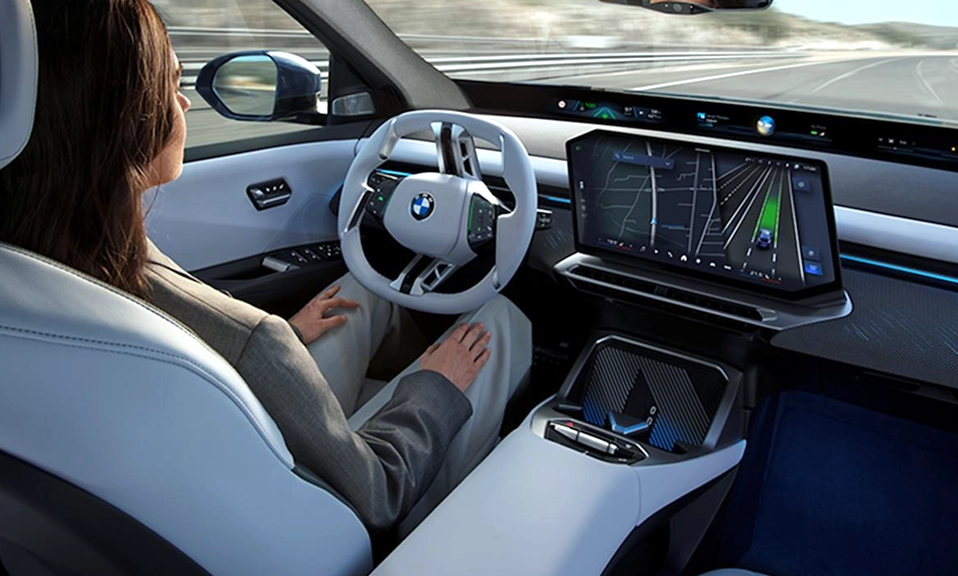
The car has been reinvented before—from horse to horsepower, from carburettor to computer—but the next decade will make the last fifty years look like a gentle evolution. The steering wheel is disappearing. The battery is changing its chemistry. The cockpit is becoming a conversational partner, a health monitor, and a workplace. And the car itself is learning to talk to the road, the grid, and the world around it.
By 2026, these are no longer concept-car fantasies. They are production features, regulatory shifts, and manufacturing realities rolling out in China, Europe, and the United States. Here are 10 technologies that will make the car you drive in 2035 feel almost unrecognisable next to the one in your driveway today.
1. The Steering Wheel That Folds Away
For a decade, the folding steering wheel was the auto-show trick that never reached production. In November 2026, BYD ended the wait. The top trim of the Fang Cheng Bao Tai 9, a six-seat plug-in hybrid SUV priced at 329,900 yuan (about $49,000) in China, now ships with a steering wheel that swings 180 degrees on a hidden hinge and drops into the dashboard in about 10 seconds.
The technology that makes it possible is steer-by-wire—no mechanical column connecting the wheel to the road wheels. China’s new national standard, GB 17675-2025, took effect on July 1, 2026, removing the requirement for a mechanical link and unlocking the design space. The wheel folds only when the vehicle is parked, and it pairs with a driver’s seat that reclines to 165 degrees, turning the driver’s area into a space for rest, work, or entertainment while charging. BYD rates the mechanism for 80,000 cycles and has built in five layers of redundancy with ASIL-D functional safety certification.
This is not autonomy. It is a bridge to the interiors that autonomous cars will demand—a conventional wheel when you need it, and usable space when you don’t.
2. Solid-State Batteries: 1,000 km Range and Ten-Minute Charging
The battery is the single biggest constraint on the electric car, and solid-state chemistry is the most credible path beyond it. In 2026, the technology moved from laboratory promise to production timelines.
Changan says it will begin trialling cars with solid-state batteries by autumn 2026, ahead of mass rollout in 2027, with its “Golden Bell” battery targeting up to 1,500 km of range from an energy density of 400 Wh/kg. Chery is targeting over 1,500 km and plans vehicle testing completion in 2027, while its Rhino liquid battery already supports 1,200 kW charging—enough to add 500 km of range in eight minutes. Toyota is aiming for 1,000 km and a 10–80% charge in roughly 10 minutes, with an initial launch targeted for 2027 or 2028.
Semi-solid-state cells are arriving even sooner. A hybrid architecture that replaces liquid electrolytes with solid materials is entering mass production in late 2026, offering 40% higher energy density and ultra-fast charging. The car that can drive from London to Edinburgh and recharge in the time it takes to buy a coffee is no longer a fantasy. It is a manufacturing schedule.
3. The Car That Watches Your Health
The cabin is becoming a clinical environment—quietly, continuously, and without any wearable device. Ultra-wideband (UWB) radar can detect cardiac and respiratory micro-movements through clothing and without contact, classifying occupants as normal, distressed, or unconscious with 97% occupancy accuracy and 94% vital-sign accuracy. The system can trigger an emergency response within five minutes, meeting Euro NCAP’s Child Presence Detection requirements.
Research vehicles from TU Braunschweig go further: electrodes in the steering wheel record electrocardiograms (ECGs), cabin cameras look for changes in facial colour that could indicate breathing trouble, and microphones in the seatbelt capture phonocardiography—the sound of the heart. An onboard AI fuses the data and selects whichever sensor is working at any given moment, so the system functions even if the driver is not touching the wheel in an autonomous car.
The car is becoming a preventive-health platform. It will not replace a doctor, but it may catch the problem before you reach one.
4. AI Agents That Know You—and Your Calendar
The voice assistant is being replaced by something more ambitious: an AI agent that reasons across contexts, routes requests between local and cloud models, and takes action on your behalf. Rivian has built an in-house agentic framework that understands what a person wants to do and routes the request to the right part of the car’s software—a local model on the edge for simple tasks, a cloud model for complex ones. The company plans to let third-party agents from Anthropic, OpenAI, and Meta run inside its vehicles, while keeping safety-critical controls strictly off-limits.
Audi has partnered with Cerence AI to bring Microsoft 365 into the car through a voice-first agent, letting drivers check email, review schedules, and join meetings while keeping their hands on the wheel and eyes on the road. Bosch has demonstrated a cockpit AI that converses like a real person while a second model interprets visual information inside and outside the vehicle. By late 2026, SBD Automotive had logged 567 public examples of in-car AI features across 11 agent capabilities, and almost every new cockpit assistant is now sold as an AI agent.
The assistant is no longer a command interpreter. It is a collaborator that knows your context, your preferences, and—increasingly—your life outside the car.
5. V2X: The Car That Talks to Everything
Vehicle-to-everything (V2X) communication has been “five years away” for a decade. In 2026, it started becoming infrastructure. Kapsch TrafficCom is deploying interoperable V2X across the Phoenix metropolitan region, connecting up to 750 intersections and approximately 400 vehicles in a multi-vendor deployment. Cisco and Verizon demonstrated V2X safety and traffic-efficiency use cases in Detroit at ITS Americas 2026. LG Electronics is testing a V2X traffic-safety solution on public roads during the 2026 ITS World Congress in Korea. ASTRI and Citybus have launched a C-V2X trial in Hong Kong’s Kai Tak Development Area.
The Chinese Society of Automotive Engineers expects vehicle-road-cloud cooperative assisted driving to reach small-batch front installation by 2027, with a commercial closed loop gradually taking shape. The car is becoming a node in a network—aware of the traffic light before it changes, the hazard around the bend, and the pedestrian about to step out. The safety gains are potentially enormous, but they depend on infrastructure that is still being built.
6. Level 4 Autonomy Without the Science Project
The robotaxi is no longer a Silicon Valley experiment. XPeng is conducting regular Level 4 pilot operations in Guangzhou and plans passenger-carrying tests with safety drivers in 2026, targeting fully driverless operation by early 2027. Its latest model is the first Chinese vehicle designed with full hardware redundancy to meet robotaxi standards.
Geely has unveiled a purpose-built electric robotaxi on a native L4 digital architecture, with a 3,000+ TOPS computing platform and a forward-looking L4 autonomous driving system. Ford plans to build the necessary hardware into its next-generation affordable EV platform due in 2027, then commercialise Level 3 via software updates in 2028. XPENG’s GX has made its mass-production debut with steer-by-wire and pre-installed Level 4 hardware.
The path is not uniform—some players are targeting L3, others are jumping to L4—but the direction is clear. The driver is becoming a passenger, at least some of the time.
7. 800V and 1,200V: Charging That Rivals a Fill-Up
The charging stop is the last great inconvenience of electric driving, and the industry is attacking it with voltage. Li Auto’s L9 Livis features an 800V fully active suspension and a full steer-by-wire chassis. Chery’s Rhino battery supports 1,200 kW charging, adding 500 km in eight minutes. An ultra-fast 1,200-volt platform concept has been shown to add 2.5 km of range for every second of charging.
Higher voltage is not just about speed. It reduces current for a given power level, which cuts resistive losses and heat, allowing thinner cables and more efficient packaging. The 800V architecture is becoming table stakes in China’s premium segment; 1,200V is the next frontier. When charging takes less time than a petrol stop, the calculus of EV ownership changes completely.
8. Centralised Computing: One Brain, Not Dozens
The modern car runs on dozens of electronic control units (ECUs), each responsible for a small domain. That architecture is collapsing into centralised computing platforms that combine previously separate domains onto a single chip. Horizon Robotics’ Starry chip, built on a 5-nanometer automotive-grade process, delivers 650 TOPS and supports both intelligent driving and cockpit AI models on a unified platform. The company says integrated architectures could cut vehicle-level costs by up to 4,000 yuan ($585) and reduce development timelines from 18 months to eight months.
More than 10 carmakers and suppliers, including BYD, Chery, Volkswagen, and Bosch, have shown interest. The shift is not just technical; it is organisational. Centralised computing simplifies the software stack, enables over-the-air updates that can improve the car after purchase, and turns the vehicle into a platform that evolves rather than a fixed product that depreciates.
9. Active Suspension That Reads the Road
Suspension has traditionally been a passive compromise: soft for comfort, stiff for control. Fully active suspension, paired with 800V electrical systems, makes it a real-time decision. The Li Auto L9 Livis uses an 800V fully active suspension alongside steer-by-wire. NIO’s ES9 combines steer-by-wire, rear-wheel steering, and fully active suspension—configurations once reserved for million-yuan vehicles are now appearing in the 400,000-yuan class.
Rear-wheel steering is trickling down too. The WEY V9X, a large SUV, comes standard with rear-wheel steering at a turning angle of ±10 degrees, giving it a turning radius of just 5.1 meters—more agile than many compact cars. Huawei’s Tuling platform integrates CDC variable damping and rear-wheel steering into a system-level chassis control architecture. The chassis is no longer a mechanical structure. It is a software-defined system that adapts to the road, the load, and the driver’s intent.
10. The Rocket-Assisted Wildcard (and the AI-Defined Vehicle)
Not every technology that will reshape the car is practical. Some are signals of ambition. Dreame Nebula NEXT unveiled a concept with a dual solid rocket booster system producing up to 100 kilonewtons of thrust and accelerating from 0 to 100 km/h in 0.9 seconds under test conditions. It is not a production feature, and it may never be. But it points to a broader shift: the industry is moving from “software-defined vehicles” to “AI-defined vehicles” , where a large-model-based agent like Dreame’s Metis shifts from reactive command execution to proactive assistance, coordinating across the car, the home, and personal devices.
The rocket is a stunt. The AI-defined vehicle is the real story. The car is becoming a reasoning agent on wheels—one that anticipates, coordinates, and acts, rather than waiting to be told what to do.
A Different Machine, Not a Faster One
The car of 2035 will not simply be a faster, quieter, more efficient version of the car of 2025. It will be a different kind of machine. The steering wheel may fold away. The battery may be solid. The cabin may monitor your heart. The assistant may know your calendar. The chassis may think. The car may talk to the road, and the road may talk back.
Some of these technologies will arrive later than promised. Some will fail. Some will be regulated into irrelevance. But the direction is unmistakable. The car is shedding the last remnants of its mechanical identity and becoming something closer to a personal AI platform with wheels—a device that happens to move, but whose intelligence extends far beyond the journey. The future car will not just look different. It will feel different, sound different, and relate to its occupants in ways that would seem alien to anyone who has only ever turned a key and driven.