For years, the promise of a “paper-like” phone screen has come with a frustrating catch. The technology that made screens easier on the eyes—TCL’s NXTPAPER—was stuck on LCD panels, which meant you had to trade away the deep blacks, vibrant colours, and slim bezels of OLED. You could have comfort, or you could have quality. Not both.
At MWC 2026, TCL finally closed that gap. The company announced that its next-generation NXTPAPER eye-care technology would be integrated with AMOLED displays for the first time, a move that combines the paper-like viewing comfort NXTPAPER is known for with the visual punch of OLED. By September, that promise became a product: the TCL P80 series, led by the P80 Ultra, became the first smartphones to ship with a NXTPAPER AMOLED panel.
The question is whether this is a genuine breakthrough for eye comfort, or a marketing story wrapped around a very good screen. The answer, based on the technical details and early impressions, is that it is both—a real improvement in how a phone display interacts with your eyes, delivered through a panel that also happens to be excellent on its own merits.
What TCL Actually Changed
The core of the new NXTPAPER AMOLED display is a set of hardware and software optimisations designed to make the light coming from your phone behave more like natural light. TCL frames the philosophy simply: “screens should feel as natural to the eyes as natural light”. Three specific upgrades do the heavy lifting.
Circular polarisation is the most important. Previous NXTPAPER panels used linear polarisation, which TCL says emitted light in a way that was less natural for the eye to process. The new panel uses circular polarisation with a rate of 90%, up from 57% on the previous generation. TCL claims this brings the light emission “more closely in line with the behaviour of natural light during prolonged viewing sessions”. In practical terms, circular polarisation is also why the display remains clear when you are wearing sunglasses—a small but genuinely useful detail.
Blue light reduction is the second pillar. Harmful blue light output has been cut by a further 15% compared to NXTPAPER 4.0, reaching as low as 2.9%. That is a striking figure, and it matters because blue light is one of the primary contributors to digital eye strain and disrupted sleep cycles. TCL is not the first company to reduce blue light, but doing so without washing out the colours is the hard part—and the AMOLED foundation helps.
Circadian and dim-light tuning is the third. The display automatically adjusts brightness and colour temperature throughout the day to follow ambient daylight patterns, supporting healthier circadian rhythms. In low-light environments, a dim-light protection mode can drop brightness to as low as 1 nit, creating a calm, night-friendly viewing experience for people who read or scroll in bed.
On top of these, TCL has added what it describes as the industry’s first anti-glare technology on an AMOLED smartphone display, using nano-matrix lithography to reduce ambient reflections without degrading clarity. An adaptive reading mode automatically adjusts background colour based on surrounding light, and a light-homogenising film softens reflections in e-reader mode.
The Panel Itself: A Flagship-Grade Display
The eye-care features would be less compelling if the underlying screen were mediocre. It is not. The NXTPAPER AMOLED panel in the P80 Ultra and P80 Pro is a 6.83-inch 1.5K display with a 120Hz refresh rate, 100% DCI-P3 coverage, Delta E under 1, and a peak brightness of 3,200 nits. Those are flagship-tier specifications, and they mean the display is not just comfortable—it is genuinely good for watching video, editing photos, and using outdoors in bright sunlight.
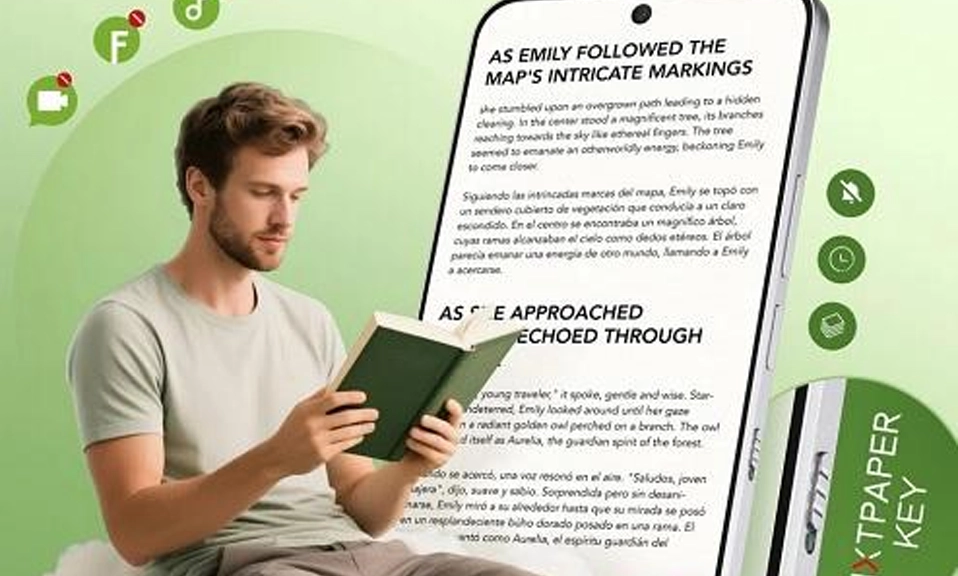
The Max Ink Mode remains a signature feature. Activated by a physical NXTPAPER Key on the side of the phone, it switches the display to a black-and-white, paper-like interface, kills app notifications except for calls and messages, and sleeps background apps. TCL claims this can extend battery life to up to 7 days. It is a mode designed for focused reading and writing, and it turns the phone into something closer to an e-reader when you need it to be.
The Phones: P80 Ultra and P80 Pro
The technology debuts in two models. The P80 Ultra is the range-topper, priced at €549 for 256GB and €599 for 512GB. It pairs the NXTPAPER AMOLED display with a MediaTek Dimensity 7400 Elite processor, 8GB of RAM, 256GB or 512GB of storage, and a 5,800mAh battery with 45W wired charging. The camera system includes a 50MP main sensor with OIS, an 8MP ultrawide, and a 50MP telephoto with 3x optical zoom and OIS.
The P80 Pro shares the same display and core specifications but drops the telephoto camera and is priced at €429 (approximately $500). Both phones carry IP68 dust and water resistance, MIL-STD-810H drop protection, stereo speakers with DTS surround sound, Wi-Fi 6, Bluetooth 5.4, and eSIM support. TCL promises 4 OS upgrades and 7 years of security updates, a commitment that puts it in rare company among mid-range Android manufacturers.
The smart eye-care assistant is a nice touch: it alerts you if you are too close to the display, slouching, if the display is too bright or too dark, or if you need to take a break. It is the kind of feature that sounds gimmicky until you realise how rarely anyone consciously adjusts their viewing habits.
The Caveats: What “Paper-Like” Really Means
TCL’s marketing leans heavily on the “paper-like” language, and it is worth being precise about what that means—and what it does not.
This is not E Ink. E Ink displays use physical ink capsules and reflective light, which is why they are so easy on the eyes and so limited in colour and refresh rate. NXTPAPER is an emissive AMOLED display with a matte, glare-reducing finish and a set of light-management technologies layered on top. It mimics the comfort of paper more than the physics of paper. It is still a screen that emits light, and it will still cause eye strain if you stare at it for too long without breaks. One analysis noted that “no clinical comparison in the cited sources establishes that one of these products prevents eye strain or eye damage, or is more comfortable for every reader”. TCL’s claims about blue light reduction and polarisation are meaningful, but they are not a cure for digital eye fatigue.
The RAM ceiling is a concern. Both the P80 Ultra and P80 Pro max out at 8GB of RAM, a limitation that reflects the broader DRAM cost pressures affecting the industry. For a phone at this price, 8GB is adequate but not generous, and power users may notice apps reloading more frequently than they would on a device with 12GB.
Availability is limited. The P80 series launched in Europe in September 2026, with an Australian rollout announced in November. There is no confirmed US launch, and TCL’s global distribution remains narrower than Samsung’s or Google’s.
A Genuine Step Forward for Eye Comfort
TCL’s NXTPAPER AMOLED display is not a gimmick. The combination of circular polarisation, meaningful blue light reduction, circadian tuning, and anti-glare technology represents a real, multi-layered approach to reducing the visual discomfort that comes with spending hours staring at a phone. The fact that it is built on a panel with 3,200 nits of peak brightness, 100% DCI-P3 coverage, and a 120Hz refresh rate means you are not sacrificing display quality to get that comfort. That was the trade-off with previous NXTPAPER phones, and it is now gone.
Does it make smartphone screens “easier on the eyes”? Yes, in the ways that matter for prolonged use. It reduces glare, it cuts blue light without wrecking colour accuracy, and it adapts to the light around you in ways that most phones do not. It will not eliminate eye strain, and it is not a substitute for taking breaks and blinking. But it is a more thoughtful, more comfortable display than the vast majority of phones on the market, and it points toward a future where eye comfort is treated as a first-class feature rather than an afterthought.
For readers, night scrollers, and anyone who spends too much of their day looking at a screen, the P80 Ultra and P80 Pro are the most compelling argument yet that you no longer have to choose between a beautiful display and one that is kind to your eyes. The paper-like phone has finally grown up.