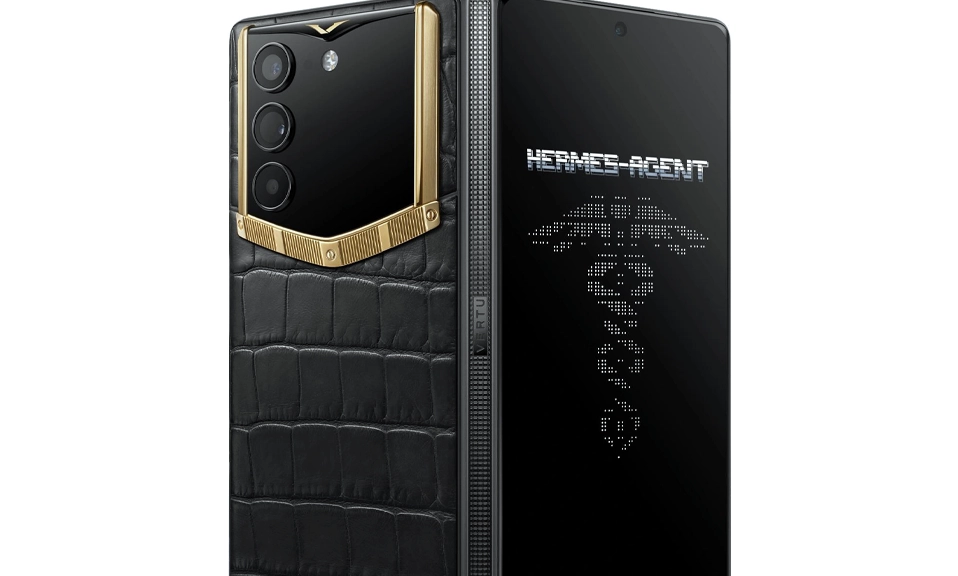
The Vertu AlphaFold is not a smartphone in the conventional sense. It is a luxury object that happens to make calls. It is a device designed for a very specific kind of buyer—one who measures value not in benchmarks or megapixels, but in the rarity of the materials against their skin and the exclusivity of the object in their hand. And on that measure, it is almost without peer.
Vertu, the British-founded, Hong Kong-headquartered luxury phone maker, unveiled the AlphaFold on May 28, 2026. It is the company’s first book-style folding phone, and it arrives with an AI agent called Hermes, a price tag that starts at $6,880, and a specification sheet that has raised more than a few eyebrows. This is a phone that asks you to pay flagship money for mid-range silicon—and then asks you to pay again for the privilege of holding it.
The Materials: A Phone Wrapped in Status
The AlphaFold’s defining feature is not its screen or its chip. It is what covers them.
The standard model is wrapped in quilted calfskin leather in a choice of colours, with metal clasps and soft linings that reviewers describe as feeling “a step above the thin vegan material found on other ‘leather’ phones”. The next tier up is alligator leather, which pushes the price to $8,800**. And then there is the bespoke tier: **18-karat gold detailing, natural diamond accents, and custom finishes** that Vertu says can push the price to **$46,800—with further customization options available beyond that.
Each unit is made to order and built by hand according to the buyer’s specifications. The hinge is a titanium and liquid-metal structure paired with UTG flexible glass, rated for 650,000 folding operations. The phone is 11.8mm thick when folded and 5.4mm when unfolded—not as svelte as a Galaxy Z Fold7, but the point is not thinness. The point is the feel.
This is the Vertu proposition in its purest form: the hardware is a canvas for the materials. The phone is a status symbol, and Vertu has been selling that proposition—with varying degrees of success—since its Nokia subsidiary days in the early 2000s.
The AI: Hermes, the Enterprise Agent
The AlphaFold’s second pillar is its software. The phone ships with Hermes Agent, an AI assistant built on the open-source Hermes project by Nous Research.
Vertu is positioning Hermes as a business tool, not a consumer gimmick. It can connect to enterprise systems like ERP and CRM, coordinate tasks such as approvals, scheduling, sales tracking, travel planning, and operational reporting through natural-language prompts, and integrate with more than 80 apps including Gmail, Google Calendar, WhatsApp, Telegram, and Amazon. It can route requests across multiple AI models—including OpenAI’s GPT, Anthropic’s Claude, and Google’s Gemini—and it is designed to learn the user’s preferences over time.
The privacy architecture is where Vertu is making its most ambitious claims. The AlphaFold includes a dedicated A5 security chip designed to isolate authentication keys, biometric credentials, and sensitive enterprise data from the main operating system. Commercially sensitive data can be processed locally on the device, and prompts sent to external AI models are redacted or tokenized before leaving the phone. Vertu CEO Molly Ma argues that mainstream smartphone AI remains focused on consumer tools like image editing and voice assistance, leaving room for an agent that is tied to the systems businesses actually run on.
The caveat is significant: Vertu has acknowledged that the system has not yet undergone third-party security audits or independent certification. The privacy claims are architectural promises, not verified guarantees.
The Specs: A Flagship Price, a Mid-Range Engine
This is where the AlphaFold becomes genuinely difficult to justify on any conventional measure.
The phone is powered by Qualcomm’s Snapdragon 8 Elite—a chip that was flagship-grade in 2025 but is a generation behind the Snapdragon 8 Elite Gen 5 that powers 2026’s best Android phones. It comes with 16GB of RAM and 1TB of storage as standard, which is generous, but the processor is the bottleneck that matters.
The cameras are similarly puzzling. There is a 50MP main sensor, a 50MP ultra-wide, and a 5MP telephoto—a combination that is fine on paper but is undermined by the tiny telephoto sensor, which is unlikely to produce compelling zoom images. The 8.05-inch inner display and 6.53-inch outer display both support 120Hz refresh rates, and the inner screen reaches 5,000 nits of peak brightness—genuinely impressive figures. The 6,500mAh silicon-carbon battery with 65W fast charging is also competitive for a foldable.
But the overall package is not a flagship by 2026 standards. It is a luxury object with competent internals, and reviewers have not been shy about saying so. Notebookcheck’s headline was blunt: “surprisingly weak specs”. CNET noted that the chip is “a step behind Qualcomm’s current flagship” and that the specs are “kinda… meh”. The AlphaFold is not competing on performance. It is competing on exclusivity, and Vertu is betting that its customers care more about the skin on the back than the silicon inside.
The Controversy: A Rebranded Nubia?
The most uncomfortable question about the AlphaFold is whether it is an original device at all.
Reports suggest that the phone is effectively a heavily customised version of the Nubia Fold, a foldable that launched in China in late 2025 at a fraction of the price. If true, it would mean that much of the underlying hardware—the display, the hinge architecture, the internal layout—already exists in a far cheaper form, and Vertu’s contribution is the materials, the software layer, and the brand.
Vertu has not confirmed or denied the Nubia connection. But the reports matter because they cut to the heart of the luxury phone proposition. If you are paying $6,880 for a phone, you are not paying for the chip or the camera. You are paying for the craftsmanship, the materials, and the status. Whether that is worth the premium is a question only the buyer can answer—but it is worth knowing that the engineering underneath may not be as bespoke as the leather on top.
A Phone for the 1%, Not for the Rest of Us
The Vertu AlphaFold is not a good phone in the way that a Galaxy Z Fold7 or a Pixel 11 Pro Fold is a good phone. It is slower, it has a weaker camera system, and it costs three to twenty times more. It is not trying to win on benchmarks. It is trying to win on desirability.
And on that measure, it succeeds. The AlphaFold is a beautiful object. The calfskin and alligator leather feel genuinely premium. The gold and diamond customizations are genuinely extravagant. The Hermes Agent, if it works as promised, is a genuinely differentiated enterprise tool. For a CEO who wants a phone that signals arrival, that opens doors, and that feels like nothing else in the room, the AlphaFold makes a certain kind of sense.
But it is not a phone for anyone who reads spec sheets. It is not a phone for anyone who cares about value. And it is not a phone for anyone who wants the best camera, the fastest processor, or the most polished software. It is a phone for the 1%—the buyers Vertu has always targeted, and the buyers who will decide whether the AlphaFold is a triumph or a curiosity.
For the rest of us, it is a fascinating window into a world where the rules of consumer electronics do not apply. It is a reminder that technology is not always about what it does. Sometimes, it is about what it says.