Right now, the artificial intelligence revolution is hitting a very physical, very earthly wall.
To train the next generation of massive AI models, tech giants are building gigawatt-scale data centers that consume as much electricity as small cities. They are draining local aquifers for cooling water, facing fierce “NIMBY” (Not In My Back Yard) opposition, and bumping up against the absolute limits of terrestrial power grids.
We are running out of room, power, and water on Earth to feed the AI beast.
So, where do we go when the planet is maxed out? We look up.
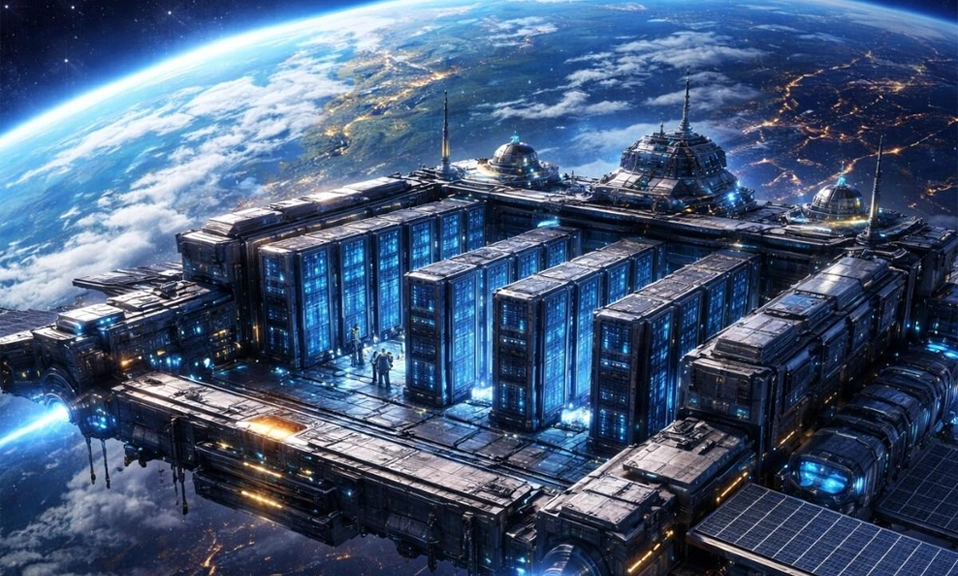
The concept of space-based data centers has migrated from the realm of science fiction into serious engineering roadmaps. In 2026, a quiet but profound shift is happening in Low Earth Orbit (LEO). The question is no longer if we will put data centers in space, but how fast we can do it, and whether satellites could become the ultimate backbone for the future of AI.
Here is a breakdown of why space might be the perfect environment for artificial intelligence, the reality of where the technology stands today, and the massive hurdles we still need to clear.
🌍 The Earthly Bottleneck: Why We Need to Look Up
To understand the space solution, you have to understand the terrestrial problem. Modern AI data centers face three inescapable constraints:
- The Power Crisis: A single advanced AI data center can demand 100+ megawatts of continuous power. Grids in regions like Northern Virginia, Ireland, and Singapore are already straining under the load. are already straining under the load.
- The Water Problem: Traditional data centers use millions of gallons of water for evaporative cooling. As climate change intensifies droughts, this is becoming environmentally and politically unsustainable.
- Latency and Bandwidth: Earth observation satellites currently beam petabytes of raw, unprocessed data down to Earth just so ground-based AI can analyze it. This is incredibly slow, expensive, and bandwidth-heavy.
Space offers a radical, elegant solution to all three.
🚀 The Space Advantage: Why Orbit is the Ultimate Server Room
Believe it or not, the harsh environment of space possesses unique characteristics that make it an ideal location for certain types of computing.
1. Limitless, Uninterrupted Solar Power
On Earth, solar panels are limited by night, weather, and atmospheric interference. In space, solar panels receive constant, unfiltered sunlight. A satellite in the right orbit can generate continuous, clean, renewable energy without relying on strained terrestrial power grids or fossil fuels.
2. Free, Infinite Cooling
Data centers on Earth spend a massive amount of energy pumping water or refrigerant to keep servers from melting. In the vacuum of space, the ambient background temperature is roughly 3 Kelvin (-270°C). While you can’t use convection (there’s no air), you can use radiative cooling. By designing server chassis with specialized radiators facing deep space, heat is effortlessly radiated away into the void. No water required.
3. The Ultimate “Edge” for Global AI
If your AI model is designed to analyze global shipping routes, track deforestation, or monitor climate change, why beam raw data to Earth to be processed? By putting AI accelerators directly on the satellite, the data is processed on orbit. The satellite then beams down only the tiny, actionable insights (e.g., “Fire detected at coordinates X,Y”), reducing latency from hours to milliseconds and saving massive amounts of bandwidth.
🛰️ The 2026 Reality: It’s Already Beginning
We are no longer just talking about theoretical whitepapers. The space-based data industry is in its early, active deployment phase.
- On-Orbit Edge AI: Companies are already launching CubeSats equipped with specialized AI chips (like radiation-hardened NVIDIA Jetson modules or custom ASICs). These satellites process high-resolution Earth imagery in real-time, identifying everything from illegal fishing vessels to crop health, and only transmitting the results.
- Lonestar Data Holdings: This company has been actively developing “lunar and orbital data storage.” The premise is simple: store cold, archival, or highly secure data on a satellite or the Moon, completely air-gapped from terrestrial cyber threats, powered by the sun.
- Mega-Constellation Compute: Providers like SpaceX (Starlink) and Amazon (Project Kuiper) are quietly laying the groundwork to turn their massive LEO satellite networks into distributed computing grids. Imagine thousands of satellites acting as a decentralized, orbital cloud, handling AI inference tasks for users in remote areas with zero latency.
⚠️ The Hurdles: Why We Aren’t Training LLMs in Orbit (Yet)
Before we start dreaming of massive, orbiting supercomputers training the next version of GPT, we have to confront the brutal realities of the space environment.
1. The Radiation Problem Space is filled with cosmic rays and solar radiation. On Earth, our atmosphere protects computer chips. In space, a single high-energy particle can strike a microchip and flip a bit from a 0 to a 1 (a Single Event Upset, or SEU). For AI, which relies on trillions of precise calculations, this is catastrophic. Developing cost-effective, radiation-hardened hardware or advanced error-correcting software is the industry’s biggest technical hurdle.
it’s catastrophic. Developing cost-effective, radiation-hardened hardware or advanced error-correcting software is the industry’s biggest technical hurdle.
2. The Maintenance Nightmare If a server rack catches fire or a fan fails in Virginia, a technician drives out and fixes it. If a server fails in Low Earth Orbit, it’s bricked. Space hardware must be built with extreme redundancy and designed for “graceful degradation,” driving up manufacturing costs.
3. The Kessler Syndrome (Space Debris) The more hardware we put into orbit, the higher the risk of collisions. A single collision can create a cloud of shrapnel that destroys other satellites, triggering a cascading chain reaction. Any space-based data center must have flawless, autonomous debris-avoidance systems and a guaranteed end-of-life deorbiting plan.
4. Regulatory and Legal Gray Areas Who owns data processed in space? Which country’s privacy laws apply to a server orbiting over the Pacific Ocean? The 1967 Outer Space Treaty is woefully unequipped to handle the complexities of orbital cloud computing and AI data sovereignty.
🔮 The Future Vision: A Hybrid Earth-Space Ecosystem
Space-based data centers will not replace terrestrial data centers. The physics of launching massive, heavy server racks into orbit will remain too expensive for general-purpose computing for the foreseeable future.
Instead, the future of AI will be hybrid.
- On Earth: Massive, ground-based data centers will continue to handle the heavy lifting: training foundational AI models, running complex simulations, and managing dense, localized user data.
- In Space: Orbital data centers will handle specialized workloads. They will act as ultra-secure, air-gapped cold storage. They will serve as the ultimate “edge” for global IoT and Earth observation, processing data at the source. And they will provide resilient, disaster-proof backup compute for critical global infrastructure.
The Final Frontier of Compute
For decades, the tech industry has operated under the assumption that all computation must happen on the ground. But as AI’s appetite for power and data outpaces our planet’s ability to sustain it, that assumption is breaking down.
Data centers in space are not a magic bullet, but they are a necessary evolution. By leveraging the infinite solar power and natural cooling of the cosmos, we can build a more sustainable, resilient, and globally accessible AI infrastructure.
The next great leap in artificial intelligence might not come from a new algorithm or a faster microchip. It might come from simply moving the computer a few hundred miles straight up.