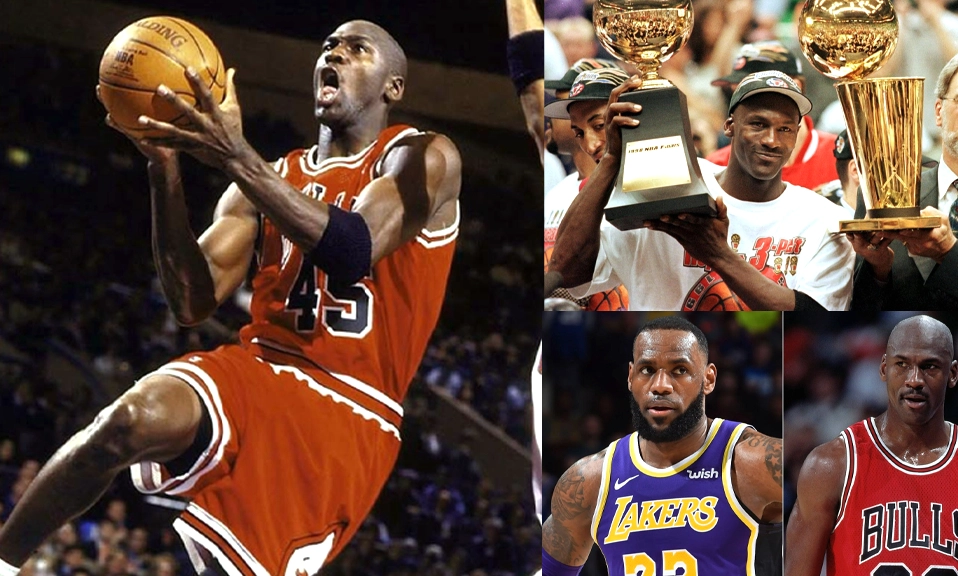
LeBron James has built the larger statistical career. He is the NBA’s all-time leading scorer, the record holder for All-NBA selections and the only player to reach 10,000 points, 10,000 rebounds and 10,000 assists.
Michael Jordan still owns a different kind of record book.
Jordan’s best marks are concentrated around peak dominance. He scored more efficiently over his career, won more scoring titles, collected more Finals MVP awards and produced one of the most complete defensive résumés ever assembled by a guard.
Some of these records are technically breakable by another future player. Others are already impossible for LeBron to match because of the way his own career unfolded. LeBron cannot turn a 4–6 Finals record into 6–0, and he cannot retroactively add scoring titles from seasons that have already passed.
Here are the six Jordan records that most strongly separate his peak from LeBron’s longevity and total production.
1. A 6–0 record in the NBA Finals
The most famous Jordan record is not a single statistical number. It is the fact that he went 6–0 in the NBA Finals.
Every time Jordan’s Bulls reached the championship round, they won the title. The NBA credits him with six championships and six Finals MVP awards, meaning that every one of his championship appearances ended with Jordan being named the series’ best player.
LeBron’s Finals résumé is larger but less perfect. He has reached the Finals 10 times, won four championships and lost six series. That comparison can be interpreted in two ways.
Jordan’s supporters see 6–0 as evidence of unmatched championship reliability. LeBron’s supporters point out that reaching 10 Finals requires a level of consistency and team success that Jordan never had to demonstrate across as many appearances.
Both points are fair. Reaching the Finals is difficult, and losing there is not the same as failing to reach the postseason. But LeBron can no longer match this particular record. Even if he wins another championship, his career Finals record cannot become undefeated.
That is what makes 6–0 different from most statistical marks. It is not merely a total that LeBron trails. It is a completed pattern that his career cannot reproduce.
2. Six Finals MVP awards
Jordan also owns the record for six NBA Finals MVP awards. He won the award in each of Chicago’s six championships.
LeBron has four Finals MVP awards, earned with three different franchises: Miami in 2012 and 2013, Cleveland in 2016 and the Los Angeles Lakers in 2020. His ability to win the award for three teams is one of the most impressive achievements in NBA history, but Jordan still leads the total count.
The Finals MVP record matters because it connects individual performance to the highest level of team success. A regular-season MVP recognizes excellence across a long schedule. A Finals MVP recognizes the player who most influenced the last stage of the championship race.
Jordan’s six awards mean that his six title runs were also six series in which he was officially judged the central performer. LeBron’s four awards show that he has been the best player on four championship teams, but they do not match Jordan’s perfect championship-award pairing.
LeBron could theoretically win two more Finals MVP awards. That is why this record is not mathematically impossible for him. In practical terms, however, he would need to lead two more championship teams in the final stage of a career already in its 24th season.
Jordan’s advantage is therefore both numerical and structural: six championships, six Finals MVPs and no championship run in which another Bull took the award from him.
3. Ten scoring titles
Michael Jordan won 10 NBA scoring titles, an all-time record. He also won seven consecutive scoring titles, matching Wilt Chamberlain’s longest streak.
LeBron has won one scoring title, in the 2007–08 season. His career scoring record is much larger because he has played longer and maintained a high level for more seasons. But a career total and a scoring title measure different kinds of dominance.
The scoring title asks a simple question: who scored at the highest rate during this specific season? Jordan answered that question 10 times.
He won scoring titles before his first championship, during Chicago’s championship years and after returning from his first retirement. The record shows that his offensive dominance was not limited to one short peak.
LeBron’s offensive value has always been broader than scoring. He has often been his team’s primary passer, rebounder and offensive organizer. A player can be more complete without leading the league in points per game.
But that explanation does not diminish Jordan’s achievement. Jordan combined enormous scoring volume with efficiency, difficult shot-making and defensive attention designed specifically to stop him. Winning 10 scoring titles in an era that included elite scorers such as Karl Malone, Hakeem Olajuwon, Shaquille O’Neal and David Robinson demonstrates how consistently he controlled the scoring race.
LeBron cannot reach 10 scoring titles now. He would need nine more, and the opportunity to accumulate them has passed. This is one of the clearest Jordan records that separates his specialized scoring peak from LeBron’s more distributed all-around role.
4. A 30.1 career regular-season scoring average
Jordan retired with a 30.1-point career scoring average, the highest in NBA history according to the NBA’s official legends profile.
A career scoring average is different from a single-season scoring title. It measures every regular-season possession across a player’s entire career. A poor rookie season, an injury-shortened year or a late-career decline can lower the number permanently.
Jordan managed to keep his average above 30 points per game despite playing 15 seasons, missing most of his second season with a broken foot and returning to the NBA at age 38 with the Washington Wizards.
The record is a direct statement about his scoring concentration. Jordan did not just score a lot. He scored at a rate that remained historically high after thousands of possessions and more than 1,000 regular-season games.
LeBron’s career average is lower because his game includes more playmaking, rebounding and role adjustment, and because he has continued playing into his forties. His larger career total reflects availability and sustained production; Jordan’s higher average reflects extraordinary scoring pressure over the seasons in which he was active.
LeBron cannot realistically match 30.1 now. Adding enough points to raise a long career average by several points would require an implausible level of late-career scoring. A future player may eventually challenge Jordan, but the record demands both a high peak and very little decline.
5. Nine All-Defensive First-Team selections
Jordan made nine All-Defensive First Teams, one of the strongest defensive records ever held by a perimeter player. The NBA also credits him with the 1988 Defensive Player of the Year award.
This is important because Jordan’s reputation is sometimes reduced to scoring, game-winning shots and championship drama. His peak was more complete than that. He could pressure the ball, disrupt passing lanes, defend elite guards and use his athleticism to recover when an offensive player appeared to have an advantage.
LeBron has six All-Defensive Team selections according to his official NBA profile, which is an excellent résumé for a player who has carried such a large offensive workload. He was also a highly effective defender at his best, especially as a versatile forward who could switch, protect the rim from the weak side and guard several positions.
The difference is that Jordan received nine First-Team honors, while LeBron’s defensive recognition was less consistent across his career. LeBron often had to preserve energy for his extraordinary offensive responsibilities, and his defensive impact varied more clearly from season to season.
Jordan’s nine First-Team selections show that his two-way peak was not a supporting feature of his game. It was part of the reason he was so difficult to attack and so valuable in playoff matchups.
LeBron could theoretically add more defensive honors, but at his current stage, matching nine First-Team selections is no longer a realistic career target. Jordan’s record is a reminder that the best version of his game operated at an elite level on both ends of the floor.
6. The playoff-record 63-point game
In the 1986 playoffs, Jordan scored 63 points against the Boston Celtics, setting the NBA record for points in a postseason game.
The performance came in only Jordan’s second NBA season, after he had missed most of the regular season with a broken foot. He made 22 of 41 shots and 19 of 21 free throws, but the Bulls lost 135–131 in overtime.
The result makes the record even more memorable. Jordan produced the greatest scoring game in playoff history against a Boston team that went on to win the championship, yet the performance still was not enough to defeat the Celtics.
LeBron has produced many spectacular postseason scoring games, but the 63-point mark remains one of Jordan’s clearest single-game advantages. It captures the destructive scoring ability that defined his early career, before his championship résumé was complete.
A future player could break the record. The modern NBA has more three-point volume, faster offensive possessions and stars who are encouraged to shoot through difficult games. That makes 63 theoretically vulnerable.
But LeBron is unlikely to match it. He has already played an enormous postseason career, and his later role has emphasized decision-making and all-around control rather than extreme single-game scoring. The record is not necessarily impossible forever, but it is a mark Jordan’s career will continue to own over LeBron’s.
What these records reveal about Jordan’s GOAT case
Jordan’s six records tell a consistent story.
The 6–0 Finals record shows perfect championship conversion. The six Finals MVP awards show that he was the central player in every title run. The 10 scoring titles and 30.1 career average show unmatched scoring dominance. The nine All-Defensive First Teams show that his peak included elite perimeter defense. The 63-point playoff record shows how high his single-game offensive ceiling could rise.
LeBron’s strongest records tell a different story. His 21 All-NBA selections, 22 All-Star appearances, career scoring total, playoff scoring total and 10,000-10,000-10,000 achievement demonstrate longevity, versatility and sustained responsibility.
That is why the GOAT debate remains open. Jordan has the stronger concentrated-peak résumé. LeBron has the stronger complete-career résumé.
Michael Jordan owns several
records LeBron James could never match—not because LeBron lacked greatness, but because the two careers were built differently.
Jordan’s career was shorter, more concentrated and more dominant in the scoring and championship categories. LeBron’s career was longer, more adaptable and more productive across multiple statistical areas.
If the standard is peak scoring, perfect Finals conversion, defensive recognition and championship-round dominance, Jordan has the advantage. His six records are not isolated trivia. Together, they explain why his peak remains the standard against which every modern superstar is measured.
LeBron may still have the best overall career argument. But Jordan’s 6–0 Finals record, six Finals MVPs, 10 scoring titles, 30.1 career average, nine All-Defensive First Teams and 63-point playoff record remain a group of achievements that LeBron cannot realistically duplicate.
That is the strongest version of the Jordan case—and it is still an exceptionally strong one.