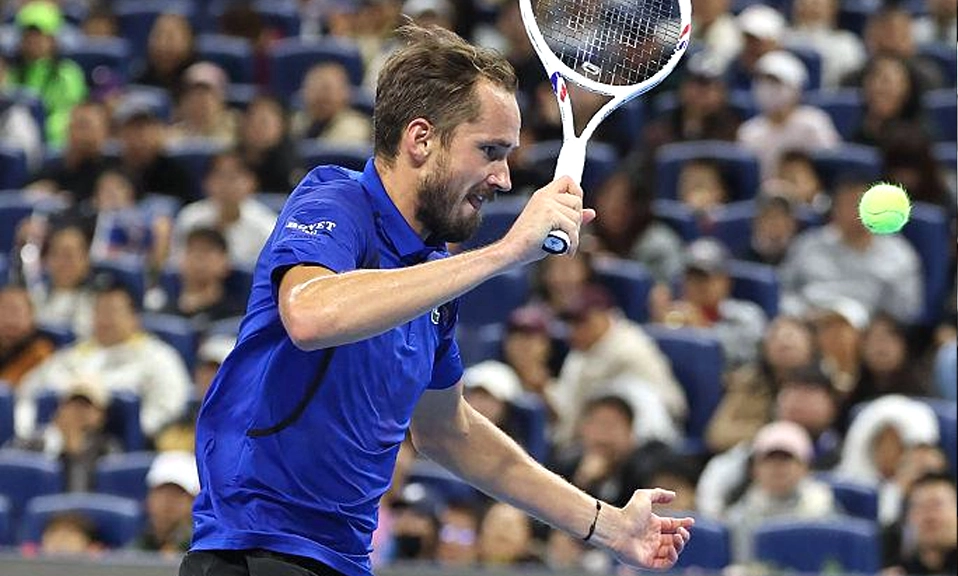
One moment of frustration. One ball hit without looking. One spectator in the wrong place at the wrong time. In the space of a few seconds, Daniil Medvedev’s China Open semifinal against Novak Djokovic was over — and the tennis world was left debating whether the punishment fit the crime.
What Happened
On Monday, October 5, 2026, Daniil Medvedev was trailing Novak Djokovic 7-5, 5-3 in their China Open semifinal in Beijing. Djokovic was serving for the match. Medvedev had just lost a point, and the ball, after rebounding off the advertising hoardings, came back toward him.
In a moment of frustration, Medvedev swatted it — not with anger, he would later insist, but instinctively — into the crowd [7†L17-L24]. The ball struck a spectator in the front row, hitting him in the left eye [5†L7-L10].
The man clutched his face and was helped from the stands by stadium staff [5†L10-L12]. Medvedev immediately waved his hand in apology [7†L25-L26].
But the damage was done. After a discussion between chair umpire Mohamed Lahyani, a tournament supervisor, and Medvedev himself, the Russian was defaulted for unsportsmanlike conduct [9†L17-L19]. He walked to the net, shook hands with Djokovic, and left the court [7†L29-L31].
The Rule That Left the Umpire “No Choice”
Medvedev’s disqualification was not a discretionary call. It was mandated by the ATP rulebook.
According to the 2026 ATP Rules, “players shall not violently, dangerously or with anger hit, kick or throw a tennis ball while on the grounds of the tournament site except in the reasonable pursuit of a point during a match” [9†L31-L37]. The rule defines abuse of balls as “intentionally or recklessly hitting a ball out of the enclosure of the court… or hitting a ball with disregard of the consequences” [9†L34-L37].
Crucially, the rule states that a player is automatically defaulted if a ball they hit strikes a spectator, official, or stadium staff member — even if it was unintentional [11†L32-L35].
“The rulebook is very clear about that,” Sky Sports analyst Jonathan Overend explained. “It was absolutely the correct decision. The rulebook is very clear about that and it was unfortunate for Medvedev. We take him at face value when he says he didn’t mean to do it, but it did leave his racket with force and it did strike the spectator” [10†L21-L24].
Tennis journalist Pete Odgers put it more bluntly: “Unfortunately, the umpire was left with no choice” [3†L12-L14].
Medvedev’s Apology: “I Feel Terribly Sorry”
Medvedev did not contest the decision. He walked off the court “sheepishly,” according to the Daily Mail, after shaking hands with Djokovic [3†L23-L25].
Speaking to reporters afterward, he was visibly shaken.
“I feel terribly sorry for him actually and I just hope he’s okay,” Medvedev said. “That’s the most important. The rest, we move on. I just really care about him right now. Hopefully I can meet him and make up for it somehow” [8†L10-L13].
He insisted the act was not intentional. “It was 100 per cent an accident,” he said. “You can see that I didn’t hit the ball in anger… The ball was bouncing back, so I tried to just hit it anywhere, so it wouldn’t go out of the court” [8†L17-L19].
“When I saw the result, I felt horrible because, again, I don’t think I was ever close to such a situation. The most important thing is I hope that he’s okay, because you never know with these types of situations” [8†L20-L22].
The Financial and Ranking Cost
The default came with severe consequences beyond the match itself.
Under ATP rules, a defaulted player forfeits all ranking points and prize money earned at the tournament [12†L30-L34]. For Medvedev, that meant losing 200 ATP ranking points and $219,925 in prize money — the amount he would have received for reaching the semifinals [12†L8-L9].
The ranking points loss was particularly painful. Medvedev was already fighting to maintain his position in the top 10. The loss of 200 points could drop him further down the rankings at a critical juncture in the season [12†L27].
Djokovic’s Empathy: “I Know Exactly How It Feels”
Djokovic, who advanced to his seventh China Open final with the win, was visibly shocked by what had happened. But his reaction was one of empathy, not triumph.
“I was shocked, to be honest… I hope that person is not badly injured,” Djokovic said. “On the other hand, I also feel sorry for Daniil because I know exactly how it feels to be disqualified in a big match… I’m sure that Daniil didn’t want to do this intentionally” [5†L12-L18].
Djokovic knew the feeling all too well. In 2020, he was defaulted from the US Open after accidentally striking a line judge in the throat with a ball [7†L31-L33]. It remains one of the most infamous moments of his career.
“It just happens,” Djokovic added [7†L37].
The Wider Debate: Is the Rule Fair?
The incident has reignited a debate about whether tennis’s default rules are too harsh — or not harsh enough.
Those who say it was correct: The rule exists for a reason. Spectators pay to watch tennis, not to be hit by balls. If a player hits a ball into the crowd and someone gets hurt, the player must bear the consequences, regardless of intent. “It was absolutely the correct decision,” Overend said [10†L21].
Those who say it was harsh: Medvedev didn’t mean to hit anyone. The ball rebounded off the hoardings, and he reacted instinctively. Former US Open champion Andy Roddick called for clearer rules on disqualifications, arguing that the current system is inconsistent [14†L8-L11]. Rennae Stubbs called for a “blanket rule” regarding player behaviour after the incident [14†L19-L25].
The inconsistency was highlighted by another incident on the same day. At the Shanghai Masters qualifying, Térence Atmane hurled his racket into the stands during a match. He was not defaulted because the racket clattered off the wall and did not hit anyone [9†L42-L45].
The message is clear: it’s not the act that determines the punishment. It’s the outcome.
What Comes Next
Medvedev will have the opportunity to appeal the fine and ranking points loss, though the default itself is not subject to appeal [12†L22]. He is expected to compete at the Shanghai Masters, where he will be eager to move past the incident.
The spectator, whose name has not been released, received medical treatment. Medvedev has expressed a desire to meet him in person to apologize [8†L13].
For Djokovic, the focus is on the final. He faces Alex de Minaur, who advanced when Hubert Hurkacz retired with an adductor injury in the other semifinal [5†L19-L22]. Djokovic is seeking his seventh China Open title and his 102nd career tour-level championship [8†L24-L25].
Daniil Medvedev’s
disqualification was a tragedy of circumstance. He didn’t mean to hit anyone. He didn’t hit the ball in anger. He didn’t even see where it was going. But the rule is the rule, and the umpire had no choice.
The incident is a reminder of the fine line professional athletes walk every time they step onto the court. A moment of frustration, a split-second decision, and everything can change. Medvedev lost $220,000, 200 ranking points, and a shot at a title — all because a ball he hit instinctively found a spectator in the eye.
He apologized. He meant it. But in the end, it wasn’t enough.