The smart home is finally growing up. Here’s what’s actually changing — and what it means for your house.
For years, the smart home was a collection of clever gadgets that didn’t quite talk to each other. You had an app for your lights, another for your thermostat, and a third for your doorbell. The promise of a seamlessly intelligent home always seemed one product cycle away.
In 2026, that promise is finally materializing. The global smart home market is projected to reach $215.77 billion this year, growing at a blistering 23.1% compound annual growth rate. But the real story isn’t the money — it’s the shift in how these systems work. AI agents are moving from answering questions to taking action. Matter has finally solved the interoperability nightmare. And for the first time, your home’s technology is becoming less about what you control and more about what it does for you, quietly, in the background.
Here are the 10 trends defining smart homes in 2026 — and why they matter for the way you’ll live.
1. AI Agents Are Taking Over the House
The biggest shift in 2026 isn’t a new device category. It’s the arrival of AI agents that don’t just respond to commands — they anticipate, plan, and execute.
At IFA 2026 in Berlin, LG unveiled ThinQ Claw, a text-based AI agent that uses your schedule, preferences, and home conditions to recommend actions and coordinate connected devices. In one demonstration, it checked available ingredients and suggested a meal. In another, it used calendar information to prepare the home before a trip. Samsung showcased its Bespoke AI Family Hub refrigerator, which uses AI Vision to track food expiration and suggest recipes. Midea’s SMART MASTER AI Agent supports 140 languages, an 8-metre voice-recognition range, and a 0.4-second response time.
The message from the industry is clear: the smart home of 2026 is one where your devices don’t wait for you to ask. They act.
Why it matters: This is the biggest conceptual leap since the smart home began. Your home isn’t just connected anymore. It’s proactive. The trade-off is that you’re trusting an AI system to make decisions on your behalf — and as we’ve seen with agentic AI in other contexts, that comes with real risks.
2. Matter 1.6 Finally Makes Ecosystems Play Nice
The single biggest frustration of the smart home era — devices that only work with one platform — is finally being solved.
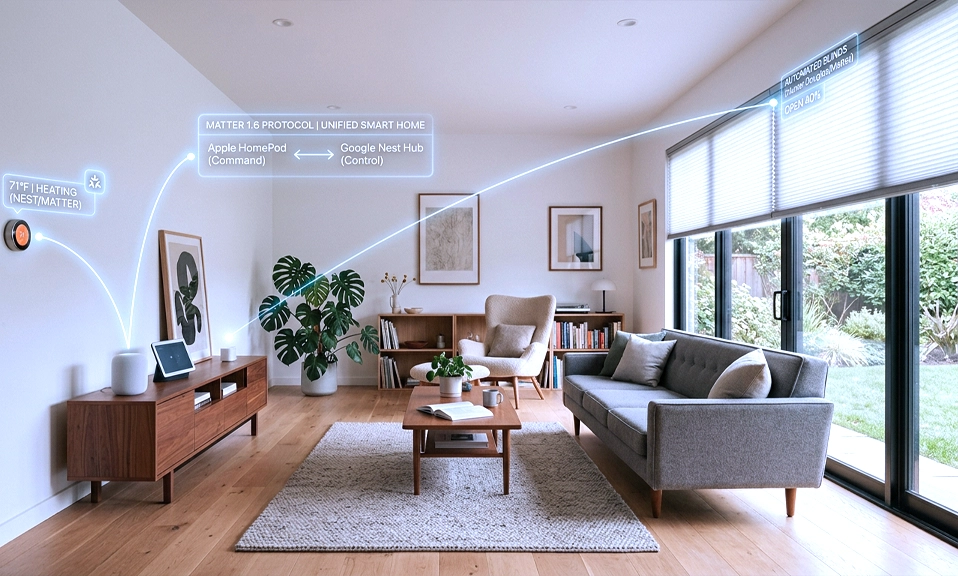
In June 2026, the Connectivity Standards Alliance released Matter 1.6, introducing Near Field Communication (NFC)-based device commissioning, Joint Fabric for multi-platform device management, and context-aware thermostat controls. Unlike previous versions that focused on expanding device categories, Matter 1.6 targets the user experience, simplifying setup and improving how traditionally distinct ecosystems interact.
The Joint Fabric feature is the game-changer: a household with devices from Apple, Google, Amazon, and Samsung can now access the same Matter devices without repeatedly onboarding them on each platform.
Why it matters: No more choosing between ecosystems. No more buying a specific brand just because it works with your hub. Matter 1.6 makes true interoperability a reality, and smaller vendors like Aqara and Eve stand to benefit disproportionately.
3. Smart Locks Become Operational Infrastructure
Smart locks have existed for years, but 2026 is the year they become core property access tools rather than novelty upgrades.
At CES 2026, Kwikset introduced modern designs that support Matter and include its SmartKey rekeying feature — allowing agents or owners to quickly change access between occupants. Lockly’s tap-based system works without internet connectivity, making it ideal for new construction and rentals. Lockin showcased mortise-style locks integrating biometric access, cameras, and wireless charging, eliminating battery maintenance entirely.
Why it matters: For renters, homeowners, and property managers alike, smart locks are becoming the primary way we control access to our homes. They’re no longer a luxury add-on — they’re operational infrastructure.
4. Agentic Home Energy Management
Energy management used to mean a smart thermostat that lowered the temperature when you left. In 2026, it means an AI system that predicts, plans, and acts autonomously.
Zendure introduced Agentic HEMS at IFA 2026, a system built on three layers: ZenPulse (a forecasting model for solar generation, prices, loads, and weather), ZENKI AI Agents (which turn forecasts into decisions), and Zen+OS (an open platform connecting everything across the home). The system integrates with 870+ energy providers across Europe and supports 5,000+ heat-pump models.
Why it matters: Energy is expensive and getting more complex. Dynamic tariffs, solar generation, battery storage, and EV charging all interact in ways humans can’t optimize manually. Agentic energy management turns your home into a self-optimizing system that saves money without you thinking about it.
5. Whole-Home Energy Backup Goes Mainstream
Home energy backup is moving out of the luxury category and into the mainstream. Anker’s Solix system was positioned at CES 2026 as a modular, expandable energy platform supporting outages and solar integration. Energy backup is becoming a selling feature for homes, not just a contingency plan.
Why it matters: As extreme weather events become more common and grid reliability becomes less certain, having backup power isn’t paranoia — it’s practical. And with modular systems, you can start small and expand as needed.
6. The Invisible Smart Home
The most interesting trend of 2026 is that the smart home is disappearing. Not literally — but visually.
At CES 2026, the focus shifted from flashy gadgets to “invisible intelligence” — technology that works quietly in the background. The demand is growing for tech-integrated design: hidden charging stations, concealed outlets, discreet lighting, and TVs and speakers built into walls or wood paneling. Lutron expanded its smart shade lineup with wood options that feel premium and design-forward, while adding automation that adjusts shades based on sunlight throughout the day. Humidity sensors now trigger bathroom fans automatically, reducing moisture buildup without any user intervention.
Why it matters: The best smart home technology is the kind you don’t notice. It doesn’t scream “smart home.” It just makes your home more comfortable, more efficient, and more responsive — without demanding your attention.
7. Local Processing and the Privacy Reckoning
Consumer trust in smart home providers is eroding, driven largely by AI’s demand for unprecedented data collection. 72% of consumers say they’re concerned about AI’s privacy and security implications. Nearly two-thirds of smart home device owners express concerns about the security of their personal data.
The industry is responding. Samsung’s EdgeAware AI Home analyzes sounds and activity locally, without sending private data to the cloud. Josh.ai has emphasized privacy-first home intelligence with local processing and reduced cloud reliance. More than half of U.S. internet households say they would pay extra for independently certified secure devices or local data storage.
Why it matters: Privacy is becoming a genuine competitive differentiator. As AI becomes more deeply embedded into residential technology, the question isn’t just what your home can do — it’s what it knows, and who can access that information.
8. Household Robots Arrive (For Real This Time)
The robot butler has been “coming” for decades. In 2026, it’s actually here — in limited form.
LG’s AI Home Robot connects to the ThinQ platform to assist with household tasks, from folding laundry to organizing the refrigerator or loading the dishwasher. Equipped with sensors, cameras, and voice recognition, it navigates autonomously while learning daily routines. It’s designed to be proactive and emotionally responsive, aiming to reduce household labor.
Why it matters: Robots aren’t replacing humans in the home yet. But they’re starting to handle the repetitive, time-consuming chores that nobody wants to do. The early versions are expensive and limited, but the trajectory is clear.
9. AI-Powered Security That Understands Context
Home security systems used to trigger on motion. In 2026, they understand what’s happening.
Samsung’s EdgeAware system detects 12 distinct sounds — from breaking glass and running water to prolonged coughing — and sends alerts, event summaries, and wellness insights. It can recommend actions, including initiating emergency response services. The AI Smart Fire Detector from Hansunst uses machine learning and multi-sensor functionality to reduce false alarms.
Why it matters: Traditional security systems are dumb — they alert on everything and nothing. AI-powered systems that understand context can distinguish between a burglar and a raccoon, a fire and burnt toast. That means fewer false alarms and more genuine protection.
10. Smart Homes for the “Old and Young”
One of the most significant trends identified in China’s 2026 Smart Internet Blue Book is the focus on “one old, one young” — using smart home technology to support elderly care and child development.
The report notes that future applications will focus on safety monitoring, health monitoring, and companionship for aging parents and young children. The smart home industry is shifting from selling individual products to providing whole-home scenario-based solutions.
Why it matters: This is where the smart home stops being a convenience and becomes genuinely transformative. For families with aging parents or young children, the ability to monitor safety, health, and wellbeing remotely isn’t a luxury — it’s peace of mind. And it’s a sign that the smart home industry is finally thinking about real human needs, not just selling gadgets.
The smart home
of 2026 isn’t about having the most devices. It’s about having devices that work together, learn from you, and act on your behalf — invisibly, reliably, and securely.
The market is growing for a reason. People aren’t buying smart home technology because it’s cool anymore. They’re buying it because it makes their lives easier, their homes more efficient, and their families safer.
The question is no longer whether your home should be smart. It’s how smart you want it to be — and how much you’re willing to trust the systems running it.