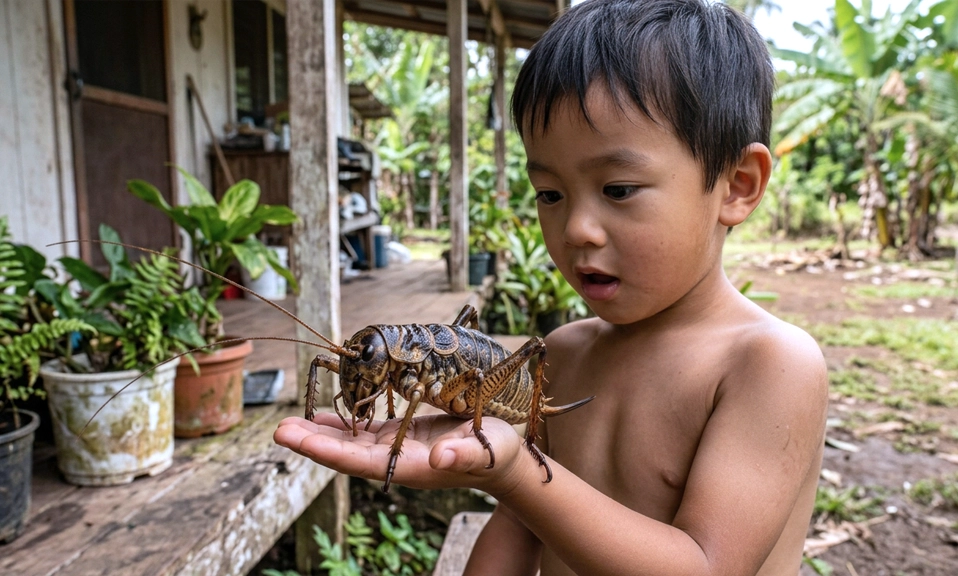
It weighs as much as a mouse, stretches across an adult’s palm, and once thrived across New Zealand’s forests. By the 1990s, it was presumed extinct on the mainland. Now, after a 15-year rescue mission that reads like a conservation thriller, the wētāpunga is officially back from the brink.
On October 2, 2026, researchers published a landmark study in the New Zealand Journal of Zoology documenting the recovery of Deinacrida heteracantha—the Little Barrier Island giant wētā, known to Māori as wētāpunga. The headline result: over 11,000 captive-bred insects have been released into the wild, and their conservation status has been upgraded from “Nationally Endangered” to “Nationally Recovering”.
Dr. Chris Green, an honorary researcher at New Zealand’s Department of Conservation and lead author of the study, put it simply: “The future of wētāpunga is looking bright”.
But getting to this point required years of painstaking work, a lot of dead ends, and one critical insight: to save a giant insect, you have to think like one.
What Is a Wētāpunga?
The wētāpunga is not just any insect. It is the heaviest insect in the world.
An adult female can grow nearly 10 centimetres long, with a leg span of up to 20 centimetres—about the width of a dinner plate. It can weigh as much as a mouse. The heaviest recorded specimen tipped the scales at 71 grams, a Guinness World Record for an insect.
These nocturnal, plant-eating giants belong to the same order as grasshoppers and crickets. They are slow, gentle, and utterly defenceless against the predators that arrived with humans: rats, cats, and stoats. Before people came to New Zealand, the wētāpunga had no mammalian predators. They had no need for defences. And when rats and stoats arrived, they were wiped out with terrifying speed.
By the mid-20th century, the species was confined to a single island in the Hauraki Gulf: Te Hauturu-o-Toi, also known as Little Barrier Island. Even there, surveys in the early 1990s painted a grim picture. The population was declining, and concerns grew that the species might vanish entirely.
The writing was on the wall. Without intervention, the wētāpunga would disappear forever.
The Rescue Mission: Six Insects and a Lot of Hope
In 2008, conservationists made a bold decision. They removed six breeding-age wētāpunga from the wild—a tiny, carefully chosen cohort—and brought them to Butterfly Creek, a wildlife facility, and Auckland Zoo.
The goal was to establish an ex situ breeding programme: a captive population that could produce enough offspring to repopulate islands where the insects could live without rats, cats, or stoats.
It was not easy. Raising wētāpunga in captivity required researchers to learn the species’ secrets from scratch. The nymphs—baby wētā—were raised in communal creches, fed a carefully designed “three-part” diet of fresh greens, leaf litter, and fish flakes for protein. The extra protein was critical for survival, one of many discoveries made through trial and error.
As techniques improved, the programme scaled up. The two founding colonies produced tens of thousands of offspring. Between 2010 and 2026, researchers bred and released more than 11,000 wētāpunga across 45 separate translocations to eight predator-free islands and two predator-proof fenced sanctuaries on the mainland.
Dr. Green described the scale of the operation as “very high compared to recovery projects for other species”. For an insect, this was industrial-scale conservation.
The Proof: Fourth-Generation Natives in the Wild
Releasing captive-bred insects is one thing. Proving they can survive, breed, and establish self-sustaining populations is another entirely.
Post-release monitoring on two islands—Motuora and Tiritiri Matangi—has confirmed the establishment of fourth- and fifth-generation wētāpunga at multiple release sites. These are not just released individuals clinging to life. They are wild-born insects, breeding in the wild, building the kind of self-sustaining populations that conservationists dream of.
That generational depth is the real measure of success. As the study authors noted, “a viable population with growth long enough to be measured in generations is a more robust measure likely to reflect ongoing persistence”.
In other words: the wētāpunga is not just surviving. It is living.
What We Learned: The Blueprint for Saving Insects
The wētāpunga recovery programme is not just a win for one species. It is a blueprint for how to save endangered invertebrates—a group that is often overlooked in conservation and chronically underfunded.
The study, published in the New Zealand Journal of Zoology, documents the scientific knowledge gained from 15 years of work. It details the breeding protocols, the release strategies, the dietary discoveries, and the monitoring techniques that made the recovery possible. For other conservationists working to save threatened insects, it is a roadmap.
Dr. Green emphasized the importance of documenting this knowledge. “It’s vital to document the scientific knowledge gained from the wētāpunga recovery efforts,” he said. Because the next species on the brink may not have 15 years to wait.
The Bigger Picture: Why an Insect Matters
It would be easy to dismiss the wētāpunga as a curiosity—a big bug with a funny name. But its story matters far beyond New Zealand.
The wētāpunga is one of New Zealand’s many unique species that evolved in isolation for millions of years. It is a living relic of a time before mammals, a creature that belongs to an ecosystem that no longer exists anywhere else on Earth.
Its recovery is also a reminder that conservation works. The wētāpunga was not saved by accident. It was saved by a deliberate, sustained, 15-year effort involving researchers, zookeepers, wildlife facility staff, and government agencies. It was saved because people decided it was worth saving.
And there is something quietly profound about that. In a world where so many species are sliding toward extinction, the wētāpunga is moving in the opposite direction. It is a rare piece of good news—proof that the tide can be turned, that extinction is not inevitable, and that even the heaviest insect in the world can fly back from the edge.
What Happens Next
The wētāpunga is not out of the woods yet. It remains confined to predator-free islands and fenced sanctuaries. On the mainland, where rats and stoats still roam, it cannot survive without human protection.
But the trajectory is clear. The species is breeding. Populations are growing. The threat ranking has improved. And for the first time in decades, the future of the world’s heaviest insect looks genuinely secure.
Dr. Green’s assessment was understated but optimistic. “The future of wētāpunga is looking bright,” he said.
Fifteen years ago, six insects were taken from the wild. Today, 11,000 of their descendants are living free. That is not just a conservation success. It is a resurrection.
The wētāpunga is back. And it is not going anywhere.