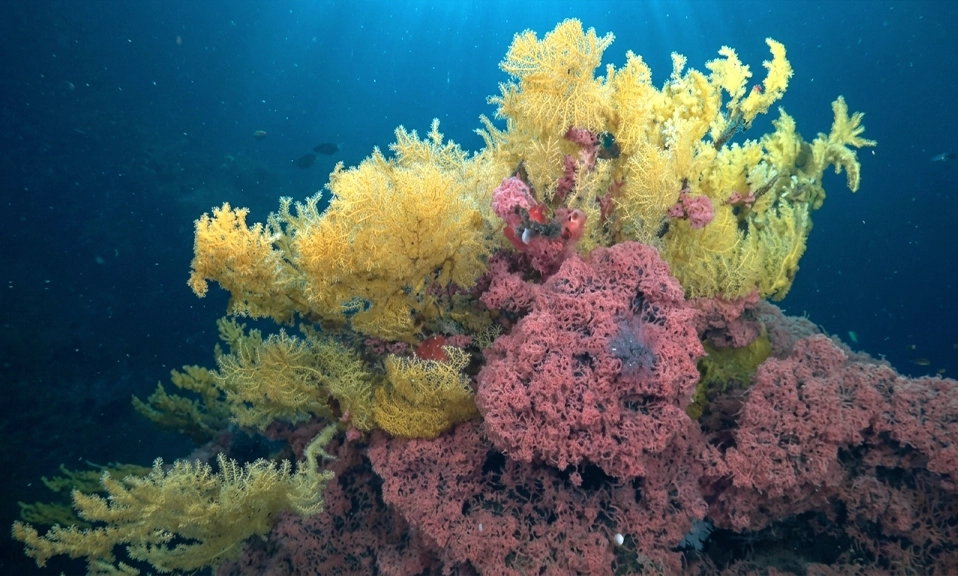
It was glowing like a tree in a forest of stars. When scientists finally analyzed it, they realized it didn’t belong to any family on Earth—and so they had to invent a new one.
A Forest of Golden Trees, 500 Meters Down
Somewhere off the coast of Costa Rica, in a place where sunlight never reaches, there is a forest. Not of trees—but of coral.
It rises from rocky outcrops on the seafloor, branching and glowing with a bright golden-yellow light. Around it, the ocean floor is almost entirely blanketed by brittle stars, their arms creating what one researcher described as a “shimmering, star-strewn seafloor”. The golden coral branches emerge from this field of stars like glowing trees from a mythical landscape.
That image—golden trees rising from a sea of stars—became the inspiration for the name of one of the most remarkable discoveries in recent marine biology.
The Discovery
In 2019, Dr. Odalisca Breedy, an octocoral specialist at the University of Costa Rica, first spotted the coral while exploring seamounts off Isla del Coco and the Costa Rican Pacific margin. She was aboard the research vessel Falkor, operated by the Schmidt Ocean Institute, and the coral was collected using the remotely operated vehicle SuBastian.
Breedy and her team returned in 2023 for further expeditions, collecting more samples and conducting the detailed analysis needed to understand what they had found.
The coral was striking. Bright yellow and tree-like, individual colonies grew to over a meter tall, thriving in large numbers on rocky outcrops between 360 and 529 meters beneath the surface of the Pacific.
“We were impressed by the beauty of the landscape,” Breedy recalled. “I thought the species could belong to a known family and genera, but after the preliminary morphological analysis I realized that it was something very different that I could not match with the known taxa”.
The Name: A Golden Tree Among the Stars
The naming of the coral reflects both its appearance and its environment.
The new genus is called Laurinque, derived from “Laurinquë”—the Quenya word for “golden tree”. The species name is elenya, Quenya for “stellar” or “of the stars”. Together, the name Laurinque elenya translates to “golden tree of the stars”.
Quenya is the Elvish language devised by J.R.R. Tolkien for The Lord of the Rings and The Silmarillion. The choice wasn’t just whimsical. The researchers described the scene they encountered as something that felt like a “mystical elvish landscape on the deep seafloor”.
Breedy, who described herself as a lifelong Tolkien fan, explained that the inspiration was immediate: the bright yellow, branching colonies rising from a field of brittle stars looked like something out of Middle-earth.
The Taxonomic Puzzle: When Three Genes Disagree
Identifying the coral proved far more difficult than expected.
Normally, scientists classify corals by sequencing a small number of genes that have proven reliable for distinguishing families and genera. The team sequenced three genes commonly used for this purpose.
The results were baffling. Each gene pointed to a different, unrelated family. The level of disagreement was extraordinarily high—so high that it became clear the standard approach simply wouldn’t work.
The researchers turned to phylogenomics—analyzing hundreds of genes at once—to settle the question. Only then did the true picture emerge.
The coral didn’t belong to any known family at all.
It represented a unique evolutionary lineage, most closely related to the family Eunicellidae, but distinct enough—both genetically and anatomically—to require an entirely new family, Laurinqueidae, and a new genus, Laurinque, built specifically to house it.
“It is a real honor when you are a taxonomist and you find something so unique,” Breedy said.
Why This Matters
A New Branch on the Tree of Life
Creating a new family is rare in biology. Creating a new family, genus, and species at the same time is extraordinarily rare. Breedy noted that researchers rarely get to classify one of those in their career, let alone all three at once.
The discovery means that Laurinque elenya is not just a new species—it represents an entire branch of the coral family tree that had been completely unknown to science. Its closest relatives are in the family Eunicellidae, but the genetic and anatomical differences are substantial enough that it warrants its own family designation.
A Window Into the Deep Ocean
The discovery also serves as a reminder of how little we know about the deep ocean. The coral was found at a relatively modest depth—not in an inaccessible trench, but on seamounts that are already known to be biodiversity hotspots.
“While not a new species per se—they are the first records of a previously unrecorded species,” Breedy noted. The coral garden near Isla del Coco was first spotted in 2019, and further expeditions in 2023 confirmed its unique status.
Costa Rica’s Pacific seamounts are turning out to be a genuine deep-sea biodiversity hotspot, and researchers expect more discoveries in the region in the coming years.
The Importance of Taxonomy
In an age of hyper-information and detailed analysis of climate change and coral bleaching, this discovery is a solid reminder of how little of the deep ocean has actually been surveyed.
Taxonomy—the science of classifying and naming organisms—isn’t just about cataloging. It’s about understanding evolutionary relationships, tracking biodiversity, and providing the foundation for conservation efforts. Without knowing what exists, we cannot protect it.
Laurinque elenya
is more than a beautiful discovery. It’s a new branch on the tree of life, a golden tree rising from a sea of stars, and a reminder that even in the 21st century, the deep ocean still holds secrets we haven’t imagined.
Breedy’s team found something so unusual that it required an entirely new family to classify it. They named it in Elvish. And they did it in a place that, by deep-sea standards, is practically in our backyard.
The coral is bright yellow, tree-like, and grows over a meter tall. It lives in the dark, on rocky outcrops blanketed by brittle stars. And until 2019, no one knew it existed.
The deep ocean covers roughly two-thirds of the planet’s surface. If a single expedition can reveal an entirely new family of coral, imagine what else is down there—waiting to be found, named, and understood.
The study, “A coral among stars: A new octocoral family (Anthozoa: Octocorallia) from the deep-sea seamounts off Costa Rica,” was published in the journal ZooKeys. The research was led by Dr. Odalisca Breedy of the Universidad de Costa Rica, working alongside an international team of collaborators, with support from the Schmidt Ocean Institute and a National Geographic Society research grant.