Heat is a killer. For most living things, prolonged exposure to temperatures above 40°C (104°F) is fatal. But across the planet, a remarkable group of animals has evolved the biological machinery to thrive in the most scorching environments on Earth — from deserts where surface temperatures hit 70°C to hot springs that would cook a human in minutes. Here are 10 animals that laugh at the heat.
1. Dromedary Camel
Habitat: North Africa and the Middle East
The camel is the poster child for desert survival. Its most famous adaptation is its ability to tolerate a body temperature swing of up to 6°C — from 34°C at night to 41°C during the day — which reduces the need to sweat. Its hump stores fat, not water, but metabolising that fat releases water. The camel’s thick fur insulates it from the sun, and its kidneys and intestines are exceptionally efficient at retaining water. It can go weeks without drinking.
2. Saharan Silver Ant (Cataglyphis bombycina)
Habitat: Sahara Desert
This is the only animal on this list that actively seeks out the hottest part of the day. While other desert creatures retreat to shade, the Saharan silver ant emerges at midday, when surface temperatures can reach 70°C (158°F). Its secret is a coat of silver hairs that reflect solar radiation and help dissipate heat. Its long legs lift its body off the scorching sand, and it moves at speeds of up to 0.9 metres per second — one of the fastest relative speeds in the animal kingdom — to minimise exposure. It can only survive a few minutes at a time, but that’s enough to scavenge food before returning underground.
3. Fennec Fox
Habitat: Sahara Desert
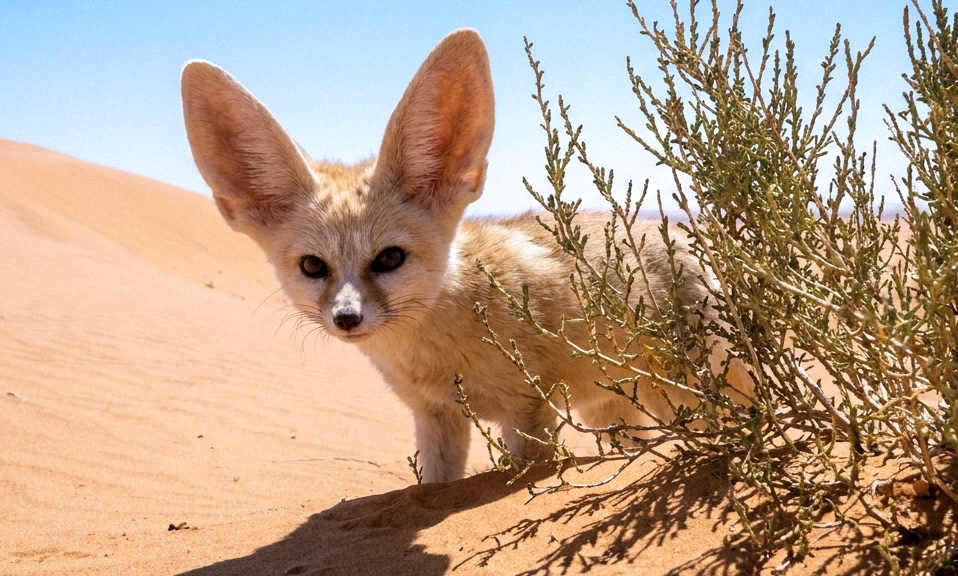
The fennec fox is the smallest canid in the world, and it survives the desert heat through a combination of behavioural and physical adaptations. It is nocturnal, spending the hottest part of the day in a cool burrow. Its most distinctive feature — enormous ears — are not just for hearing. They are packed with blood vessels and act as radiators, dissipating heat into the air. Its thick, sandy-coloured fur reflects sunlight and insulates against both heat and cold.
4. Kangaroo Rat
Habitat: North American deserts
The kangaroo rat is a master of water conservation. It never drinks water. Instead, it extracts moisture from the seeds it eats and metabolises it internally. It stays in its burrow during the day, plugging the entrance with soil to trap humidity. Its kidneys are incredibly efficient, producing urine that is up to five times more concentrated than human urine. It can survive its entire life without ever taking a drink.
5. Chuckwalla
Habitat: Southwestern United States and northern Mexico
This large desert lizard has an unusual survival strategy: it inflates its body when threatened, wedging itself into rock crevices so tightly that predators can’t pull it out. But its heat tolerance is equally impressive. The chuckwalla can withstand body temperatures of up to 42°C (108°F) — higher than most reptiles. It basks in the morning to warm up, then retreats to shade during the hottest hours. It can also tolerate dehydration better than most lizards.
6. Tardigrade
Habitat: Everywhere, from deserts to hot springs
Tardigrades — also known as water bears — are microscopic extremophiles that can survive conditions that would kill any other animal. When exposed to extreme heat, they enter a state called a “tun”, expelling almost all water from their bodies and producing a sugar called trehalose that protects their cells. In this state, they can survive temperatures of up to 150°C (302°F). They can also survive being frozen, irradiated, and even exposed to the vacuum of space. They are, quite literally, indestructible.
7. Desert Pupfish
Habitat: Hot springs in the southwestern United States and Mexico
The desert pupfish lives in some of the hottest aquatic environments on Earth. It can survive water temperatures of up to 45°C (113°F) — hotter than most fish can tolerate. It also endures extreme salinity, low oxygen levels, and rapid temperature fluctuations. Some populations live in pools that shrink to tiny, scalding puddles in summer. The pupfish’s ability to adapt to such hostile conditions has made it a subject of intense scientific study.
8. Ostrich
Habitat: African savanna and deserts
The ostrich is the world’s largest bird, and it thrives in some of the hottest places on Earth. It can tolerate ambient temperatures of up to 50°C (122°F). Its feathers provide insulation against the sun, and it can raise its body temperature by several degrees during the day to avoid sweating. When it does need to cool down, it pants — using rapid breathing to evaporate water from its mouth and throat. It can also go without drinking for days, extracting moisture from the plants it eats.
9. Thorny Devil
Habitat: Australian outback
The thorny devil is a small lizard covered in spikes, but its most remarkable adaptation is its water-collecting skin. The grooves between its spines form a network of microscopic channels that draw water — from dew, rain, or even damp sand — directly to its mouth. It can also change colour to reflect more sunlight when temperatures rise. It is active during the day, when surface temperatures can exceed 50°C, and it moves with a slow, deliberate gait that minimises heat absorption.
10. Addax
Habitat: Sahara Desert
The addax is a critically endangered antelope that has evolved to survive in the most arid parts of the Sahara. It can go months without drinking water, getting all the moisture it needs from the desert plants it eats. Its coat is highly reflective, bouncing sunlight away from its body. Its hooves are wide and splayed, allowing it to walk on sand without sinking. And like the camel, it can tolerate a significant rise in body temperature during the day, cooling down at night without losing water.
The Common Thread: Adaptation Is Everything
What do these animals have in common? They don’t fight the heat. They manage it.
Some avoid it entirely, emerging only at night or retreating to burrows. Some reflect it, using silver hairs or pale coats to bounce sunlight away. Some tolerate it, allowing their body temperatures to rise to levels that would kill other creatures. And some, like the tardigrade, simply shut down until conditions improve.
As climate change pushes global temperatures higher, understanding how these animals survive extreme heat is becoming more than an academic exercise. It’s a window into the limits of life — and a reminder that even in the most hostile environments, evolution finds a way.
The next time you complain about a heatwave, spare a thought for the Saharan silver ant, foraging in 70°C heat. It doesn’t complain. It just keeps moving.