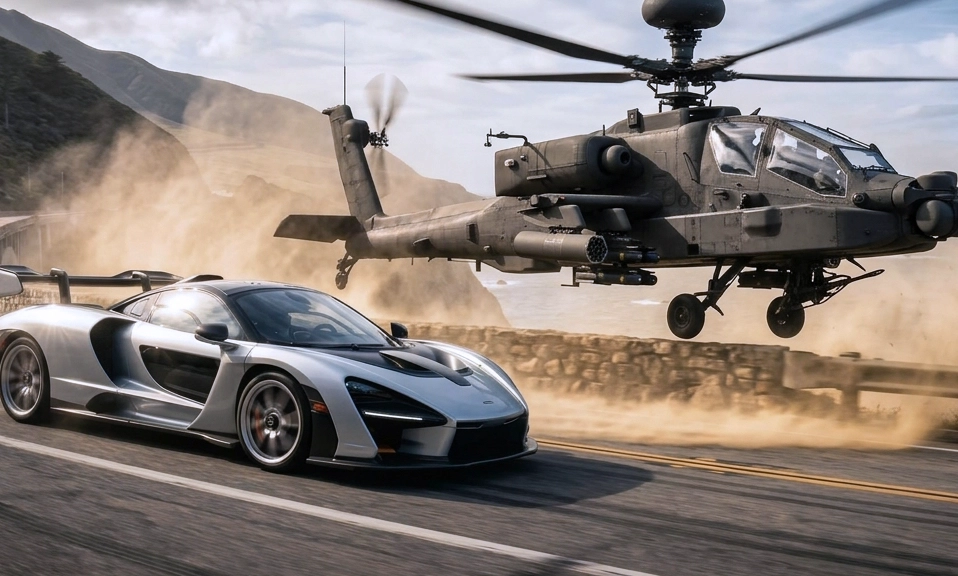
Picture this: You’re stuck in gridlock traffic, sweating in your car, when you hear the rhythmic thwack-thwack-thwack of rotor blades above. You look up and see a helicopter gliding effortlessly over the chaos, and you think, “Must be nice to fly.”
It’s a universal assumption: helicopters are the ultimate speed machines, effortlessly beating anything on the ground.
But what if we took that helicopter off the highway and put it on a long, straight stretch of asphalt against a modern car?
The answer might surprise you. Yes, many cars can absolutely overtake a helicopter. In fact, the fastest cars in the world are faster than almost every helicopter ever built.
Here is the fascinating, physics-defying breakdown of the ultimate ground-vs-air speed showdown.
🚁 The Helicopter’s Speed Limit: Why They Are Slower Than You Think
To understand the matchup, we first have to look at the helicopter’s top speed.
The average civilian helicopter (like a Robinson R44 or a Bell 206) has a cruising speed of about 130 to 150 mph (210 to 240 km/h). Their absolute top speed rarely exceeds 160 mph.
Why so “slow” for an aircraft? It comes down to a fundamental law of aerodynamics called retreating blade stall. A helicopter’s main rotor spins to create lift. As the helicopter moves forward, the rotor blade moving forward into the wind experiences a massive increase in airspeed, while the blade moving backward (retreating) experiences a decrease. If the helicopter flies too fast, the retreating blade loses lift entirely, causing the helicopter to violently roll over.
Even the most advanced, experimental helicopters in the world hit a wall. The current official world speed record for a helicopter is held by the Eurocopter (now Airbus) X3, which reached 293 mph (472 km/h) in 2013 using a unique compound design with forward-facing propellers. That is the absolute ceiling of rotorcraft physics.
🏎️ The Car’s Advantage: Defying Gravity with Horsepower
Now, let’s look at the cars.
You don’t even need a multi-million-dollar hypercar to beat an average helicopter. A standard, modern sports car like a Porsche 911 Carrera, a Chevrolet Corvette, or a Nissan GT-R has a top speed ranging from 180 to 200 mph (290 to 320 km/h).
On a long, straight highway or a racetrack, these everyday supercars would leave a standard police or news helicopter eating their dust (or rather, rotor wash).
But when we bring out the heavy artillery, the car wins by a landslide:
- Bugatti Chiron Super Sport 300+: Reached a verified 304.77 mph (490 km/h) in 2019.
- SSC Tuatara: Hit a verified 295 mph (475 km/h) in 2022.
- Koenigsegg Jesko Absolut: Theoretically capable of exceeding 330 mph (530 km/h).
These hypercars don’t just beat the average helicopter; they beat the fastest experimental helicopter in the world.
⚔️ The Showdown: How the Race Actually Plays Out
Let’s break down three realistic scenarios to see who really wins:
1. The Daily Commute (0 to 150 mph)
- Helicopter: Takes off vertically, bypasses all traffic, and cruises at 140 mph in a straight line to the destination.
- Car: Stuck at a red light, then limited by speed limits, traffic, and curves.
- Winner: The Helicopter. (Point-to-point travel is where aircraft shine).
2. The Top Speed Run (On a 10-mile straight track)
- Helicopter: Pushes its engines to the limit, fighting immense aerodynamic drag and retreating blade stall, maxing out around 160 mph (or 293 mph if it’s the record-breaking X3).
- Car: A Bugatti or Koenigsegg shifts through its gears, utilizing advanced active aerodynamics and 1,500+ horsepower to rocket past 300 mph.
- Winner: The Car. By a massive margin.
3. The Acceleration Test (0 to 60 mph)
- Helicopter: Takes a few seconds to spool up the rotors, lift off the ground, and begin moving forward.
- Car: A high-performance electric vehicle (like a Tesla Model S Plaid or Lucid Air Sapphire) or a hypercar can hit 60 mph in under 2.5 seconds.
- Winner: The Car. The instant torque of modern EVs and supercars leaves a helicopter’s gradual forward acceleration in the dust.
⚠️ The Catch: Context is Everything
Before you trade your driver’s license for a pilot’s license, remember the caveats.
A car can only overtake a helicopter under very specific conditions: a long, perfectly flat, straight piece of pavement with no obstacles.
The moment you introduce a mountain, a river, a forest, or a traffic jam, the helicopter’s ability to travel in a straight, three-dimensional line makes it infinitely faster in the real world. A car might have a higher top speed, but a helicopter has a higher average speed over complex terrain.
The idea that helicopters
are the undisputed kings of speed is a myth born from their ability to ignore roads. But when it comes to pure, unadulterated velocity, the laws of aerodynamics favor the low-slung, wind-cheating shape of a car over the drag-heavy, physics-limited design of a rotorcraft.
So, the next time you hear a helicopter buzzing overhead, you can smile and know the truth: if that pilot challenged you to a top-speed race on the Bonneville Salt Flats, your sports car (and certainly a hypercar) would leave them behind.
Would you rather have the 300+ mph top speed of a hypercar, or the traffic-dodging freedom of a helicopter? 🚁🏎️💨