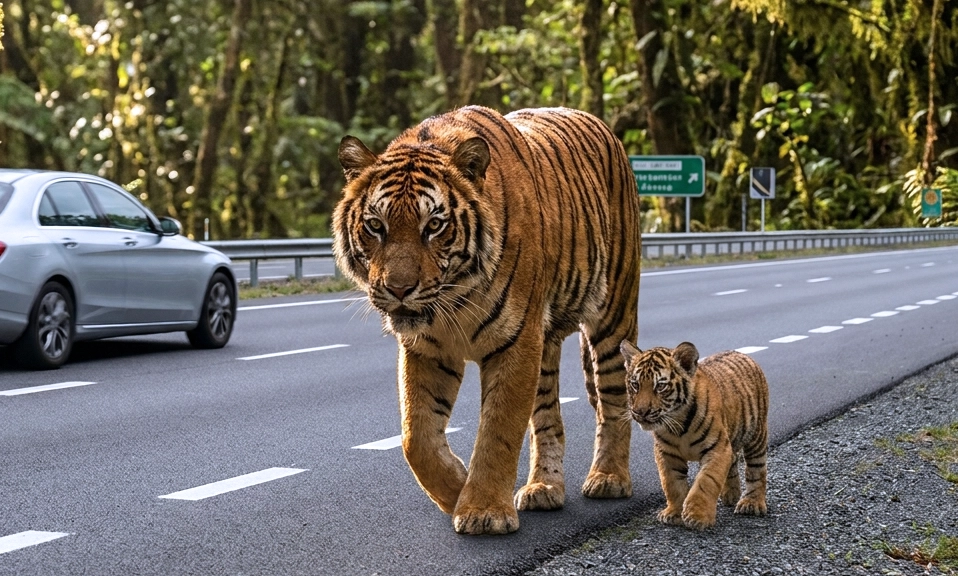
In 2010, there were only about 3,200 wild tigers left on the planet. Today, there are nearly 5,700 — an increase of more than 70% in just 15 years.
That number is more than a statistic. It is the first documented reversal of the tiger’s long-term decline — a species that had lost 93% of its historic range and was sliding toward extinction across most of Asia. The 2026 WWF Living Planet Report, released on October 8, confirmed what conservationists had been cautiously hoping for: tigers are coming back.
But the recovery is not uniform. It is concentrated in a handful of countries, driven by a specific set of interventions, and still fragile. Here is how it happened — and what it will take to keep the momentum going.
The Numbers: A 78% Increase in 15 Years
The global wild tiger population stood at approximately 3,200 in 2010. By 2025, that number had risen to 5,700, according to the WWF Living Planet Report. Some estimates place the figure slightly higher — between 5,574 and 5,711 — depending on methodology and survey timing.
The increase represents a 78% rise over 15 years, or roughly 5% annual growth. For a species that had been in freefall for decades, that is a remarkable turnaround.
But the global average hides a more complex picture. India alone is now home to nearly 70% of the world’s wild tigers, with an estimated 3,682 tigers across 58 reserves — up from around 1,400 in the early 2000s. Russia and China have also recorded significant recoveries, particularly for the Amur (Siberian) tiger. Thailand became the first country in Southeast Asia to increase its wild tiger population, rising from an estimated 148–189 tigers in 2022 to 210 in 2026.
Meanwhile, populations in parts of Southeast Asia — Malaysia, Indonesia, Cambodia, Laos, and Vietnam — continue to face severe pressure from habitat loss, poaching, and human-wildlife conflict.
What Actually Worked: The Four Pillars of Recovery
The tiger recovery was not accidental. It was the result of deliberate, sustained, and coordinated conservation work across multiple countries. The 2026 Living Planet Report identified four key drivers.
1. Protected Areas and Ecological Corridors
The most fundamental intervention was simply giving tigers space. Countries expanded and upgraded protected areas, established new tiger reserves, and created ecological corridors that allow tigers to move between fragmented habitats.
India increased its tiger reserves from 28 to 58 over the past decade, with a corresponding rise in tiger numbers. China established the Northeast China Tiger and Leopard National Park, spanning 14,100 square kilometers and now home to around 72 wild Siberian tigers. Kazakhstan released its first wild tiger in 70 years, reviving a role that had been absent since the 1940s.
2. Professional Ranger Forces and SMART Patrols
Protected areas are only as effective as the people guarding them. The recovery effort invested heavily in professional ranger workforces and technology-driven monitoring.
Thailand’s recovery, for example, was driven by significant investments in ranger strength, coupled with the widespread use of SMART patrols — a system that enables rangers to systematically monitor threats and collect field data. India deployed technology-driven monitoring, including camera traps, AI-powered stripe-pattern recognition, and satellite remote sensing, to track individual tigers and identify threats.
3. Data-Driven Anti-Poaching Enforcement
Poaching was the primary driver of the tiger’s decline. The recovery effort responded with intelligence-led enforcement — using data to predict and prevent poaching rather than simply reacting to it.
The use of AI-powered stripe-pattern recognition allows researchers to identify individual tigers and monitor populations with far greater accuracy than was previously possible. Combined with data-driven anti-poaching patrols, this approach has made it significantly harder for poachers to operate undetected.
4. Cross-Border Cooperation
Tigers do not respect national borders. The recovery of the Amur tiger, in particular, depended on cooperation between China and Russia, which share the tiger’s primary remaining habitat. In 2024, the two countries agreed to establish the “Land of Big Cats,” a transboundary conservation area linking about 18,000 square kilometers of tiger and leopard habitat.
The IUCN has also supported six cross-border initiatives across Bhutan, India, Indonesia, Malaysia, Nepal, and Thailand, combining habitat restoration, wildlife corridors, community participation, and conflict mitigation.
The Stories Behind the Statistics
Numbers tell one story. Individual tigers tell another.
In Thailand’s Western Forest Complex, a tigress named Mae Kaew has become a symbol of the country’s recovery. Since 2021, she has raised three litters — nine cubs in total. One of her daughters has now had cubs of her own, making Mae Kaew a grandmother. For a species that had been in retreat for decades, the sight of a tigress successfully raising multiple litters is a powerful sign that Thailand’s forests are becoming places where tigers can survive, breed, and thrive again.
In China, a wild Amur tiger known as the “Hero Tigress” gave birth to 13 cubs in four litters by 2025 — a vivid symbol of the species’ recovery in the Northeast China Tiger and Leopard National Park.
In India, the Buxa Tiger Reserve — where tigers had once become completely extinct — is now home to 53 tigers, following a phased reintroduction programme that began with the release of a three-year-old tigress in October 2026.
And in Indonesia, two Sumatran tiger cubs were born in Lampung Province in February 2026 — the first successful breeding of the species outside their natural habitat in the province, from parents that had both survived poachers’ snares.
The Challenges That Remain
The tiger recovery is real. But it is not complete. And it is not secure.
Habitat fragmentation remains the single greatest threat. Tigers need large, connected territories. As human development encroaches on forests, tiger populations become isolated, reducing genetic diversity and increasing the risk of local extinction. The next challenge, as the WWF report noted, is “reconnecting fragmented habitats and improving coexistence between people and wildlife”.
Human-wildlife conflict is rising. As tiger numbers grow, so do encounters with communities living near forests. Livestock predation and, in rare cases, attacks on humans create tension that can undermine local support for conservation. Thailand’s approach — working with communities, restoring prey populations, and building trust through education and engagement — offers a model for managing this tension.
Poaching has not been eliminated. Despite the progress, the illegal wildlife trade continues. The WWF has warned that wildlife crime and illegal trade remain largely unpunished, with trafficking increasingly moving online.
Southeast Asia is still a crisis zone. While India, Russia, China, and Thailand have seen recoveries, tiger populations in Malaysia, Indonesia, Cambodia, Laos, and Vietnam continue to decline. The global recovery is real, but it is not yet universal.
The Bigger Picture: Why Tigers Matter
The tiger is an apex predator and a flagship species — a symbol of wild nature that carries disproportionate cultural and ecological weight. But its recovery is not just about tigers.
Protecting tigers means protecting the entire ecosystems they depend on — the forests, the prey species, the watersheds that supply clean water to millions of people. As India’s Environment Minister Bhupender Yadav put it, tiger conservation means “protecting the entire ecosystem”.
The tiger’s recovery also proves something larger: biodiversity loss is not inevitable. The 2026 Living Planet Report is subtitled “The Science of Hope” for a reason. While monitored wildlife populations have declined by an average of 73% since 1970, nearly half of all monitored populations are actually stable or increasing. The tiger is the most prominent example of what sustained, coordinated, well-funded conservation can achieve.
What Comes Next
The Tx2 goal — set in 2010 at the Saint Petersburg Tiger Summit — aimed to double the global wild tiger population by 2022. That goal was not met. But the recovery that has happened — from 3,200 to 5,700 — is the first documented reversal of the species’ decline.
The next phase is harder. It requires moving from protecting isolated populations to reconnecting landscapes, from counting tigers to ensuring they have room to roam, and from managing conflict to building genuine coexistence.
“We are at a fork in the road,” said Tanya Steele, chief executive of WWF UK. “Either we continue paying the rising price of nature loss, or we invest in nature’s recovery and a future where people and wildlife can thrive together”.
The tiger’s comeback shows that the second path is possible. It does not show that it is guaranteed.
The tiger was once a symbol of what we were losing. Now it is becoming a symbol of what we can save. The numbers — 3,200 to 5,700 — are the proof.