Netflix is turning Cinderella’s so-called “evil” stepsisters into the leads of a new animated musical comedy. Titled STEPS, the film follows Lilith and Margot as they step out of Cinderella’s shadow, accidentally break the kingdom’s fairy tale and discover that a happily-ever-after may look very different from the story they were given.
STEPS premieres globally on Netflix on November 20, 2026. The film is directed by Alyce Tzue and John Ripa, with voices from Ali Wong, Stephanie Hsu, Amanda Seyfried, Nikki Glaser, Bette Midler, Daniel Radcliffe, Young Mazino and Peter Dinklage.
The project is being produced by Netflix Animation Studios and Amy Poehler’s Paper Kite Productions. It began as a more traditional revisionist Cinderella idea, but the finished film has expanded into a comic fantasy adventure about sisterhood, belonging, identity and the danger of judging people by the role a familiar story gives them.
What is STEPS about?
The film begins with a recognizable fairy-tale setup: a royal ball, a glass slipper and a magical deadline.
But STEPS shifts the focus away from Cinderella and toward her stepsisters. Lilith, voiced by Ali Wong, is tired of living in Cinderella’s shadow. She steals the Fairy Godmother’s magic wand and hijacks the Royal Ball with her sister, Margot, voiced by Stephanie Hsu.
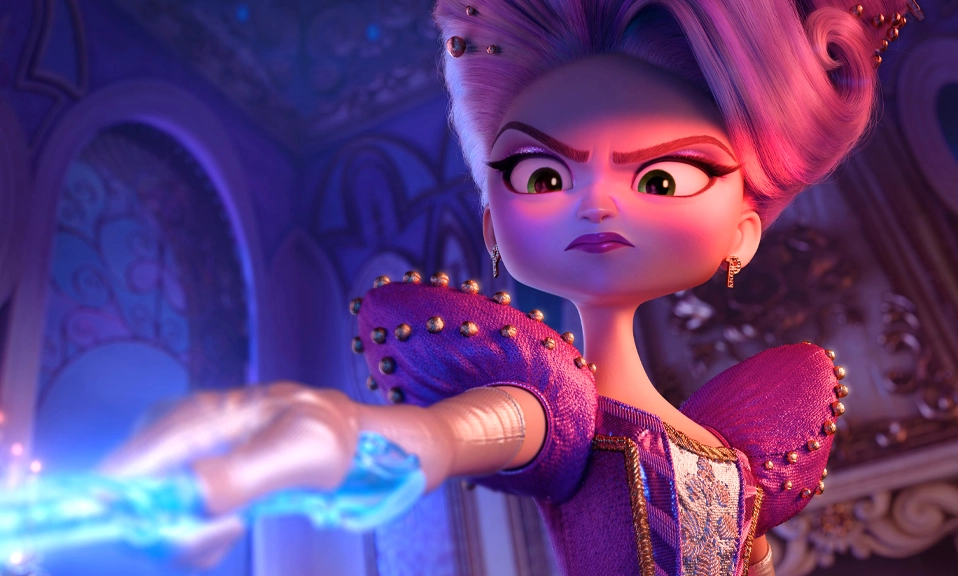
The plan goes wrong. Lilith accidentally turns Margot into a frog, while the kingdom falls under the control of Priscilla, a prince-obsessed schemer who takes the throne. Lilith must then team up with Cinderella to save the kingdom, repair the damaged fairy tale and restore her relationship with her sister.
The official synopsis promises biker trolls, evil henchmen and the Screaming Woods, suggesting that the film is structured as a quest rather than a simple domestic retelling.
At its center, however, is a family problem. Lilith and Margot are very different sisters, but the crisis forces Lilith to confront the consequences of her resentment and decide whether she wants attention or genuine connection.
The “evil” stepsisters get a new story
Traditional Cinderella versions usually define the stepsisters through cruelty, vanity or comic humiliation. They exist to make Cinderella’s goodness look brighter and her transformation more satisfying.
STEPS asks what happens when those supporting characters are allowed to speak for themselves.
Lilith is not presented as a villain who simply deserves punishment. She is misunderstood, frustrated and tired of being measured against Cinderella’s perfect image. Margot is not just a second antagonist either. She is Lilith’s sister, someone caught in the same family and royal system even though the two women respond to it differently.
That does not mean the film excuses Lilith’s choices. Stealing a magical wand and disrupting a royal ball has consequences. The point is that a bad decision does not necessarily define an entire person.
The story’s central idea is that people can be more complicated than the role assigned to them. The “evil” stepsister may have made selfish choices, but she may also be capable of loyalty, courage and change.
Ali Wong voices Lilith
Ali Wong voices Lilith, the sister who drives the story into chaos and then has to take responsibility for fixing it.
Wong’s comedy background makes her a natural fit for a character whose frustration can come out as sarcasm, defensiveness and impulsive action. Lilith is not waiting patiently for the fairy tale to reward her. She wants to interrupt it.
That makes her different from the usual Cinderella antagonist. The traditional stepsister wants the slipper, the prince or the social status attached to them. Lilith wants recognition. She wants the kingdom to acknowledge that she exists and that her life should not be treated as a failed version of Cinderella’s.
Her mistake is trying to force that recognition through magic. When the spell creates a larger crisis, she must learn that being seen is not the same as being loved or understood.
Stephanie Hsu voices Margot
Stephanie Hsu voices Margot, Lilith’s sister, who is accidentally transformed into a frog.
The transformation is more than a visual joke. It turns Margot into the most literal example of how the fairy tale reduces people to symbols. She is no longer even seen as a human princess or stepsister. She becomes a magical problem that Lilith must solve.
Margot’s relationship with Lilith is the emotional foundation of the film. The sisters do not simply need to reverse a spell. They need to understand why they have been competing and whether they can stop treating one another as rivals for a limited amount of love and attention.
Hsu’s casting brings a strong comic and dramatic voice to a character who could easily have been reduced to a sidekick. Margot is part of the story’s larger argument that every character deserves to be treated as a complete person rather than a function in someone else’s fairy tale.
Amanda Seyfried plays Cinderella
Amanda Seyfried voices Cinderella, but this is not a version of the character who simply waits for the story to resolve in her favor.
Netflix describes this Cinderella as a modern heroine with flaws and coping mechanisms. Director Alyce Tzue said the filmmakers wanted a character who would feel specific, relatable and human rather than an untouchable symbol of goodness.
That is important because the film is not trying to replace Cinderella with Lilith. It is trying to give both women more room to exist.
Cinderella is still the person who has been placed at the center of the familiar story, but she is also part of the family tension. Lilith’s resentment is connected to the way everyone compares the sisters. If Cinderella is always treated as the perfect one, the other sisters are left to compete for whatever attention remains.
The adventure requires Cinderella and Lilith to work together, which means Cinderella must also see Lilith as more than an obstacle to her own happy ending.
Bette Midler is the Fairy Godmother
Bette Midler voices the Fairy Godmother, whose magic wand becomes the object that sets the main plot in motion.
In a traditional Cinderella story, the Fairy Godmother is a benevolent guide who gives the heroine the tools to attend the ball. In STEPS, the wand is connected to a disruption of the royal order.
That shift creates room for the film to question fairy-tale magic itself. Does a magical object actually solve a person’s problems, or does it simply give them the power to create new ones? Does the Fairy Godmother understand the pressure placed on people who are expected to live happily ever after according to a fixed script?
Her presence keeps the film tied to the original myth while allowing the filmmakers to play with its rules.
The new prince and the supporting cast
Daniel Radcliffe voices the Prince. Director John Ripa said the filmmakers wanted a prince unlike the versions audiences have seen before, with a quirky and big-hearted sense of humor.
Young Mazino voices Gef, described as “The Heartthrob,” while Peter Dinklage voices Roderick, “The Muscle.” Ripa and Tzue have described Roderick as a murderous man-nanny who must balance menace with love.
Nikki Glaser voices Priscilla, the villainous schemer who takes advantage of the royal-ball chaos and seizes power.
The cast suggests that the film is not aiming for a solemn reconstruction of the fairy tale. The characters are designed to be comic, strange and emotionally specific. Even the figures who might normally be reduced to a single trait—the prince, the muscle, the fairy godmother or the villain—are being given enough personality to support the film’s central argument about three-dimensional characters.
A musical comedy with an unusual development history
STEPS was first announced as a Netflix animated musical comedy in 2021. The original development announcement named Amy Poehler’s Paper Kite Productions as a producer and identified Riki Lindhome and Kate Micucci as the writers and songwriters. The early premise followed two stepsisters who were overlooked by a prince and set off on an adventure to discover that their own versions of a perfect fairy tale might be different from what they expected.
The finished film has evolved since that announcement, with Ava Tramer, James Madejski, Jen Chuck, Dana Schwartz and Felicia Ho credited on the screenplay, and a story credited to Tramer, Madejski, Schwartz, Felicia Ho, Riki Lindhome and Kate Micucci.
That history helps explain why the project is positioned as a musical fantasy comedy rather than only a standard fairy-tale spoof. The story is built around songs, character arcs and a reworked set of familiar symbols.
The musical format also gives the film a way to express the difference between how the characters appear and how they feel. Fairy tales often present people through simple roles: princess, prince, stepsister, villain. A song can give those characters a voice that the original story never allowed them to use.
Alyce Tzue’s personal connection to the story
Alyce Tzue makes her major feature directing debut with STEPS. She previously won a Student Academy Award for her animated short Soar. John Ripa, who co-directs, was a co-director of Raya and the Last Dragon.
Tzue has described the film as personal because she grew up feeling like an outsider. She has spoken about being an awkward, artistic Taiwanese child in suburban New Jersey and about wanting to create a story for people who feel that happily ever after was not designed for them.
That perspective influences the way the film treats its characters. The story does not simply ask whether Lilith can become good enough to join the fairy tale. It asks whether the fairy tale itself can expand to include someone who does not fit its expected image.
The distinction matters. A conventional redemption story might tell the outsider to change until the kingdom accepts her. STEPS appears more interested in changing the way the kingdom sees her.
The film’s central theme is belonging
At first glance, STEPS is about magic, royal politics and a rescue mission. Underneath that adventure is a story about people who believe they have been left outside the group that matters.
Lilith is living in Cinderella’s shadow. Margot is caught in the consequences of Lilith’s rebellion. Cinderella is treated as the ideal that everyone else is expected to match. Even the villains and supporting characters are being designed as more than single-purpose figures.
The film’s message is not that everyone should receive the same fairy-tale ending. It is that a person should not have to become someone else in order to deserve a future.
That idea is especially relevant to children’s animation, where stories can quietly teach viewers who gets to be beautiful, kind, heroic or loved. By moving the stepsisters to the center, STEPS gives young audiences permission to question the roles assigned to them.
What makes the animation distinctive
Netflix Animation Studios is handling the film, with animation work produced at the studio’s Sydney and Vancouver locations.
The official images and teaser position the film as bright, energetic and deliberately unconventional. The world combines classic fairy-tale architecture with comic fantasy elements such as biker trolls, magical woods and a kingdom threatened by a ruler who has seized power through opportunism.
That mixture should allow the film to move between parody and genuine emotional stakes. The setting can be visually absurd while the sisters’ conflict remains recognizable.
The animation also has to sell a complicated tonal balance. The film includes slapstick, magical transformations and a comedic cast, but the story is about jealousy, belonging and the fear of being permanently defined by other people’s opinions.
The best version of that balance will let children enjoy the adventure while adults recognize the emotional problem underneath it.
Why the film could stand out in Netflix’s animation slate
Netflix has released a growing range of animated features for children, families and adults. STEPS arrives after the platform’s major animation successes and as part of a 2026 slate that includes films such as In Waves and Ray Gunn.
Its most obvious advantage is a clear hook. Audiences already know Cinderella, but they have not often seen the stepsisters treated as the emotional leads of a large animated adventure.
The voice cast adds another point of interest. Wong, Hsu, Seyfried, Midler, Glaser, Radcliffe and Dinklage bring recognizable comic and dramatic identities to characters who must still work as animated personalities rather than celebrity impressions.
The film will also have to avoid a common problem with revisionist fairy tales: replacing one simplistic moral with another. The stepsisters should not become perfect merely because the story is now told from their perspective. Lilith needs to make genuine mistakes, Margot needs her own agency and Cinderella needs to be more than the symbol being questioned.
The official premise suggests that the filmmakers understand that challenge. The kingdom needs to be saved, but the most important relationship to repair is between the sisters.
Release date and where to watch
STEPS premieres globally on Netflix on November 20, 2026.
Netflix has released an official teaser introducing Lilith, Margot, Cinderella and the film’s reworked fairy-tale world. The teaser presents the movie as a fresh take on Cinderella told partly from the perspective of one of the characters traditionally labeled “evil.”
The film is rated PG on Netflix’s listing, positioning it as a family title with broad appeal.
Why STEPS is more than a Cinderella parody
The official hook is easy to summarize: Cinderella’s stepsister steals a magic wand, turns her sister into a frog and must save the kingdom.
But the reason the film may connect with viewers is more specific. It is about what happens when someone who feels overlooked tries to force the world to notice her—and accidentally hurts the person closest to her.
Lilith does not need another version of Cinderella’s life. She needs to understand that her own story can exist without defeating her sister. Margot does not need to remain the victim of a magical accident. Cinderella does not need to remain trapped as the perfect heroine. The kingdom does not need to keep using the same script.
That is the promise of STEPS: not a story in which the “evil” stepsisters secretly become conventional heroes, but a story in which the fairy tale becomes large enough to include the people it used to dismiss.
When the film arrives on Netflix, audiences will find a musical fantasy filled with trolls, magic, royal danger and comic chaos. Beneath all of that is a simple question with wide appeal:
What if happily ever after begins when you stop trying to fit into someone else’s story?