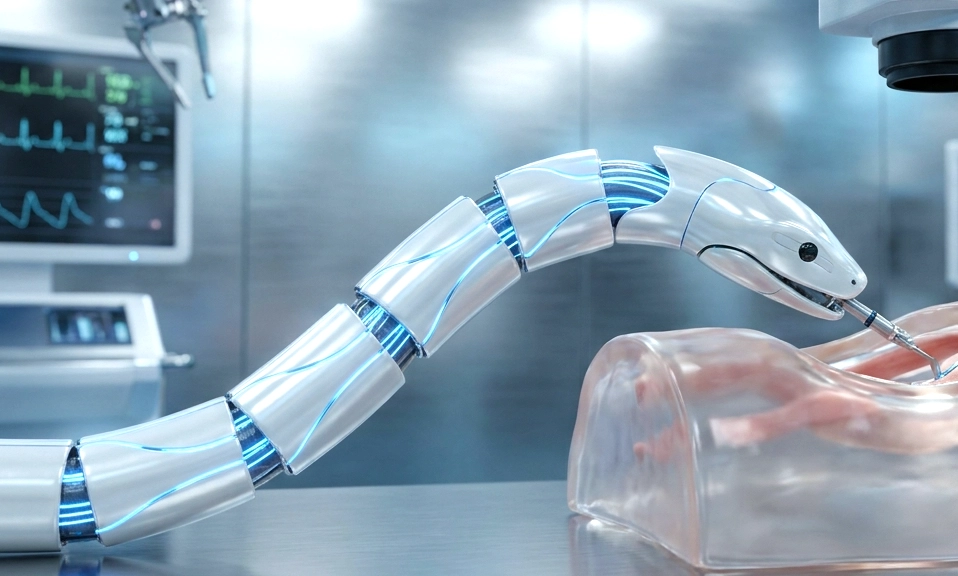
For decades, the “robot snake” has been a staple of science fiction and robotics labs alike.
Early versions were fascinating but fundamentally limited. They were essentially stiff, segmented tubes that moved via rigid, pre-programmed wave patterns. If they encountered an unexpected obstacle—a loose rock, a sharp turn, or a slippery surface—they would often get stuck, requiring a human operator to manually guide them out of the jam.
But recently, a quiet revolution has taken place in the world of biomimetic robotics. By integrating advanced Artificial Intelligence, specifically machine learning and reinforcement learning, snake-like robots are no longer just blindly following code.
They are learning, adapting, and “thinking” on the fly.
Here is a look at how AI-powered movement is transforming snake robots from clumsy mechanical novelties into highly intelligent, autonomous machines, and why this matters for the future of technology.
🧠 1. The Brain Upgrade: From Pre-Programmed to Reinforcement Learning
The biggest leap in snake robot technology isn’t in their motors or materials; it’s in their “brains.”
Traditionally, engineers had to manually code every single movement pattern (called “gaits”) for a specific terrain. If the terrain changed, the code had to be rewritten.
Today, researchers use Reinforcement Learning (RL). Instead of programming the exact movements, engineers give the AI a goal (e.g., “move forward over this rubble”) and a reward system. The AI then practices millions of times in a hyper-realistic virtual simulation, trying different body contortions, failing, and adjusting until it finds the most efficient way to move.
Through a process called “Sim-to-Real” transfer, this virtual intelligence is then downloaded into the physical robot. The result? A robot that doesn’t just execute a command; it figures out how to execute it based on the environment.
🐍 2. Proprioception: The Robot “Feel”
One of the hardest things to replicate in robotics is proprioception—the body’s ability to sense its own position and movement in space without looking.
Modern AI-powered snake robots are equipped with a network of internal sensors (IMUs, joint encoders, and even soft tactile sensors along their “skin”). The AI processes this sensory data in real-time. If the robot’s midsection gets wedged in a narrow pipe, the AI instantly feels the resistance, calculates the friction, and autonomously alters its gait—perhaps switching from a smooth slither to a sidewinding motion—to free itself. It’s a level of physical intuition that was impossible just a few years ago.
🌍 3. Real-World Superpowers: Where Smart Snake Robots Shine
This newfound intelligence isn’t just a lab trick. It’s unlocking life-saving and industry-changing applications:
- Search and Rescue: In the aftermath of an earthquake or building collapse, the terrain is chaotic, unstable, and full of tight gaps. AI snake robots can autonomously navigate through shifting rubble, using computer vision and tactile feedback to find survivors, map the debris, and relay information back to human rescuers—all without getting hopelessly tangled.
- Minimally Invasive Surgery: In the medical field, “continuum robots” (the medical term for snake-like robots) are being used for endoscopic procedures. AI allows these tiny, flexible robots to navigate the complex, twisting, and delicate pathways of the human body (like the colon or blood vessels) with a level of precision and autonomy that reduces the risk of human error and tissue damage.
- Extreme Infrastructure Inspection: From inspecting the inside of jet engines to crawling through miles of underground oil pipelines or radioactive environments in nuclear facilities, AI snake robots can now autonomously identify cracks, corrosion, or blockages, adapting their movement to vertical climbs or slippery surfaces without human intervention.
🧗 4. Adaptive Locomotion: Mastering the “Gait”
A real snake doesn’t move the same way on sand as it does on a tree branch or in water. AI has allowed robotic snakes to achieve this same versatility.
Researchers have trained AI models to recognize the terrain and seamlessly switch gaits:
- Serpentine motion for flat, open ground.
- Sidewinding for loose sand or slippery slopes.
- Concertina motion (bunching up and extending) for climbing vertical poles or navigating tight, confined tubes. The AI makes these transitions fluidly, in real-time, making the robot incredibly robust in unpredictable environments.
⚠️ The Challenges Ahead
Despite the massive progress, hurdles remain.
- Power and Compute: Running complex AI models and powering dozens of tiny motors requires a lot of energy. Battery life remains a bottleneck for long-duration missions.
- The “Uncanny Valley” of Movement: As these robots become more fluid and lifelike, they can trigger a natural, instinctual unease in humans. Designing them to be helpful rather than horrifying is a unique psychological challenge for engineers.
- Hardware Durability: While the AI is smart, the physical joints and motors are still vulnerable to extreme wear and tear, dust, and water.
Nature’s Blueprint, Upgraded by AI
The evolution of the snake robot is a perfect example of why the future of robotics isn’t about replacing nature, but learning from it—and then giving it a computational upgrade.
By combining the millions of years of evolutionary perfection found in biological snakes with the rapid, adaptive learning capabilities of Artificial Intelligence, we are creating machines that can go where humans, wheeled robots, and drones simply cannot.
They are no longer just mechanical toys. They are intelligent, adaptable, and ready to slither into the most dangerous, complex, and delicate spaces on Earth to do the jobs we can’t.