It was hiding in plain sight. A tiny, spotted cat living in a wildlife sanctuary in Bolivia has just been confirmed as an entirely new species — the first new wild cat named by science in over a century.
The last time scientists formally described a new living wild cat species, Calvin Coolidge was in the White House and the first Model T was rolling off the assembly line. That was 1923, when the Uruguayan pampas cat was identified. Now, after more than 100 years, that drought has finally ended.
Researchers have confirmed the existence of Leopardus tilcayo — the Bolivian Tilcayo — a diminutive feline that inhabits Bolivia’s Yungas cloud forest, a mountainous region where forests are shrouded in clouds and humidity hangs heavy in the air. The discovery, published Thursday in the journal Current Biology, marks the first time scientists have named and described a new living wild cat species since 1923.
A Cat Smaller Than Your House Cat
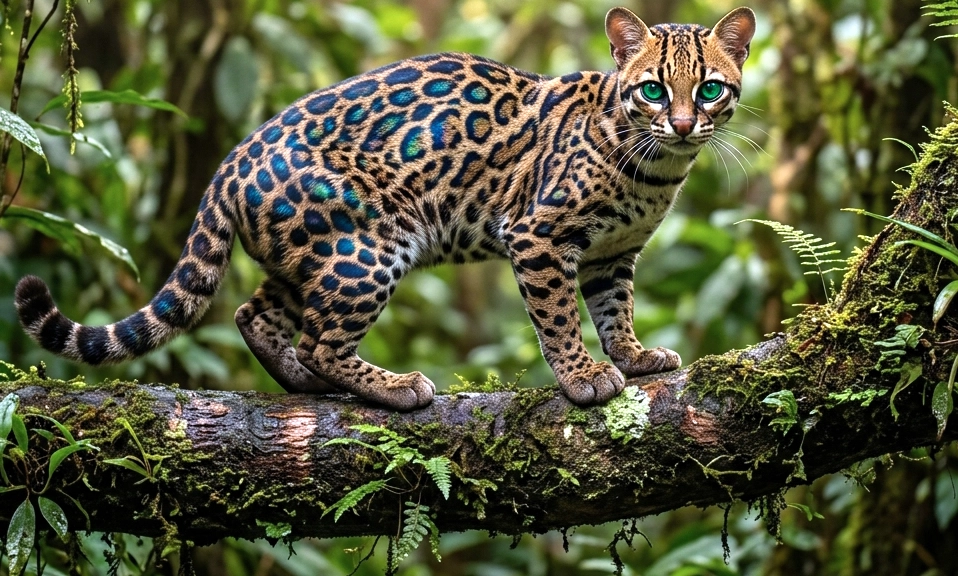
The Tilcayo is not a large predator. It’s not even an average-sized one. It measures about 18 inches (46 cm) from head to the base of its tail and weighs roughly 3 pounds (1.4 kg), making it smaller than the average domestic cat.
Its fur is light brown, patterned with irregularly shaped rosettes across its body — a coat that resembles a miniature leopard. “Knowing other wild cats, it was peculiar,” said Paola Nogales-Ascarrunz, a National Geographic Explorer and one of the study’s lead authors. “He really is tiny”.
The cat is part of a group called tiger cats, small spotted felines found across much of South America. Tiger cats are what biologists call a “cryptic species” — they look so similar to one another that they can’t be reliably distinguished by appearance alone. For decades, scientists assumed they were all the same species. Genetic studies hinted otherwise, but the evidence remained incomplete.
How They Found It
The breakthrough came not from a remote expedition, but from a wildlife sanctuary a couple of hours’ drive from La Paz.
A local family had found the cat in the forest and tried to keep it as a pet before eventually leaving it at the Senda Verde Wildlife Sanctuary. A colleague who thought the cat looked unusual invited Nogales-Ascarrunz to examine it. What struck her was its size — and its coat, which didn’t quite match the descriptions she knew from Brazilian tiger cats.
“This made us wonder: what tiger cat do we actually have in Bolivia?” she said.
To answer that question, the team analyzed DNA from 38 cats sampled across several South American countries, including eight museum specimens that filled gaps where fresh samples were unavailable. They compared genomes from cats in Colombia, Peru, and Brazil, using bones and skins preserved in U.S. and European museums to reconstruct the broader genetic picture.
The results were unambiguous. The sanctuary cat belonged to a previously unrecognized species whose lineage split from its closest relatives about 1.4 million years ago. That kind of genetic separation, researchers say, is generally considered a species-level divide in cats.
“We never expected this Bolivian tiger cat to be a separate species, and no one had ever proposed it as a different animal, subspecies or otherwise,” said Jonas Lescroart, an evolutionary biologist at the University of Antwerp and co-lead author of the study.
One Discovery, Five Species
The Tilcayo isn’t the only surprise to come out of the research. The DNA analysis revealed that South America’s tiger cats are actually five genetically distinct species, not the two or three previously recognized.
Alongside the four previously named species, the team also described a new tiger cat subspecies in Peru’s Yungas region, naming it Leopardus tigrinus antisuyo after Antisuyu, the region of the old Inca Empire that included the area it inhabits.
“Even in groups that are very well studied, like the cat family, apparently there’s still a diversity that is hidden,” Lescroart said.
A Name From the Community
While some species are named after scientists or explorers, the researchers chose to honor the people who already knew this cat existed. They named it Leopardus tilcayo, preserving the local name used by communities in the Bolivian cloud forests where the animal lives.
“This isn’t an animal that nobody had ever seen before. Local communities knew it existed, but until now science had not recognized it as a separate species,” said Wai-Ming Wong, an expert with the global wild cat conservation group Panthera, who was not involved in the research.
The last formally identified feline species, the Uruguayan pampas cat, was named in 1923. As Nogales-Ascarrunz noted, “During naturalist expeditions in the 17th, 18th and 19th centuries, this cat was never collected and the species was never properly described”.
What We Still Don’t Know
The discovery comes with a significant caveat: we know almost nothing about the Tilcayo’s life in the wild.
“Our information at this moment is limited to the two live individuals that we examined, and a small number of camera-trap records,” Lescroart said. One of those individuals is the 10-year-old male at Senda Verde, originally taken in by a local family.
What researchers can infer is fragmentary. Remains of small rodents in scat samples suggest they form part of the cat’s diet. Camera-trap evidence indicates it may be more active at night. Its presence has been confirmed only in Bolivia’s Yungas forests, but its full range remains unknown.
“We still don’t know how many there are,” Nogales-Ascarrunz said.
Why This Matters for Conservation
The Tilcayo’s discovery has immediate implications for how we protect it.
The International Union for Conservation of Nature (IUCN) currently treats tiger cats as two “vulnerable” species with declining populations. The researchers have shared their findings with the IUCN, whose upcoming review will assess the five newly recognized lineages separately. That could give a more accurate picture of risk — and species like the Tilcayo could potentially be considered endangered when assessed on their own.
The Yungas cloud forest, where the Tilcayo lives, is itself under threat. It’s a region of high humidity and mountainous terrain that faces pressure from deforestation and habitat loss. A species with an unknown population size, a limited confirmed range, and a habitat under pressure is a species that needs attention — and quickly.
The Tilcayo’s story
is a reminder that discovery doesn’t always happen in remote, unexplored wilderness. Sometimes it happens in a wildlife sanctuary, a few hours from a capital city, where a cat that doesn’t quite look like the others has been living quietly for years.
It’s also a reminder that “well-studied” doesn’t mean “fully understood.” The cat family is one of the most intensively researched groups of mammals on Earth. And yet, hidden within the tiger cats — a group scientists thought they had figured out — was an entirely new species, separated from its relatives by more than a million years of evolution.
Local communities knew the Tilcayo existed. They had a name for it. What they didn’t have was scientific recognition. Now they do.
The next challenge is making sure that recognition translates into protection — before the tiny cat of Bolivia’s cloud forests becomes a footnote in a natural history museum, rather than a living part of the forest it has called home for over a million years.