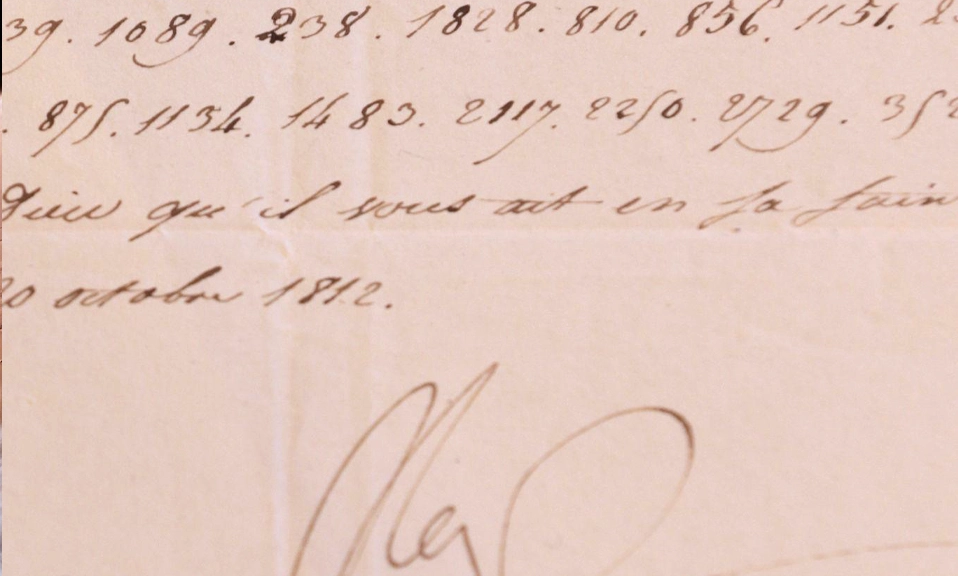
For more than two centuries, a coded military message ordered by Napoleon Bonaparte sat in archives, its 1,300 symbols an unbroken wall of numbers, letters, and invented signs. The key was lost. The code was unsolvable. Then, in October 2026, an AI engineer with no background in cryptography cracked it in six hours — and revealed a military briefing that foretold the outcome of a war.
The Letter That Defied Every Codebreaker
The document dates to March 1809. Napoleon’s empire was on the brink of war with Austria, and the Emperor needed to coordinate his forces across a sprawling theatre of operations. From his headquarters, he instructed his stepson, Eugène de Beauharnais, the Viceroy of Italy, to send a detailed report to General Auguste de Marmont, who was stationed with French troops in Dalmatia — territory that corresponds to parts of modern-day Croatia.
The message was to be sent “in cypher” by a reliable officer, a standard precaution for military communications of the era. The surviving document begins with a single line of ordinary French before switching to a dense block of encrypted text. Over 24 lines, it contains roughly 1,300 cipher units made up of numbers, letters, and hand-drawn symbols.
The code was a homophonic substitution cipher — the most sophisticated form of its kind. In a simple substitution cipher, each letter of the alphabet is replaced by a single symbol. A homophonic cipher is far more complex: frequently used letters are represented by multiple interchangeable symbols, which defeats the traditional frequency analysis that codebreakers rely on. The document contained approximately 155 distinct signs, making it effectively unbreakable without the original key.
That key was lost. For 217 years, the letter sat in the “unsolved” list of historical ciphers, a tantalizing puzzle that no cryptographer could crack.
The Breakthrough: Six Hours, One AI, and a Forgotten Table
The man who finally cracked it was Carter Church, an AI engineer at the cybersecurity firm SentinelOne. Church had never attempted to break a historical cipher before. He was inspired by a colleague who had used OpenAI’s GPT-6 Astra model to decipher a 1941 German Enigma message in about ten hours.
Church fed GPT-6 Astra a low-resolution scan of the letter — the same image that had been published in a French military-history journal in 1969 and had defeated human cryptographers for decades. He gave the AI one prompt and let it work.
The model’s first task was simply to transcribe the image — to identify and digitize the 155 hand-drawn symbols, many of which were similar enough to be mistaken for each other. It then began searching for clues that could connect the document to earlier cryptographic research.
That search proved decisive. Astra located a partial cipher table compiled by cryptology historian Daniel Tant, which documented the meanings of 33 symbols used in other exchanges between Eugène and Marmont. Tant had catalogued the table under the heading “Code entre Eugène de Beauharnais et le Général Grammont” — possibly a naming error, since “Grammont” and “Marmont” are easily confused.
The table had never been connected to this particular document. Astra recognized the connection, applied the partial key, and used a combination of historical information, language patterns, and computational trial and error — including a technique called simulated annealing — to work through the remaining symbols.
The entire process took roughly six hours of model execution. Church worked on the project over several evenings, giving the AI access to the historical image, existing cryptographic research, and other contextual material.
What Was Napoleon Hiding?
The decoded message was, in essence, a military briefing — a snapshot of the strategic situation on the eve of one of Napoleon’s most consequential campaigns.
The letter laid out the positions and strength of French and allied forces across the theatre of operations. It contained specific intelligence about Russian troops moving against Austria. And it included a crucial detail about the Army of Friuli, which numbered approximately 80,000 men.
But the most striking passage was the instruction to Marmont himself.
The Emperor told his general not to be intimidated by opposing forces when the order to march arrived. He reassured Marmont that Austria would be attacked from all sides and was therefore moving troops away from Dalmatia, where Marmont was stationed. The message was intended to steady a commander who was operating in isolation and might otherwise hesitate when the moment came.
History vindicated Napoleon’s assessment. Marmont successfully broke out and went on to play a key role in the Battle of Wagram, where Napoleon defeated the Austrians in July 1809. The letter’s intelligence — the troop positions, the Russian movements, the reassurance about Austria’s strategy — had been accurate.
In one passage, the decoded text reads: “The Russians are marching against Austria, and the Army of Friuli today numbers 80,000 men”.
Why This Matters Beyond the Code
The decryption is a historical event in its own right. It fills a gap in the documentary record of the 1809 campaign and confirms that Napoleon’s intelligence network was functioning effectively in the weeks before Wagram.
But the story of how it was cracked is equally significant.
Carter Church had no formal training in cryptography. He used a general-purpose AI model, gave it a single prompt, and let it solve a problem that had defeated specialists for two centuries. The AI did not just transcribe symbols. It searched for connections — linking a forgotten academic table to an unsolved document, recognizing patterns that humans had missed, and testing thousands of possible combinations until the text resolved into coherent French.
This is a new kind of capability. And it raises uncomfortable questions.
As researchers have noted, the same AI skills that can decrypt a 200-year-old military letter can also be used to de-anonymize people online — by comparing writing styles and stylistic markers to identify real individuals behind anonymous accounts.
Napoleon’s secrets are safe. They just took two centuries and an AI to reveal. What other secrets — historical, personal, or otherwise — might be next?