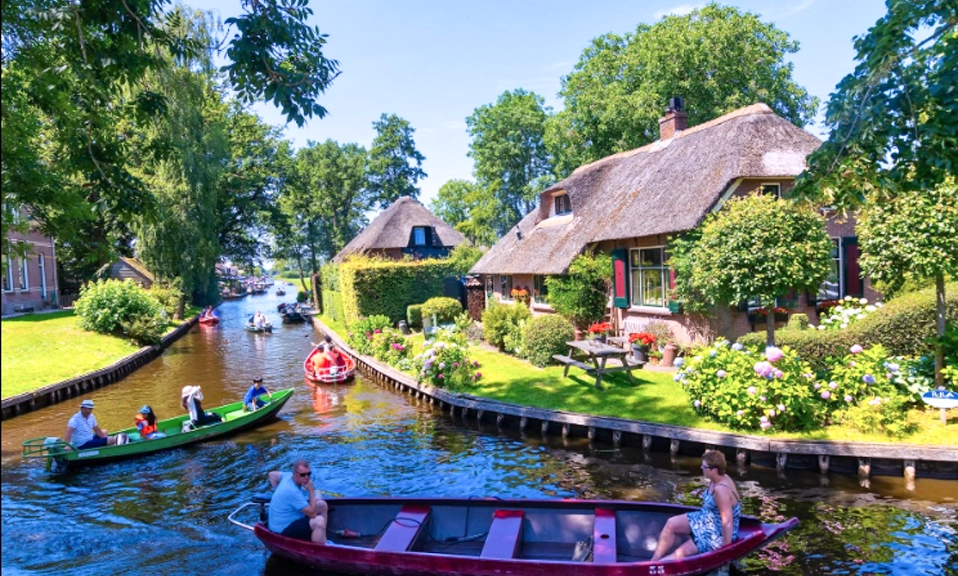
Imagine waking up in the morning and hearing a boat engine instead of a car.
You step outside your house, but there is no road. No traffic jam.
No motorcycles racing past. No buses. Instead, there is a canal. Your neighbor doesn’t drive to work. They take a boat.
Your children don’t walk along a normal street to school. They may travel by water. And when you need groceries, visit a friend, or even go to a restaurant, the route may involve navigating through water.
It sounds like something from a movie. But there are places around the world where waterways function as the streets.
And one of the most famous examples is Giethoorn, a small village in the Netherlands that became internationally known for its canals, bridges and almost complete absence of traditional roads through its historic center.
Welcome to Giethoorn
Giethoorn is located in the Dutch province of Overijssel, within the municipality of Steenwijkerland. Its historic village center is famous for narrow canals lined with houses, gardens and small bridges. Instead of streets dominating the landscape, water does. That is why Giethoorn is often described online as the “Venice of the Netherlands.” But there is an important difference.Giethoorn isn’t simply a city built around canals for tourists. Its waterways developed as part of the settlement’s history and everyday life.
Why Does a Town Need Roads When It Has Water?
The answer goes back centuries. Giethoorn developed in a wet, low-lying landscape where peat extraction played an important role. Digging peat created waterways and ponds. Over time, these waterways became part of how people moved around the settlement. Instead of building a conventional road network through the wetlands, residents developed a landscape where canals, footpaths and bridges became essential forms of transportation. The result is extraordinary. Homes sit beside water. Small bridges connect properties. Boats move through canals that look almost like streets. And from above, the settlement looks less like a conventional European village and more like a network of waterways.
There Are Roads—Just Not Where You Expect Them
This is where the viral description “the town with no roads” needs a little clarification. Giethoorn isn’t literally a place with zero roads. There are roads around and through parts of the wider settlement. Cars can reach the village. People can also travel by bicycle and on foot. But in the historic canal-centered area, traditional roads are largely absent. That’s what makes the place so fascinating. The central question isn’t really: “How can a town have absolutely no roads?”
It’s: “How did people build a functioning community where waterways became more important than roads?” And that’s much more interesting.
Imagine Going to Work Here
Picture your morning commute. In most cities: Car keys. Traffic. Fuel. Horn. Traffic lights. Giethoorn can offer something completely different. You walk toward the canal. A small boat is waiting. You start the engine—or use an electric boat—and quietly move through the water. Instead of seeing traffic lights, you see gardens. Instead of concrete intersections, you see bridges. Instead of apartment blocks, you see traditional houses beside canals. The journey itself becomes part of the experience.
The Boats Aren’t Just for Tourists
Tourists understandably love the boats.
But the waterways aren’t simply a theme park attraction.
Boats have historically been part of everyday transportation in Giethoorn.
Today, however, the village has also adapted to modern transportation.
Residents can use bicycles, walk, drive on roads outside the most famous canal areas and use boats for navigating the waterways.
And because tourism is such an important part of the local economy, visitors can rent boats and explore the canals themselves.
The Bridges Are Part of the Magic
One of the first things visitors notice isn’t actually the boats. It’s the bridges. Hundreds of small wooden bridges connect homes and paths across the canals. Some look so small and picturesque that they seem designed specifically for postcards. And that’s part of why photographs of Giethoorn spread so widely online. You can stand beside a canal and see:
Water → bridge → traditional house → garden → another bridge → another canal.
There is almost no visual clutter. No giant highway. No rows of traffic. No massive intersections. Just water and architecture.
Why Are the Houses So Beautiful?
Many traditional homes in Giethoorn have steep roofs and distinctive Dutch architecture. A number of older properties are associated with the region’s traditional farmhouses. Their gardens often extend directly toward the water.
This creates another unusual feature: the canal becomes part of the property’s front yard. In a normal city, you might have: House → driveway → road. Here, you can have:
House → garden → canal.
And sometimes:
House → bridge → footpath. That completely changes how the settlement feels.
It Isn’t Just a Pretty Tourist Village
It would be easy to look at photographs of Giethoorn and think: “This is basically a giant tourist attraction.” But people actually live here. Families have homes. Businesses operate. There are restaurants and accommodation facilities. People maintain gardens and properties. Children grow up in the community. The difference is that the physical environment has developed around water rather than conventional urban roads.
What Happens When You Need an Ambulance?
This is one of the questions people immediately ask. “Okay, boats are fine for tourists. But what about emergencies?” Modern emergency services don’t simply disappear because a neighborhood has canals. Emergency vehicles can access areas connected to the road network, while other locations can be reached through appropriate paths and waterways depending on circumstances. The existence of canals doesn’t mean the community is isolated from the modern world. It’s a modern settlement built around an unusual historic landscape.
What About Deliveries?
This is another fascinating part of living in a canal village. Modern life requires deliveries. Packages. Groceries. Construction materials. Mail. Businesses need supplies. The community therefore combines traditional waterways with modern road access and other forms of transportation. In other words, Giethoorn didn’t stop developing when automobiles arrived. It adapted.
The Biggest Problem: Too Many Visitors
The same thing that made Giethoorn famous created a new problem. Tourism.
Pictures of the village spread across social media and travel websites. Suddenly, millions of people around the world discovered this tiny Dutch community. Tourists wanted to experience the canals. They wanted photographs. They wanted to rent boats. And during busy periods, the peaceful waterways can become surprisingly crowded. Imagine expecting a quiet boat ride through a peaceful village and instead encountering dozens of tourist boats.The popularity that protects the village economically can also put pressure on it.
Is It Really the “Venice of the Netherlands”?
The nickname is catchy. But Giethoorn has its own identity. Venice is a major historic city with an enormous urban and cultural history. Giethoorn is a much smaller village whose waterways are deeply connected to its landscape and agricultural past. So calling it the “Venice of the Netherlands” helps people understand the visual idea. But Giethoorn is not simply a smaller Venice. It’s something different.