If you’ve spent more than five minutes scrolling through YouTube or TikTok, you’ve seen the promises: “How I made $10,000 in my first month working from my laptop!”
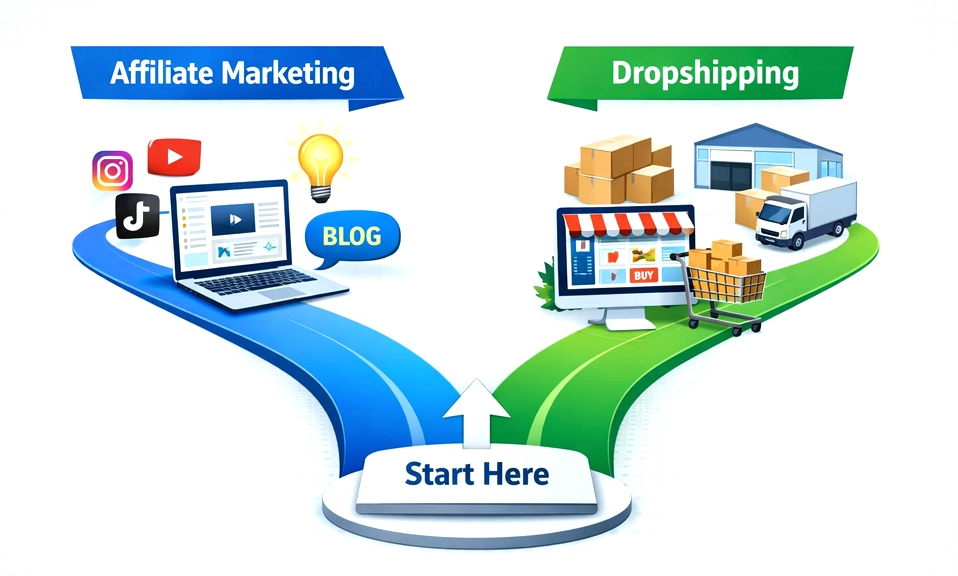
Behind almost all of those claims are two of the most popular online business models in the world: Affiliate Marketing and Dropshipping.
Both allow you to make money online without holding a traditional 9-to-5 job. Both promise location independence. And both are frequently oversold by “gurus” as effortless get-rich-quick schemes.
The truth? Neither is easy, but both are highly legitimate and profitable if executed correctly. The catch is that they require completely different skill sets, budgets, and daily routines.
So, which one is actually better for you? Let’s break down the mechanics, the pros and cons, and the harsh realities of both models so you can choose the right path for your goals.
🤝 1. Affiliate Marketing: The “Digital Matchmaker”
What it is: You promote other companies’ products or services using a unique tracking link. When someone clicks your link and makes a purchase, you earn a commission. You don’t own the product, you don’t handle shipping, and you don’t deal with customer service.
The Analogy: You are a real estate agent. You don’t build the house, you don’t own the house, and you don’t fix the plumbing. You simply connect the buyer to the seller and take a cut of the sale for making the introduction.
The Pros:
- Extremely Low Startup Cost: You can start for free using social media, a blog, or a YouTube channel. No inventory, no website hosting (initially), no product creation.
- Zero Customer Service: Once the customer clicks your link and buys, your job is done. Returns, refunds, and angry emails are the merchant’s problem, not yours.
- True Passive Income Potential: A well-ranking blog post or a viral YouTube video can generate affiliate commissions for years with minimal ongoing maintenance.
- High-Ticket & Recurring Commissions: Promoting software (SaaS) can yield 20–40% recurring monthly commissions for as long as the customer stays subscribed.
The Cons:
- Lower Profit Margins: You only get a slice of the pie (typically 5% to 50%, depending on the product). You don’t control the pricing.
- Zero Control: If the company changes its commission structure, discontinues the product, or bans your account, your income stream can vanish overnight.
- Heavy Reliance on Traffic: You are entirely dependent on your ability to drive eyeballs to your links. Without an audience or ad budget, you make $0.
📦 2. Dropshipping: The “Virtual Storefront”
What it is: You set up an online store (usually on Shopify) and list products for sale. When a customer buys from you, you forward the order to a third-party supplier (often overseas, like on AliExpress or via a private agent). The supplier packages and ships the product directly to the customer. You keep the difference between the retail price and the wholesale cost.
The Analogy: You are a traditional retail store manager, but you don’t have a warehouse. You just take the orders and pass them to the factory, acting as the middleman who handles the branding and marketing.
The Pros:
- Higher Profit Margins: You set the retail price. If a product costs you $10 to source and ship, you can sell it for $30, $40, or $50, keeping the bulk of the profit.
- You Build a Real Asset: You are building your own brand, your own email list, and your own customer base. This business can eventually be sold for a multiple of its revenue.
- Total Control: You control the website design, the pricing, the marketing angles, and the overall customer experience.
The Cons:
- Customer Service Nightmares: You are the face of the business. If the product is late, broken, or not as described, the customer blames you. You have to handle refunds, chargebacks, and angry emails.
- Higher Upfront Costs: While you don’t buy inventory upfront, you do need money for a website, apps, and most importantly, paid advertising (Meta, TikTok, Google) to test products.
- Supply Chain Vulnerabilities: You are at the mercy of your supplier. If they run out of stock, raise prices, or ship late, your business suffers, and your ad spend goes to waste.
⚔️ Head-to-Head Breakdown
Feature | Affiliate Marketing | Dropshipping |
|---|---|---|
Startup Cost | Very Low ($0 – $100) | Moderate ($500 – $2,000+ for testing ads) |
Risk Level | Low (You only risk your time) | Medium/High (You risk ad spend and store costs) |
Profit Margins | Lower (Commission-based) | Higher (You set the retail markup) |
Daily Grind | Content creation, SEO, audience building | Product research, ad management, customer service |
Customer Service | None (Handled by the merchant) | High (You handle all inquiries and refunds) |
Time to First $ | Slow (Requires building trust/traffic) | Fast (Can make a sale on Day 1 with paid ads) |
🏆 The Verdict: Which Is Better for YOU?
Neither model is objectively “better.” The right choice depends entirely on your personality, your budget, and your long-term goals.
Choose Affiliate Marketing IF:
- You are a complete beginner with a very tight budget.
- You are a content creator, writer, or influencer who already knows how to build an audience.
- You absolutely hate the idea of dealing with customer service, shipping logistics, or refunds.
- You are playing the long game and want to build sustainable, passive income streams through SEO or organic social media.
Choose Dropshipping IF:
- You have some capital ($1,000+) to invest in testing products and running paid ads.
- You want to build a tangible, sellable brand asset rather than just being a middleman for someone else.
- You are highly analytical, enjoy testing marketing angles, and don’t mind handling customer support.
- You want the potential for higher, scalable profit margins per sale.
There Is No “Easy” Button
The biggest mistake beginners make is choosing a business model based on which one sounds easier, rather than which one aligns with their actual skills.
If you have no money but lots of time and creativity, Affiliate Marketing is your golden ticket. If you have some capital, a knack for marketing, and the stomach for operational headaches, Dropshipping offers a higher ceiling for building a real, scalable business.
Both require relentless consistency, a willingness to learn, and the resilience to fail a few times before you succeed. Pick the one that excites you enough to stick with it when the initial hype wears off.