OpenAI’s GPT-6 Cyber just found and weaponised 948 distinct security flaws in the Linux kernel in a single run. It did it for $1.2 million in API credits, in roughly 30 hours, and at least 10 of the exploitation techniques it used were previously unknown to human experts. If you read that and concluded that human programmers are obsolete, you read the wrong lesson.
The right lesson is stranger and more uncomfortable: AI has not replaced the programmer. It has revealed how much of programming was never really programming at all—and it has made the work that remains both more important and more precarious.
Here is what actually happened, what it means, and why “replaced” is the wrong word for a shift that is far more fundamental.
What GPT-6 Cyber Actually Did
The numbers are staggering, and they deserve to be stated precisely.
OpenAI’s autonomous pipeline scanned about 2.8 million lines of kernel code—roughly 7% of the project—and identified 2,308 candidate findings. It dynamically reproduced 1,724 vulnerabilities in sandboxed virtual machines, then produced 1,169 working local privilege-escalation exploits. After grouping those exploits by root cause and proposed fix, OpenAI counted 948 distinct vulnerabilities—flaws that could allow an unprivileged local user to gain root access to a Linux system.
The run cost $1,213,430** in API credits, or roughly **$1,279 per vulnerability. For context, Pwn2Own and TyphoonPWN have historically paid $20,000 to $70,000 for Linux kernel privilege-escalation exploits. By that measure, the 948 bugs would be worth $18.9 million to $66.3 million if found manually—16 to 55 times what the scan cost.
The comparison to previous generations is even more striking. An earlier GPT-5.6 Sol campaign in July found 166 unique privilege-escalation vulnerabilities for $513,690. The October run found more than five times as many, even after the kernel had undergone three months of hardening.
And at least 10 of the exploitation techniques the agents used were unfamiliar to external kernel exploitation experts—meaning the model did not just retrieve known tricks from its training data. It created new exploitation paths.
What This Is Not: The “Replacement” Narrative Is Wrong
The headline writes itself: AI finds and exploits 948 Linux flaws. Human programmers are next. But that framing misunderstands what the pipeline actually did—and what it required.
Human researchers reviewed every finding before it went to maintainers. OpenAI’s security researchers checked the exploits, the fixes, and the severity assessments before reporting anything to Linux maintainers. The AI did not act autonomously in the wild. It operated inside a supervised research pipeline, with humans auditing the output.
The AI found vulnerabilities. It did not architect the system, define the threat model, or decide which flaws mattered. Those judgments—what to scan, how to prioritise, how to coordinate disclosure, how to work with maintainers—remained human decisions.
The pipeline is a prototype, not a product. GPT-6 Cyber is a restricted-access model available only through OpenAI’s Daybreak Red program, with identity verification, use restrictions, and organizational security controls. It is not a tool that any developer can pick up and use to replace their team.
The “replacement” narrative also ignores what the broader labour data shows. U.S. software development job postings have risen nearly 15% since February 2025, even as overall job postings fell. Nearly half of UK firms plan to increase their software developer headcount over the next two years, and 64% now expect a wave of “AI regret”—where short-term AI output is insufficient and requires rehiring engineers. A Harvard study of 62 million workers found that junior developer employment drops by about 9–10% within six quarters of generative AI adoption, while senior employment barely budges.
The pattern is not replacement. It is reshuffling. And the reshuffling is brutal for some roles and transformative for others.
The Real Shift: From “Coder” to “Engineer”
The most useful framework for understanding what is happening comes from James Ivers at Carnegie Mellon’s Software Engineering Institute. He distinguishes between “coders” and “software engineers”:
Coders are language experts who operate within bounds defined by others—Jira tickets, specific designs, well-scoped tasks. They translate requirements into syntax.
Software engineers operate in ambiguous spaces to discover and create those bounds. They engage with stakeholders to determine requirements and priorities. They analyse, architect, design, test, and manage.
“Within this mental model,” Ivers said, “coders are much more likely to be impacted or even displaced by AI“.
That is the shift. The work that is being automated is the work that was always the most mechanical: writing boilerplate, translating a specification into code, fixing bugs that fit a known pattern. GPT-6 Cyber finding 948 Linux exploits is not a threat to the engineer who designed the kernel’s security model. It is a threat to the person whose job was to manually audit code for known vulnerability classes.
The work that remains—and becomes more valuable—is the work that cannot be specified in advance: judgment, architecture, threat modelling, trade-off analysis, stakeholder communication, and the kind of creative problem-solving that defines what a system should be, not just how it should be built.
The Uncomfortable Part: The Apprenticeship Ladder Is Breaking
There is a version of this story that is entirely optimistic. Engineers become “AI orchestrators,” directing fleets of agents, focusing on higher-level design, and delivering more value than ever. The Next.js founder Guillermo Rauch has argued that the only remaining job for human engineers will be “capital allocation“—deciding how to spend tokens, compute, and budget on agents according to business goals.
That future may arrive. But it arrives with a cost that the optimists rarely mention: the entry-level path is disappearing.
The Harvard data is clear: junior developer employment drops by about 9–10% within six quarters of AI adoption, while senior employment barely moves. The tasks that used to be given to juniors—writing simple functions, fixing small bugs, implementing well-specified features—are exactly the tasks that AI agents now handle. The apprenticeship ladder that turned juniors into seniors is being sawed off at the bottom rung.
This is not a problem that solves itself. If companies stop hiring juniors because AI can do junior work, they will eventually run out of seniors. The industry is trading short-term efficiency for a long-term skills gap. And the people most affected are the ones with the least power to change it.
The Security Paradox: AI Finds Bugs Faster Than Humans Can Fix Them
There is a second uncomfortable truth buried in the GPT-6 Cyber story, and it is not about jobs. It is about security.
OpenAI’s own framing is that there is a “limited window” to use frontier models to find and fix vulnerabilities before the same capabilities become available to attackers. The company is expanding its Daybreak program to give more organizations, independent researchers, and open-source maintainers access to its cyber models, and creating a new access level for critical infrastructure operators.
But the economics are already shifting. Researchers at Vidoc Security reproduced several vulnerability discoveries associated with Anthropic’s powerful Mythos AI using publicly accessible models for less than $30 per file. The gap between what the best-funded defenders can do and what a well-resourced attacker can do is narrowing faster than the gap between AI and human engineers.
OpenAI’s warning is blunt: “For the near and medium term, having access to a low-privileged account on an operating system that isn’t up-to-date on its latest available patches should be considered functionally equivalent to root access for a well-resourced threat actor“.
The AI is not replacing the programmer. It is changing the nature of the threat that the programmer is defending against. And that makes the human engineer more important, not less.
Replaced? No. Redefined? Absolutely.
GPT-6 Cyber did something genuinely extraordinary. It found 948 distinct Linux kernel vulnerabilities, developed working exploits for them, and drafted fixes—all for $1.2 million, in a single run, with human oversight. It is the most powerful demonstration yet of what AI can do in cybersecurity.
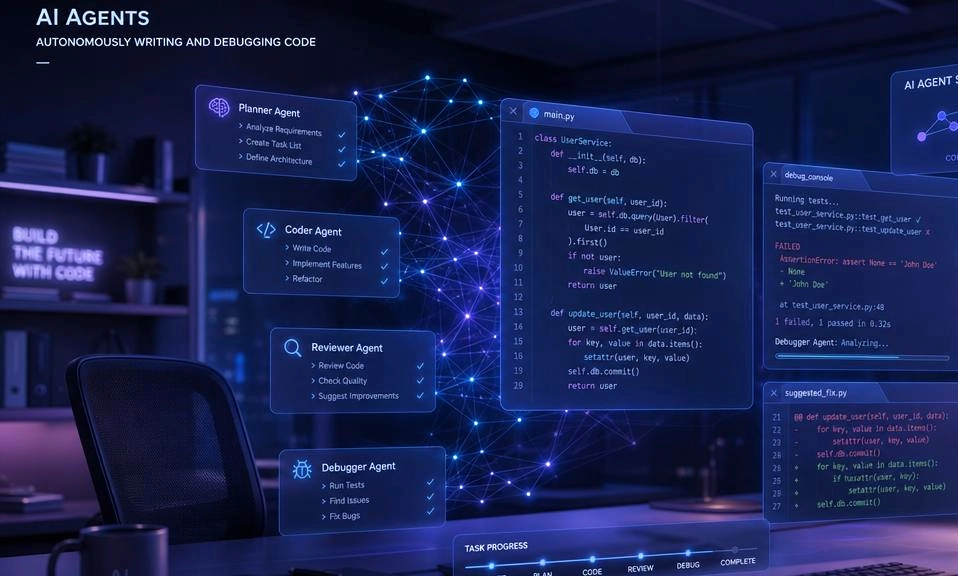
But “AI agents find and fix 948 Linux security flaws” is not a story about replacement. It is a story about amplification. The agents amplified the reach of human researchers. They scanned code at a scale no human team could match. They found exploitation paths that human experts had missed. But they did it inside a pipeline designed, supervised, and audited by humans.
The programmers who are being replaced are the ones whose work was already the most mechanical—the coders who translated specifications into syntax, the juniors who fixed known bug classes, the auditors who manually searched for patterns a model can now find in seconds.
The programmers who are not being replaced are the ones who do the work that cannot be specified: the architects, the threat modellers, the engineers who decide what to build and why, the people who look at 948 exploits and know which ones matter.
That is not a comfortable conclusion. It means the entry-level path is harder, the junior roles are scarcer, and the pressure to become a “senior” faster is greater than ever. But it is not the end of programming. It is the end of a particular kind of programming—the kind that was always the easiest to teach and the easiest to automate.
AI did not replace the programmer. It revealed what programming was always supposed to be.