Remember the dreaded “Check Engine” light?
For decades, that little yellow icon on the dashboard was the universal symbol for driver anxiety. It would illuminate out of nowhere, sending you to a mechanic who would plug in a scanner, read a vague code, and say, “Well, it could be the oxygen sensor, or it could be a vacuum leak. It’ll be $120 just to figure it out.”
Welcome to 2026. That frustrating, expensive game of automotive roulette is rapidly becoming a relic of the past.
Thanks to the integration of advanced Artificial Intelligence, edge computing, and hyper-connected sensors, the way we diagnose and maintain our vehicles has undergone a massive paradigm shift. Your car is no longer just a machine that tells you when it’s broken; it’s a self-aware system that tells you exactly what’s wrong, why it’s happening, and when it will fail.
Here is how AI car diagnostics are changing vehicle maintenance in 2026, and what it means for your wallet, your safety, and the future of the mechanic.
🛑 1. The Death of the Vague Warning Light
In the past, an On-Board Diagnostics (OBD) scanner would just read a generic error code (like P0300 for a random misfire).
Today, AI doesn’t just read the code; it analyses the context. The car’s central computer continuously monitors thousands of data points per second—fuel trim, exhaust temperature, battery voltage, and engine vibration.
When an anomaly occurs, the AI cross-references this real-time data against millions of data points from similar vehicles in its cloud network. Instead of a generic “Check Engine” light, your dashboard (or smartphone app) now gives you a highly specific diagnostic report: “Your alternator’s voltage regulator is degrading. Based on current degradation rates, it will likely fail within 300 miles. Here are three local dealerships with the part in stock.”
🔮 2. Predictive vs. Preventative Maintenance
For a century, vehicle maintenance has been preventative: change the oil every 5,000 miles, replace the brakes at 40,000 miles, flush the fluid at 60,000 miles. But this is incredibly inefficient.
AI has ushered in the era of Predictive Maintenance. The AI learns your specific driving habits, your local climate, and your typical routes.
- If you mostly do short, stop-and-go city trips in freezing weather, the AI knows your engine oil degrades faster and will prompt you to change it at 3,500 miles.
- If you do mostly highway driving in mild weather, it might tell you that you’re good for another 4,000 miles.
- For EVs, the AI monitors the exact chemical health of individual battery cells, predicting range degradation and advising you on charging habits to maximise the battery’s lifespan.
You no longer replace parts “just in case.” You replace them exactly when the data says they need it.
👂 3. Acoustic and Visual AI (The Car’s Digital Senses)
Cars in 2026 don’t just rely on internal engine sensors; they use external AI to “see” and “hear” themselves.
- Acoustic AI: Using microphones already installed for cabin noise cancellation and pedestrian warning systems, AI algorithms listen to the mechanical sounds of the car. It can detect the microscopic, high-frequency whine of a failing wheel bearing or the subtle knock of a worn suspension bushing long before a human driver could ever feel it.
- Visual AI: The cameras used for Advanced Driver Assistance Systems (ADAS) and self-driving features are now turned inward and downward. They can visually scan your brake pads for thickness, check your tire tread depth, and even detect if a rock has chipped your windshield, prompting you to fix it before it spreads.
📡 4. Over-the-Air (OTA) “Self-Healing”
Not all car problems are mechanical; many are software glitches. A buggy infotainment system, a sluggish transmission shift logic, or a false alarm from a safety sensor used to require a trip to the dealership.
Now, AI continuously monitors the vehicle’s software health. If it detects a software anomaly, it can often deploy an Over-the-Air (OTA) patch to fix it. You wake up in the morning, and the car has literally healed itself overnight while parked in the driveway. No service centre visit required.
🛠️ 5. The Evolution of the Mechanic
With AI doing the heavy lifting of diagnostics, are human mechanics obsolete? Absolutely not. But their job has fundamentally changed.
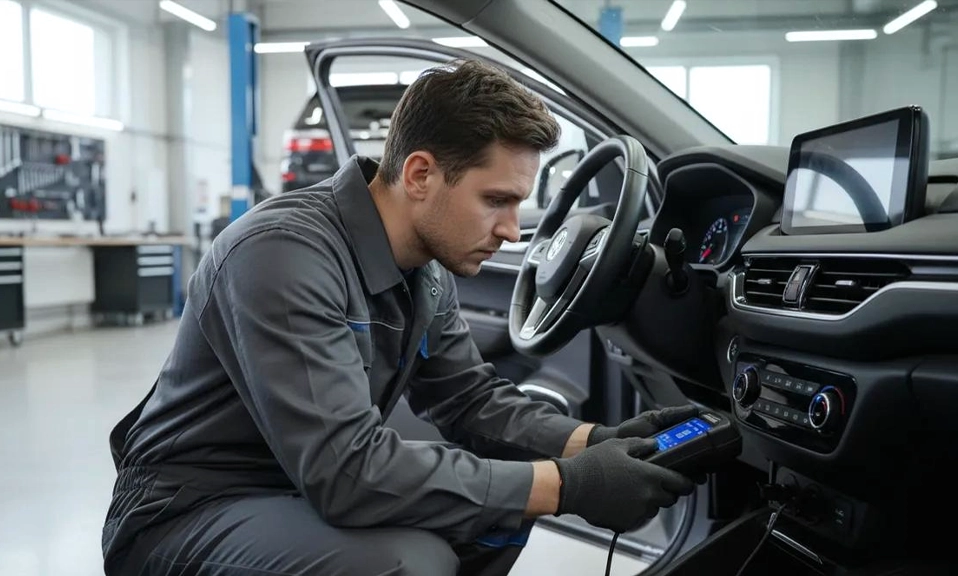
Mechanics in 2026 are less like “guessers” and more like automotive data analysts and surgical technicians. When your car breaks down, the AI has already isolated the fault to a specific 3-inch section of wiring or a single failing solenoid. The mechanic’s job is no longer to spend two hours hunting for the problem; their job is to efficiently execute the physical repair.
This means lower labour bills for you (you aren’t paying for their diagnostic time) and faster turnaround times.
⚠️ The Catch: Privacy, Subscriptions, and “Right to Repair”
As with all AI integrations, this utopian vision comes with some very real 2026 caveats.
1. The Data Privacy Question For AI to predict your car’s maintenance, it needs to know where you drive, how fast you drive, and how you drive. Who owns this data? If your car’s AI detects that you frequently speed and hard-brake, does your auto insurance company get access to that data to raise your premiums? Data privacy is the biggest battleground in connected cars right now.
2. The Subscription Model While basic diagnostics are standard, automakers are increasingly locking “premium” AI predictive features behind monthly subscriptions. Want the AI to tell you exactly when your suspension will fail? That might cost you $15 a month.
3. The Right to Repair Independent, local mechanics are fighting hard to ensure they have access to the same AI diagnostic data that the manufacturer’s dealerships have. If the AI locks out independent shops, you lose the ability to get affordable repairs outside the dealership ecosystem.
From Reactive to Proactive
The shift to AI car diagnostics is one of the most significant leaps in automotive history since the invention of the assembly line.
We have moved from a reactive model (fix it when it breaks) to a preventative model (fix it on a schedule), and finally to a predictive model (fix it exactly when it needs it, before it breaks).
For the everyday driver, this means fewer breakdowns, lower long-term maintenance costs, and the total elimination of the anxiety induced by the mysterious “Check Engine” light. Your car is no longer a dumb piece of metal; it’s a connected, intelligent partner keeping you safely on the road.
So, the next time your dashboard lights up, don’t panic. Just look at the screen. Your car is about to tell you exactly what to do.