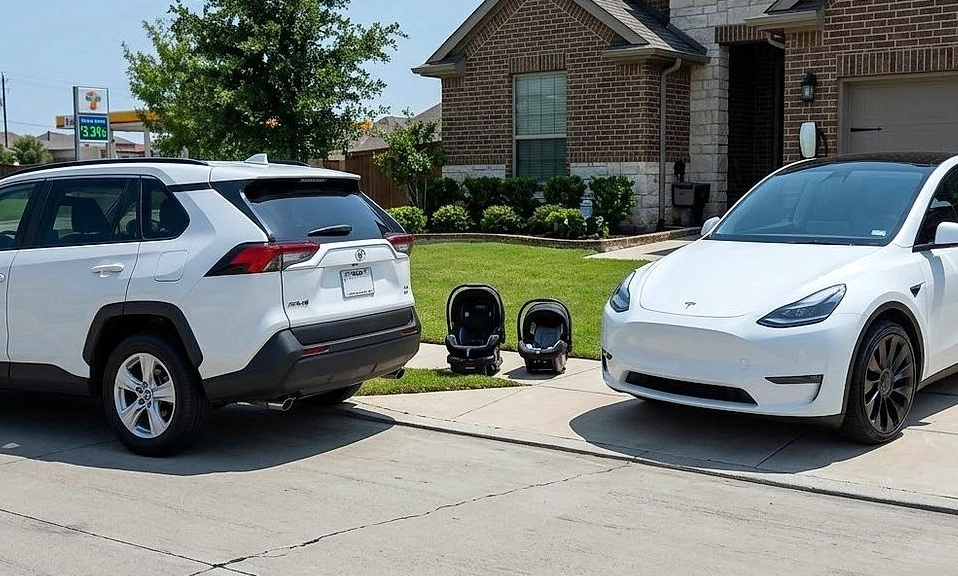
The choice between the Tesla Model Y and the Toyota RAV4 Hybrid in 2026 is not a simple matter of electric versus gas. It is a choice between two fundamentally different philosophies of what a family SUV should be—and the gap between them has narrowed to the point where the “right” answer depends entirely on your driveway, your commute, and how you feel about software updates.
The RAV4 Hybrid has been the default answer for value-minded crossover shoppers for years, and for 2026 it is hybrid-only—Toyota has dropped the gas-only version entirely, making every RAV4 a hybrid or plug-in hybrid. The Model Y, meanwhile, has been refreshed under the “Juniper” project, with a broader lineup than ever: a new entry-level Standard trim, a Long Range AWD, a Performance version, and even a six-seat Model Y L. Both are excellent vehicles. They are just excellent at different things.
The Sticker Price: The RAV4 Lands the First Punch
On price, the RAV4 has a clear advantage—though the gap is smaller than a base-to-base comparison suggests.
The RAV4 Hybrid LE starts at $31,900**, with the volume-selling **Limited AWD** rolling out around **$44,800. The Model Y Standard RWD starts at $39,990**, and the **Long Range AWD**—the trim most people cross-shop against a loaded RAV4—starts at **$50,380. Out-the-door with tax in an average state, that is roughly $48,000 for the RAV4 versus $54,000 for the Model Y.
The real, feature-matched gap is about **$9,500**, not the ~$19,000 a base sticker implies. And the old equalizer—the federal $7,500 EV tax credit—was terminated on September 30, 2025, so it is no longer part of the calculation. Tesla does offer promotional financing as low as 0–0.99% APR on the Model Y through mid-2026, which narrows the monthly payment gap more than most shoppers expect.
Powertrain and Efficiency: Electric Speed vs. Hybrid Flexibility
This is where the two vehicles diverge most sharply.
The Model Y Long Range AWD produces 4.1 miles per kWh in MotorCrunch’s modeling, with 327 miles of EPA range and a 0–60 mph time of 4.6 seconds. The RAV4 Hybrid delivers 43 mpg combined (FWD) and 38–41 mpg combined (AWD), with a 0–60 mph time of around 7.5 seconds. The Model Y is significantly faster and quieter. The RAV4 is more flexible—no charging required, no range anxiety, and the ability to travel to remote areas without planning around a charging network.
The efficiency math is more nuanced than the headline numbers suggest. At 275 Wh per mile and home electricity around $0.154/kWh**, the Model Y costs a little over **four cents per mile** to fuel. The RAV4 Hybrid, at around **39 mpg combined** and gas near **$3.42/gallon, costs roughly nine cents per mile. Home charging cuts the Tesla’s fuel cost by more than half—but if you rely on Supercharging at around $0.42/kWh, much of that advantage disappears. The Tesla’s lowest running costs assume you can plug in at home overnight.
Driving Experience and Technology: Two Different Kinds of “Modern”
The RAV4 Hybrid is the easier vehicle to live with. It is comfortable, practical, and remarkably efficient, and the 2026 redesign has improved the interior significantly—better materials, better visibility, better layout. But it is not a tech showcase. The Model Y’s minimalist cabin, with a 15.4-inch central touchscreen controlling nearly everything, is polarizing. Judges in MotorTrend’s testing found the base Model Y’s touchscreen-only adjustments “universally annoying,” and the lack of Apple CarPlay is a turn-off for many buyers. The Model Y does offer Tesla’s extensive Supercharger network, which is a genuine advantage for long-distance travel.
Practicality: The Model Y L’s Six-Seat Trick
If you need more than five seats, the Model Y L is a compelling option. It is a six-seat, three-row version of the Model Y, with second-row captain’s chairs and a redesigned profile that is hard to distinguish from the five-seat model without seeing them side by side. The third row is tight to access, but the cabin layout “makes a lot of sense” for families who do not need to squeeze someone into a compromised middle seat. The RAV4 Hybrid is a five-seater only. If you need six seats at this price point, the Model Y L is the only option between the two.
Cost of Ownership: The RAV4 Wins on the Full Ledger
The sticker price is only the beginning. Over five years, the RAV4 Hybrid is the cheaper vehicle to own by about $5,504** on MotorCrunch’s modeled defaults—roughly **$1,101 per year. The breakdown is instructive:
| Cost category | Tesla Model Y | Toyota RAV4 Hybrid | Advantage |
|---|---|---|---|
| 5-year total cost | $42,467 | $36,963 | RAV4 by $5,504 |
| Depreciation (5 yr) | $25,164 | $17,746 | RAV4 by $7,418 |
| Energy (5 yr) | $2,488 | $4,744 | Model Y by $2,256 |
| Insurance (5 yr) | Higher (~15–25% more) | Lower | RAV4 |
| Cost per mile | $0.71 | $0.62 | RAV4 |
Source: MotorCrunch 5-year ownership model, 12,000 miles/year
The depreciation gap is the biggest single factor. The RAV4 Hybrid is a “depreciation unicorn,” retaining value far better than the Model Y. A $44,800 RAV4 Limited is worth around **$32,000–$35,000 at three years** (roughly **23% depreciation**), while a $50,380 Model Y Long Range AWD is expected to be worth $33,000–$36,000 (about 30% depreciation)—a $4,500 gap in the Tesla’s disfavor** at three years. Over five years, the depreciation gap widens to **$7,418.
Insurance is the second cost that favors the RAV4. Teslas generally cost 15–25% more to insure because of higher repair costs and parts pricing, and state EV fees (like Texas’s $400 upfront plus $200 every year) add well over a thousand dollars to the Model Y’s column over a typical ownership period.
The Model Y’s advantage is energy—about $2,256 cheaper over five years in MotorCrunch’s model—but that is not enough to overcome the depreciation and insurance gaps. The Tesla also has lower maintenance costs (no oil changes, longer brake life), but the RAV4 is already one of the cheapest gas SUVs to maintain, so the gap is smaller than against a typical luxury car.
Match the Vehicle to Your Life, Not the Hype
The honest answer is that there is no single winner. Both vehicles are excellent, and the right choice depends on factors that no spec sheet can capture.
Choose the Toyota RAV4 Hybrid if:
Total cost of ownership is your priority. It is cheaper to buy, cheaper to insure, and holds its value far better than the Model Y.
You cannot charge at home. Without a home charger, the Model Y’s fuel advantage largely disappears, and the RAV4’s hybrid efficiency shines.
You value reliability and a proven track record. The RAV4 has been the benchmark in the segment for years, and Toyota’s hybrid system is the gold standard.
You want a five-seat family SUV with no range anxiety and the flexibility to travel anywhere without planning around charging.
Choose the Tesla Model Y if:
You can charge at home. The fuel savings are real, and the convenience of waking up to a “full tank” every morning is a genuine lifestyle upgrade.
You want the fastest, quietest, and most tech-forward vehicle in this comparison. The Model Y’s instant torque, minimalist cabin, and Supercharger network are unmatched by the RAV4.
You need six seats. The Model Y L is the only option between the two for a family that needs more than five seats.
You value software updates and a constantly evolving vehicle. The Model Y improves over time in ways that a traditional hybrid does not.
The RAV4 Hybrid is the smarter financial choice for most buyers, especially those who cannot charge at home. The Model Y is the more exciting and technologically advanced choice, and for buyers with a home charger and a tolerance for higher depreciation, it is a genuinely compelling alternative. The gap between them has never been smaller—but the differences that remain are the ones that matter most: your driveway, your commute, and what you value in a car.