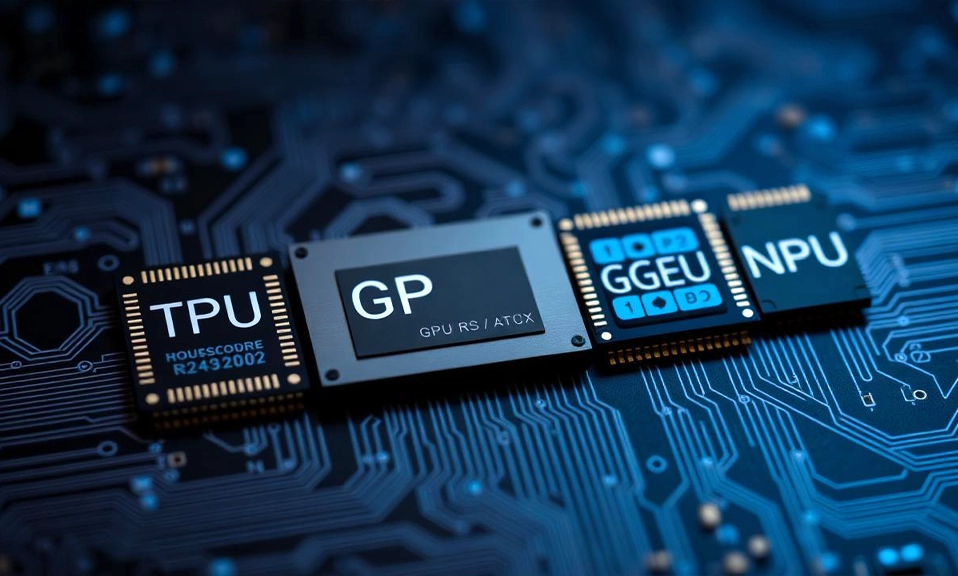
For decades, the central processing unit (CPU) was the undisputed brain of computing. It handled everything from word processing to web browsing to scientific simulation, a general-purpose workhorse that could be programmed to do almost anything. Then artificial intelligence arrived, and it exposed a fundamental truth: the CPU is very good at many things, but it is not very good at the one thing AI needs most—massive, parallel, low-precision math. The result is one of the largest reallocations of capital in the history of technology, as the world pours billions into specialised computing hardware designed from the ground up for AI.
The numbers are staggering. The four largest hyperscalers—Alphabet, Amazon, Microsoft, and Meta—are on track to spend roughly $700 billion on capital expenditure in 2026, much of it on AI accelerators. JPMorgan projects that global AI accelerator shipments will reach ~16.3 million units in 2026, and by 2027, ASIC shipments will surpass GPUs for the first time, rising to 53% of the market from 42% in 2026. This is not a niche trend. It is a fundamental shift in how computers are built, bought, and used.
The Problem with General-Purpose Processors
To understand why specialised hardware is winning, you have to understand what AI actually does. A modern large language model is, at its core, a vast matrix multiplication engine. Training a model like GPT-6 or Claude involves multiplying matrices with billions of parameters, over and over again, at an almost incomprehensible scale. Inference—running the model to answer a question or generate text—involves the same operations, just with smaller matrices.
CPUs are not designed for this. They have a small number of cores (typically 8 to 64 in a server), each optimised for sequential, high-precision operations. They excel at branching logic, complex control flow, and tasks that require a lot of memory and a little bit of math. But matrix multiplication is embarrassingly parallel: you can split it into thousands of independent calculations that can be done simultaneously. A CPU with 64 cores can do 64 calculations at once. A GPU with 10,000 cores can do 10,000.
That is why Nvidia’s GPUs became the default platform for AI training. They were not designed for AI originally—they were designed for graphics—but their massively parallel architecture turned out to be perfectly suited to the matrix math that underpins deep learning.
What Makes AI Chips Different
Specialised AI chips take the GPU’s parallelism and push it further, stripping away everything that is not needed for AI workloads.
Parallelism at scale. An AI accelerator like Nvidia’s Blackwell or Google’s TPU has thousands of cores optimised for the low-precision arithmetic that neural networks use. They can perform trillions of operations per second, far beyond what any CPU can achieve.
Memory bandwidth. AI models are memory-hungry. The bottleneck in many AI workloads is not compute but the speed at which data can be moved from memory to the processor. Specialised chips use high-bandwidth memory (HBM) stacked directly on the package, achieving bandwidth measured in terabytes per second. Nvidia’s Rubin Ultra, expected in the second half of 2027, will feature 1TB of HBM4E memory.
Low-precision arithmetic. AI models do not need the 64-bit floating-point precision that CPUs provide. They can run on 16-bit, 8-bit, or even 4-bit numbers without meaningful loss of accuracy. Specialised chips are designed to exploit this, packing more operations into the same silicon area and consuming less power.
Domain-specific architectures. The most extreme form of specialisation is the custom ASIC—a chip designed for a specific workload. Google’s TPUs, Meta’s MTIA, Microsoft’s Maia, and OpenAI’s Jalapeño are all examples. Broadcom, which designs many of these chips, holds 80–85% of the high-end custom ASIC market and is on track to exceed $100 billion in AI semiconductor revenue in fiscal 2027.
The Investment Frenzy
The scale of the investment is difficult to comprehend. It is not just the chipmakers—Nvidia, AMD, Broadcom—that are spending. It is the entire ecosystem.
Hyperscalers are building data centres at a pace that defies historical precedent. Alphabet has raised its 2026 capital expenditure guidance to as much as $205 billion. Microsoft, Amazon, and Meta are spending at similar scales. Much of that money goes to AI accelerators, networking equipment, and the power and cooling infrastructure required to run them.
Chipmakers are investing in advanced manufacturing. TSMC, the world’s largest contract chipmaker, has approved a $40.9 billion capital budget for advanced process capacity, packaging, and R&D. It has also invested directly in Anthropic and OpenAI, a sign that the lines between chipmaker and customer are blurring.
Startups are attracting billions in venture capital. Companies like Cerebras, SambaNova, Groq, and TensTorrent are building alternative architectures, betting that they can carve out niches where Nvidia’s general-purpose GPUs are not optimal. Some are finding traction: Groq’s LPU (Language Processing Unit) has become popular for low-latency inference, and Cerebras’ wafer-scale engine has set records for training speed.
Governments are subsidising domestic chip production. The US CHIPS Act, the EU Chips Act, and similar programmes in Japan, South Korea, and India are pouring tens of billions into fab construction and R&D, driven by the recognition that AI chips are strategic assets.
The Trade-Offs: Flexibility vs. Efficiency
Specialised hardware is not a free lunch. The same design choices that make AI chips so efficient for AI workloads make them less flexible for everything else.
A CPU can run any program. An AI accelerator can only run the programs it was designed for. If the algorithms change—and they change rapidly—the hardware may become obsolete faster than a general-purpose processor would.
Software ecosystems matter as much as hardware. Nvidia’s CUDA is the default language of AI development. It has been built over more than a decade and is deeply embedded in the workflows of millions of developers. Any challenger must offer a software stack that is compatible, performant, and easy to adopt. AMD’s ROCm is improving, but it is not CUDA. Google’s TorchTPU is an attempt to lower the switching cost, but it is still early.
Custom ASICs are expensive to design and manufacture. A leading-edge chip can cost hundreds of millions of dollars to develop and requires access to advanced fabrication capacity that is concentrated in a handful of companies—TSMC, Samsung, Intel. Only the largest customers can justify the investment, which is why the custom-silicon market is dominated by hyperscalers and a few well-funded startups.
The market is diversifying, not consolidating. The AI chip market of 2027 is not a single kingdom. It is a collection of duchies. Nvidia remains the largest and most profitable player, anchored by its training monopoly and its system-level integration. Broadcom is the insurgent, carving out a custom-silicon empire. AMD is the challenger, fighting for a credible second platform. Each has a different strategy, and each is investing billions to defend or expand its position.
A New Computing Paradigm
The shift from general-purpose processors to specialised AI hardware is not a temporary boom. It is a structural change in how computing is done. The CPU will remain essential for the tasks it does best—operating systems, databases, control flow, branching logic. But the heavy lifting of AI—training and inference at scale—will increasingly be done by specialised accelerators designed for the unique demands of neural networks.
The world is investing billions in this hardware because the returns are measurable. AI models are becoming more capable, and the demand for compute is growing faster than any general-purpose architecture can satisfy. The companies that control the hardware—and the software ecosystems that run on it—will control the pace of AI progress for the next decade.
The CPU era is not over. But the AI chip era has begun. And the billions being spent today are a bet that the future of computing will be specialised, parallel, and built for intelligence.