The scam that empties your bank account no longer starts with a broken sentence. It starts with a voice you recognize, a face you trust, or a message that reads like it was written by someone who knows you.
In 2025, the FBI’s Internet Crime Complaint Center logged $20.9 billion in reported consumer fraud losses**—a 26% jump from the year before. For the first time, it tracked AI-related complaints as their own category: **over 22,000 complaints and nearly $900 million in losses tied directly to AI-enabled fraud. The deepfake-enabled financial fraud market is now estimated at $40 billion a year, with video synthesis accounting for 42.7% of cases and audio-based voice cloning for 21.9%.
The old advice—look for typos, awkward grammar, a badly copied logo—no longer works. 82.6% of phishing emails now contain AI-generated content, erasing the tells people were taught to spot. Voice clones need as little as three seconds of audio to reach 85% accuracy, and only about one in four people can reliably identify a high-quality deepfake voice.
The playbook hasn’t changed. Urgency, emotional manipulation, pressure to act before you think—fraudsters have always relied on those levers. AI just makes them easier to deploy, harder to detect, and far more convincing.
Here are eight warning signs that could save your money.
1. The Voice Is Right, but the Request Is Wrong
The sign: You get a call from a family member, a colleague, or your bank. The voice sounds exactly like them. But the request is urgent, emotional, and out of character—money for a bail bond, a wire transfer for a “deal,” a payment to fix an “emergency.”
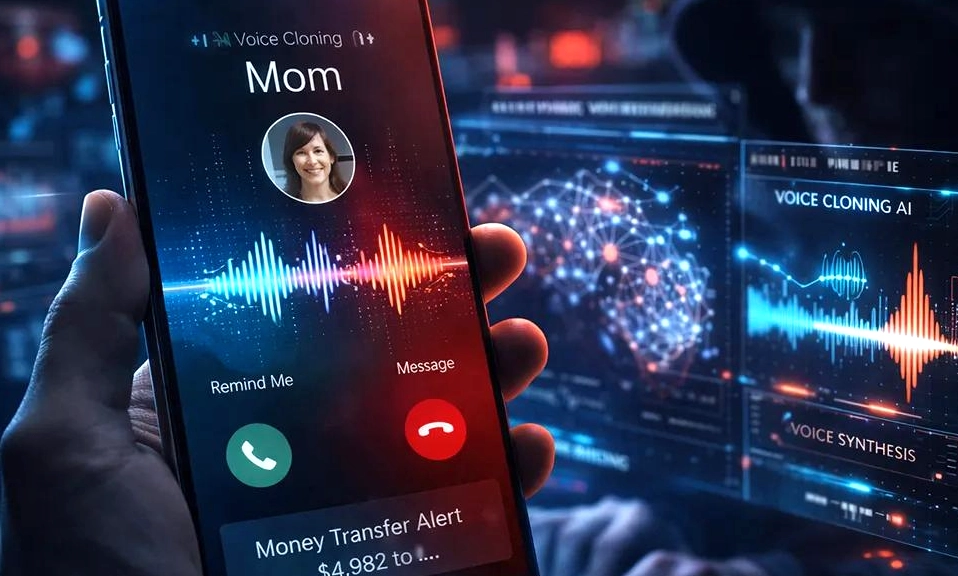
Why it matters: Scammers can clone a voice from a short clip posted on social media, a voicemail, or even a few seconds of silence on a call. The voice is the hook. The request is the scam.
What to do: Hang up and call the person back on a number you already know. Do not use the number they give you. Do not continue the conversation to “verify” details—the AI is designed to keep you talking and keep you panicked.
2. They Demand Secrecy
The sign: “Don’t tell your parents.” “Don’t call the bank.” “Keep this between us.”
Why it matters: Secrecy exists because someone else might recognize the scam. AI voice cloning makes this worse, because the voice asking for silence may sound genuinely familiar. The FTC warns that scammers use secrecy to isolate you from the people who could help you see through the deception.
What to do: Tell someone anyway. A legitimate emergency does not require you to hide it from everyone else. If the caller insists on secrecy, that is the scam.
3. The Payment Method Is Untraceable
The sign: They ask for gift cards, cryptocurrency, a wire transfer, or a payment app transfer. Not a credit card, not a check, not a normal bank transfer.
Why it matters: Gift cards, crypto, and wire transfers are difficult to trace and almost impossible to reverse. The FTC is clear: legitimate businesses and government agencies never demand gift cards. Even if the voice sounds exactly like your child, a demand for “Bitcoin” or “Apple Gift Cards” is the hallmark of a criminal operation.
What to do: Stop. No legitimate request for money—from a family member, a bank, or a government agency—requires an untraceable payment method. This single sign is enough to end the conversation.
4. There Is a Countdown
The sign: “Your account closes in 30 minutes.” “Pay today or face arrest.” “This offer expires tonight.”
Why it matters: Manufactured urgency is the oldest trick in the scammer’s playbook, and AI makes it easier to deploy at scale. The FTC warns that urgency and fear are used deliberately—to keep you from checking the story. A real problem will still be there after you verify it.
What to do: Slow down. The urgency is the point. If the request is real, it will survive a 10-minute delay while you call the person or the institution directly.
5. The Message Is Perfect—Too Perfect
The sign: An email or text with no typos, correct tone, and personal details pulled from your social media. It looks like it came from your bank, your boss, or a company you actually use.
Why it matters: AI can write a polished, personalized message in seconds. The old “look for bad grammar” advice is obsolete. The new question is not “does this look fake?” but “what is this person asking me to do?”
What to do: Verify through a separate channel. Don’t reply to the email. Don’t click the link. Open your banking app directly, or call the number on the back of your card. Use a contact method you already trust, not the one provided in the message.
6. They Want Remote Access or a Code
The sign: “Let me connect to your computer and fix that.” “Tell me the code we just sent to your phone.” “Download this app so we can verify your identity.”
Why it matters: No legitimate company verifies your identity by asking for a one-time code or remote access to your device. Giving someone remote access or a code hands them the keys to your accounts. TechRadar notes that attackers are now building fake sign-in pages with QR codes and CAPTCHAs to make them look more trustworthy—the extra “verification” steps are part of the trap.
What to do: Never share a code or grant remote access to someone who contacted you. Hang up and call the company directly using a number you find yourself.
7. The Contact Comes Through an Unexpected Channel
The sign: Your boss texts from a new number. Your bank messages you on WhatsApp. A family member reaches out through a social media account you didn’t know they had.
Why it matters: AI-powered scams often start on one channel—a text, a social media message, a WhatsApp chat—and then move you to another. The unexpected channel is a reason to verify, not a reason to trust. The FBI’s IC3 data shows that adults 60 and older filed the most complaints of any age group and absorbed $7.7 billion in losses—roughly 39% of the total.
What to do: Don’t use the contact information given to you. Use an authorized number, app, or email address you already have. If your boss is texting from a new number, call their office line. If your bank is messaging you on WhatsApp, open the banking app.
8. It’s a Romance That Turns Into an Investment Pitch
The sign: An online relationship that moves—slowly, patiently—toward investment advice, a “special app,” or a “once-in-a-lifetime opportunity.”
Why it matters: “Pig butchering” scams use AI chatbots to sustain months-long relationships before steering the victim into a fake investment platform. The relationship is the lure. The investment is the trap. FINRA notes that the underlying playbook—urgency, emotional manipulation, pressure to act—hasn’t changed, but AI makes it easier to run at scale.
What to do: Any online relationship that moves toward investment advice is a red flag. No legitimate romantic partner, new friend, or mentor should be directing you to a specific investment platform. Talk to someone you trust before you transfer any money.
AI has not invented new scams.
It has removed the tells that used to give them away. The fake grandchild, the fake bank rep, the fake romantic interest—they are all still here, but the voice is perfect, the email is polished, and the video call looks real.
The defence is not to look for mistakes. It is to verify through a second channel, every time. Hang up and call back. Don’t use the number they give you. Don’t share codes. Don’t send money through untraceable methods. Establish a family safe word that an AI cannot guess.
The technology will keep getting better. The warning signs will keep getting subtler. But the core of every scam—the demand for urgency, secrecy, and an irreversible payment—remains the same. If you remember one thing, remember this: the request is the red flag, not the polish.