Could It Finally Reveal the City’s Lost Origins?
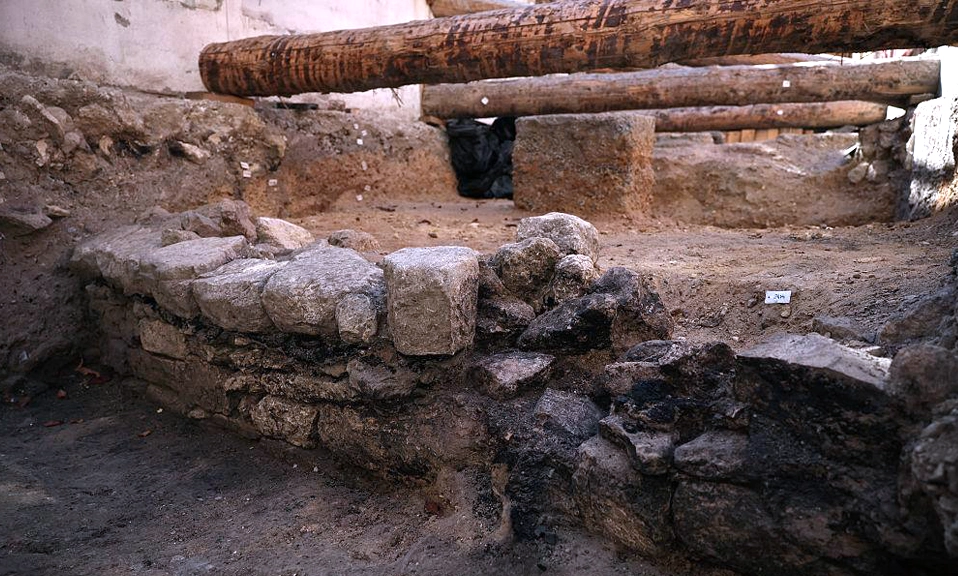
It sat just four metres beneath the courtyard of Paris’s oldest hospital, hidden for over 2,000 years. A stone-and-timber wall, scarred by fire, built in a distinctly Celtic style. For historians, it represents something they have hunted for centuries: the first physical proof of the Gallic settlement that became Paris.
The discovery, announced by France’s Ministry of Culture on September 23, 2026, has been described as a “major breakthrough” that could finally settle one of the longest-running debates in French archaeology.
The wall — roughly 20 metres long and barely a metre high — was found during excavations beneath the Hôtel-Dieu hospital on the Île de la Cité, just a stone’s throw from Notre-Dame Cathedral. It was buried four metres deep and was discovered as part of redevelopment work that began in February 2026.
But what makes this wall extraordinary is not its size. It’s what it represents: the first material evidence of Lutetia, the ancient Gallic settlement built by the Parisii tribe — the people who gave Paris its name.
The City That Caesar Described But No One Could Find
Lutetia is known primarily through the writings of Julius Caesar. In Book VII of his Gallic Wars, Caesar described it as a fortified settlement on an island in the River Seine, linked by bridges — a vague description that has fuelled centuries of speculation about its exact location.
The Île de la Cité, the island at the heart of modern Paris, has traditionally been regarded as the centre of Lutetia. But a rival theory, backed by archaeological research, contended that the original settlement was actually in Nanterre, a suburb to the west. For decades, the debate remained unresolved because the physical evidence for a Gallic presence on the Île de la Cité was frustratingly limited.
“We may be looking at one of the most important remains ever discovered for understanding Gallic Lutetia,” Culture Minister Catherine Pégard said in a statement. “Scientific caution still requires that we verify its function and its chronology, but the convergence of evidence is particularly remarkable at this stage”.
What Makes This Wall So Significant
A Celtic Fortification, Burned and Preserved
The wall’s construction technique is characteristic of Gallic fortifications from the late Iron Age. The architecture — large blocks with an interlocking beam system — immediately pointed to Gallic construction traditions rather than a later Roman build.
But the most striking feature is the fire damage. The wall bears traces of an intense blaze: a carbonized facing, charred seeds, and the remains of a burned wooden building nearby.
That detail may correspond directly to Caesar’s account. According to his writings, the Gauls set fire to their own town before the Battle of Lutetia against the Romans in 52 BC, choosing to destroy their settlement rather than let it fall into enemy hands.
Behind the fortification, archaeologists also found an artificial platform of sand and gravel, preserved to a thickness of nearly two metres — further evidence of a major defensive structure. At the foot of the wall, they recovered a Gallic spearhead.
Preliminary radiocarbon analysis of the wooden elements dates them to between 200 and 10 BC — a timeframe that includes the Battle of Lutetia in 52 BC.
The Discovery That Fills an Archaeological Gap
“This discovery fills an archaeological gap,” said Stéphane Deschamps, regional curator of archaeology at the Île-de-France Regional Archaeology Service.
For archaeologists, the find represents the kind of evidence they had long hoped for.
“All of our predecessors dreamed of finding traces of Gallic presences on the Île de la Cité,” said Dorothée Chaoui-Derieux, coordinator of archaeological operations in Paris for the culture ministry. “There has been a lot of speculation on the subject. We’re fortunate to be in the right place at the right time”.
Matthieu Poux, an archaeology professor at the University of Lyon II who had been among those skeptical that Lutetia was on the Île de la Cité, told the New York Times that the find changed his mind. He now has “no doubt” that the ancient city was there.
Poux said this single excavation had increased the available evidence on Gallic Paris “tenfold”.
The Debate That May Finally Be Settled
The question of where Lutetia was located has divided archaeologists for generations.
Caesar’s description — an island linked by bridges, situated in a bend of the Seine — pointed to the Île de la Cité. But for decades, the physical evidence didn’t match the text. Excavations at Nanterre had turned up extensive Gallic remains, while the Île de la Cité had yielded frustratingly little.
By the 1990s, some scholars had come to believe that ancient Lutetia was actually at Nanterre. The new discovery changes that calculus.
The wall, combined with the charred seeds, the burned building, the spearhead, and the artificial platform, forms a body of evidence that is difficult to explain away as coincidence. This was a fortified settlement. It was destroyed by fire. And it was built in the Gallic tradition.
What Happens Next
The excavation is ongoing. Researchers will continue to analyse the wall’s function and chronology, and further study of the burned layer may confirm whether it corresponds to the events of 52 BC. The ministry has emphasized that scientific caution is still required — the observations are “compatible with a late Iron Age occupation and an episode of destruction by fire” but “do not yet allow the fire of 52 BC to be precisely dated”.
Further excavations are planned around the hospital, and the wall will eventually be removed so it can be studied and displayed.
For now, the wall sits beneath a working hospital, four metres below the courtyards where patients and staff walk every day. It has been there for two thousand years, waiting. And it took a routine construction dig to finally bring it into the light.
“It’s dizzying to find oneself here and to discover what is probably the origin of the city of Paris,” said Paris mayor Emmanuel Grégoire.
The city Caesar wrote about is no longer lost. It was under our feet the whole time.