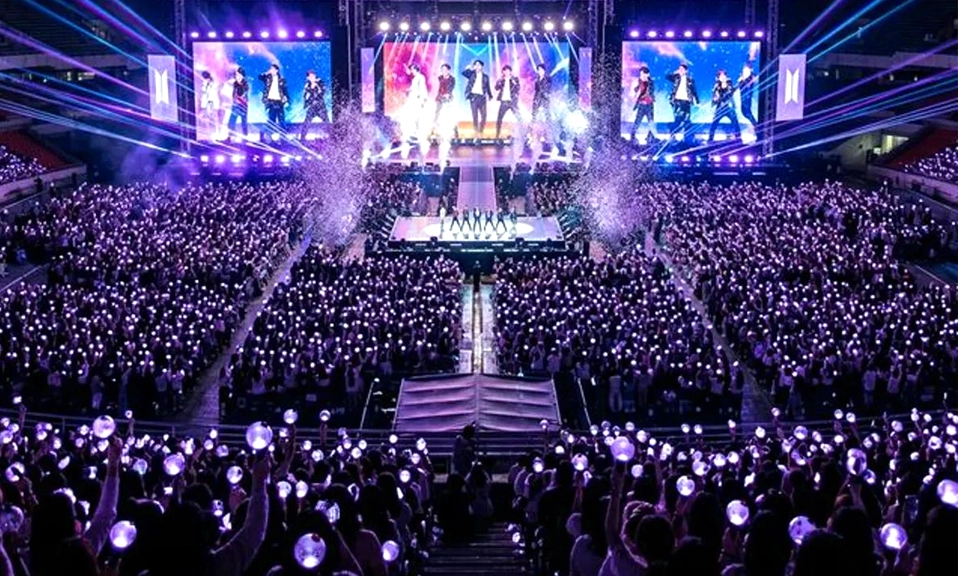
BTS just drew 853,000 fans to 14 sold-out shows across five South American cities. That is not a tour stop. That is a continent-scale mobilization. And it is the clearest evidence yet that K-pop’s global footprint has moved far beyond the “niche fandom” label its critics still try to apply.
The numbers, announced by Big Hit Music on Monday, are staggering on their own. But they become something more when placed alongside the rest of BTS’s 2026: a world tour that has already grossed more than $561 million** from 46 sold-out concerts, drawing **2.85 million fans** and becoming the first pop group ever to cross **$500 million in a single tour. The Latin American leg alone—Bogotá, Lima, Santiago, Buenos Aires, and São Paulo—sold out every seat, including the group’s first full-group concerts in Colombia and Buenos Aires, their first visit to Lima since debut, and their first shows in Chile and Brazil in nine and seven years respectively.
This is not a band riding a nostalgia wave. This is a band that paused for mandatory military service, came back, and found its audience larger, more geographically distributed, and more willing to travel than ever.
The ARIRANG Effect: From Goyang to São Paulo
The ARIRANG tour began on April 9, 2026, in Goyang, South Korea, marking BTS’s return to large-scale international touring after the members completed their military service. By September, they had performed across North America, Europe, and Asia. The North American leg alone drew 1.92 million fans across 31 concerts in 12 cities, with four nights at SoFi Stadium in Los Angeles accounting for more than 282,000 attendees.
The South American leg was not an afterthought. It was a deliberate expansion into a market that K-pop has historically treated as secondary. BTS held 14 sold-out concerts in five cities, and Big Hit Music explicitly noted that the tour boosted local economies across tourism, transportation, and accommodation.
The tour is scheduled to continue into March 2027, with upcoming stops in Kaohsiung, Bangkok, Kuala Lumpur, Jakarta, and Sydney. Billboard has estimated that ARIRANG could eventually reach $1 billion in ticket sales, potentially placing it among the highest-grossing concert tours ever recorded.
The Business Behind the Boom: HYBE’s Record Quarter
BTS’s touring success has translated directly into financial results for HYBE, the company behind the group.
On July 28, 2026, HYBE reported its highest quarterly revenue ever: 1.45 trillion won ($1 billion)** for the April-to-June period, more than double the figure from a year earlier. Operating profit rose **159.3% year-on-year** to **170.9 billion won ($127.5 million) , while net profit increased more than sevenfold to 109.8 billion won ($82.3 million) .
Concert revenue alone reached 647.7 billion won ($485.6 million)** , with merchandise and licensing adding another **310.6 billion won ($232.9 million) . HYBE attributed much of the growth to BTS’s return, including the release of their fifth studio album, ARIRANG, in March and the launch of the world tour in April.
The ARIRANG album drove HYBE to record Q1 revenue of 698.3 billion won ($477 million) , up 39.5% year-on-year. The group’s comeback was not just a cultural event. It was a commercial engine.
The Market: K-Pop Is Growing, But Not Everywhere Equally
The global K-pop market was valued at $12.4 billion in 2024** and is projected to grow from **$13.74 billion in 2025 to $31.2 billion by 2033, at a compound annual growth rate of 10.8%. That is a market that is more than doubling in less than a decade.
The physical album market is also breaking records. In the first half of 2026, global consumers bought 49.53 million physical albums—the highest half-year total ever recorded, with 14 million-seller acts contributing to the surge. The Korea Times reported that the market is closing in on 100 million album sales for the year, a milestone not reached since 2023.
But the picture is not uniformly rosy. According to music analytics firm Luminate, Korean-language music accounted for just 1.1% of on-demand audio streams in the US in the first quarter of 2026, compared with 86% for English-language music. That figure does not represent K-pop’s exact market share—K-pop includes English-language tracks and collaborations—but it illustrates the genre’s limited penetration into everyday American listening habits.
The challenge for K-pop is not building fandom. It is converting fandom into mainstream adoption. BTS can sell out stadiums in cities where Korean-language music is barely played on the radio. The question is whether that intensity can translate into the kind of broad cultural saturation that English-language pop enjoys.
The Streaming Bridge: Netflix, Spotify, and the Mainstream Push
The industry is not waiting for that transition to happen organically. It is building bridges.
Netflix livestreamed BTS’s comeback concert from Gwanghwamun Square in Seoul in March. The broadcast, BTS The Comeback Live: Arirang, attracted 18.4 million viewers worldwide live and within 24 hours, entered the platform’s weekly top 10 in 80 countries, and ranked first in 24. A week later, Netflix released BTS: The Return, a documentary chronicling the group’s preparations for their first full album after the military hiatus.
The partnership is expanding beyond established superstars. In October, Netflix announced “We Go High,” an original audition series recruiting students from South Korean arts high schools to form a new girl group, with support from SM C&C. The model is clear: use K-pop’s engaged fandom to drive subscriptions, and use streaming platforms’ mainstream reach to introduce K-pop to audiences who would never seek it out.
Spotify is seeing the same pattern. K-rock streaming was up 58% year-on-year in 2026, while K-indie streaming rose 68% from a year earlier. Royalties generated by Korean-language music grew 25% year-on-year, and 92% of royalties generated from Korean artists came from outside South Korea.
“Korea is a home base for creative expression,” said Gautam Talwar, Spotify’s APAC general manager. “It’s a cultural force”.
Bigger Than Ever, But Not Yet Everywhere
Is K-pop bigger than ever? Yes—by almost every measure that matters.
BTS drew 853,000 fans to a single continental tour leg. The ARIRANG tour has grossed more than half a billion dollars and is on track to approach $1 billion. HYBE posted its highest quarterly revenue in history. The global K-pop market is growing at 10.8% a year. Physical album sales are at an all-time high. And the genre is expanding into Latin America, Asia, and Australia with a scale that would have been unimaginable a decade ago.
But “bigger than ever” is not the same as “everywhere.” Korean-language music is still just 1.1% of US streaming. K-pop’s growth is driven by deep fandom, not broad adoption. The genre has proven it can mobilize millions of dedicated fans across continents. It has not yet proven it can become the default soundtrack of the global mainstream.
The 853,000 fans in South America are not an anomaly. They are a preview. K-pop’s next decade will be defined by whether it can turn those stadiums into something more permanent—a presence in the cultural conversation that extends beyond the fans who were already listening.
BTS have done their part. They have built the audience. The industry now has to figure out what to do with it.