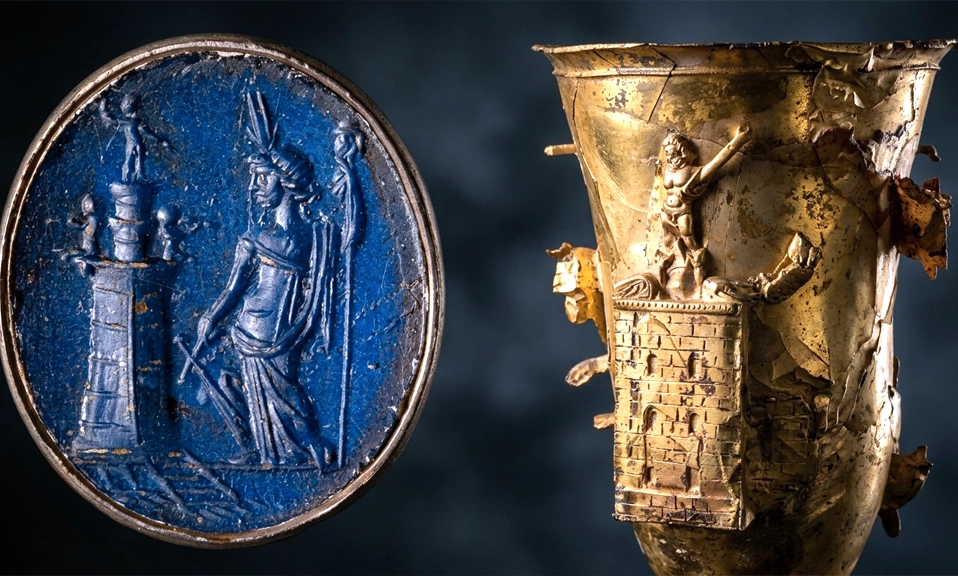
It was buried beneath the Mediterranean for two millennia. A tiny bronze signet ring, its face carved with an image so precise it matches ancient coins from the 2nd century AD. And it depicts a building that no longer exists: the Lighthouse of Alexandria, one of the Seven Wonders of the Ancient World.
The Discovery
Archaeologists from the European Institute for Underwater Archaeology (IEASM), led by Franck Goddio, were excavating the submerged ruins of the royal island of Antirhodos in Alexandria’s ancient harbour when they found it. The island was once part of the royal quarters of Alexandria, home to a lavish Ptolemaic palace visited by Mark Antony and Cleopatra.
The ring is bronze, a signet ring designed to be pressed into wax or clay to seal documents. On its face is a miniature carving of the Pharos — the lighthouse that stood on the island of Pharos in Alexandria’s harbour, guiding ships to safety for over a millennium.
Egypt’s Ministry of Tourism and Antiquities called the discovery “exceptional,” noting that it is the first time an image of the lighthouse has been found engraved on a seal ring. The shape of the engraving matches known images of the lighthouse on coins dating back to the second century AD.
The Wonder That Vanished
The Lighthouse of Alexandria was built in the third century BC and stood between 330 and 430 feet tall — making it one of the tallest human-made structures in the world, second only to the Pyramids of Giza. It dominated the Alexandrian skyline for more than a thousand years.
Then it was destroyed. A series of earthquakes in the 14th century caused the structure to crumble into the sea. Some 700 years later, few traces of the lighthouse remain. It is, for all practical purposes, a lost wonder — known to us only through ancient descriptions, coins, mosaics, and now, this ring.
Why This Ring Matters
The ring isn’t just a beautiful object. It’s a clue.
Where it was found is nearly as important as what’s carved on it. Antirhodos was the site of an ancient palace observed and described by the Greek geographer Strabo when he visited Egypt between 29 and 25 BC. The discovery of the ring in that location may indicate that the palace remained in use into the second century AD for administrative purposes — possibly including work connected to the management of the lighthouse.
“The discovery of the ring-signet is even more important as it has been excavated in the legendary palace of the Island of Antirhodos, that once was a centre of power,” Goddio said. The statement added that the find demonstrates the palace once comprised “offices for administrative functions, including the administration of the famous lighthouse”.
A Window Into a Lost World
The ring is the first of its kind known to exist. Hector Williams, an archaeologist and maritime historian at the University of British Columbia, called it “a most interesting and important discovery,” noting that “this little ring matches descriptions of the lighthouse as well as representations believed to be of it on ancient mosaics and small objects like terracotta lamps”.
The excavation also uncovered pottery and glass artefacts dating from the fourth century BC to the fourth century AD — everyday objects, tableware, amphorae, and vessels that offer a glimpse into centuries of life in Alexandria’s royal quarter.
What Comes Next
The IEASM mission, conducted in collaboration with Egypt’s Ministry of Tourism and Antiquities, is continuing its work at four sites in Alexandria’s Eastern Harbour, including the Temple of Isis, the palace on Antirhodos, and the Timonium associated with Mark Antony.
Williams noted that “until we get a detailed account of just where it was found and whether it was in a dateable context… its full importance won’t be known”. But the discovery has already given archaeologists something remarkable: a tangible, wearable connection to a building that has been gone for seven centuries.
The Lighthouse of Alexandria stood for over a thousand years. It has been gone for 700. And now, on a tiny bronze ring pulled from the bottom of the Mediterranean, its image has surfaced again.
The ring is the first of its kind ever found — a small, sealed link to a wonder the ancient world knew and the modern world has only imagined.