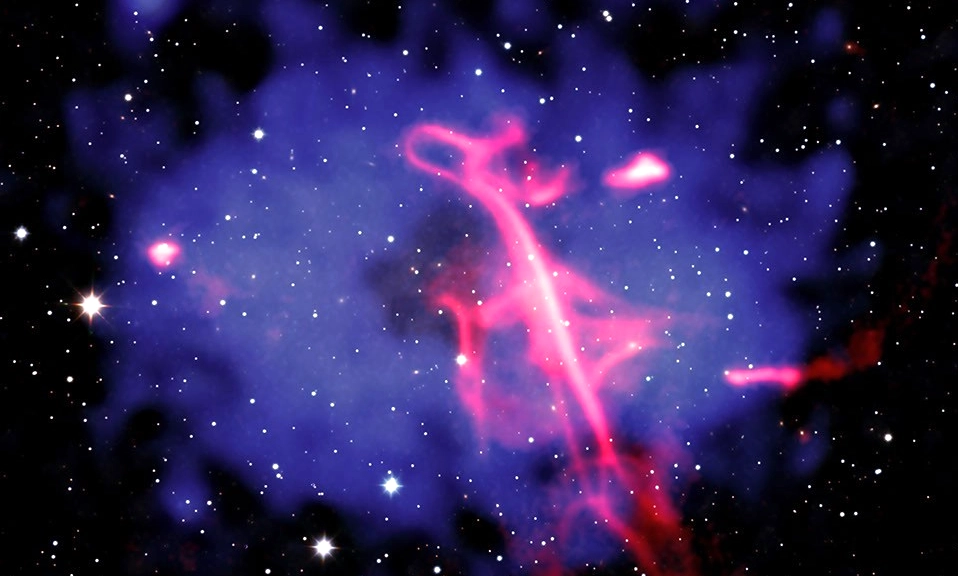
Somewhere behind the dusty veil of our own galaxy, a structure the size of a small galaxy is humming with the remnants of a cosmic catastrophe. It looks like a musical note. It behaves like a ghost. And now, astronomers finally know what it is.
NASA’s Chandra X-ray Observatory has helped solve the mystery of the “Treble Clef”—a vast, looping formation of radio waves that bears an uncanny resemblance to the musical symbol. The answer, published in Astronomy & Astrophysics, involves not one but two of the most powerful phenomena in the universe: the outburst of a supermassive black hole, followed by the collision of two galaxy clusters.
A Shape Hidden Behind the Milky Way
The Treble Clef was never going to be easy to study. It lies almost directly behind the plane of the Milky Way, in a region astronomers call the “Zone of Avoidance”—a band of sky where the stars, gas, and dust of our own galaxy block the view of whatever lies beyond. Optical telescopes are essentially blind to it.
But radio waves and X-rays can pierce through the intervening material. Using the LOw Frequency ARray (LOFAR) in Europe, astronomers captured the delicate, curling filaments of the Treble Clef in radio light. Then, Chandra and Germany’s eROSITA X-ray telescope detected the multimillion-degree gas that revealed what the structure was hiding inside: a galaxy cluster in the midst of a violent merger.
The composite image tells the story in color. Blue represents the superheated X-ray gas. Red shows the radio emission that traces the Treble Clef’s shape. White is infrared data from the United Kingdom Infrared Telescope. Together, they reveal a structure that is not a symbol, not a pulsar, and not a coincidence—but a physical object shaped by enormous forces.
The Two-Stage Crescendo
The Treble Clef formed in two distinct acts, separated by hundreds of millions of years. The researchers, led by Andrea Botteon of Italy’s National Institute for Astrophysics (INAF), reconstructed the sequence.
Act One: The Black Hole’s Outburst. Long ago, the supermassive black hole at the center of one of the galaxy clusters could not consume all the material falling toward it. It expelled some of it outward—driving clouds of charged particles and magnetic fields into intergalactic space at close to the speed of light. This created a bright burst of radio emission, a “cosmic crescendo” that gradually faded as the particles lost energy and went dark.
Act Two: The Cluster Collision. Then, two galaxy clusters crashed into each other. The collision compressed and stirred the leftover particle clouds, re-energizing them and causing them to light up again in radio waves. Shock waves from the impact—similar to the sonic booms of supersonic jets—may have contributed to the revival.
This is why astronomers call the Treble Clef a “radio phoenix“—a cloud of faded particles that died and was brought back to life.
How They Proved the Collision Happened
Detecting the collision required a clever technique. The hot gas in a galaxy cluster is typically symmetrical, shaped roughly like an oval. The team removed this symmetrical oval from the Chandra X-ray image, leaving behind a “residual” image that revealed the asymmetries. The remaining X-ray emission was brightest on the left and right of the cluster’s center, implying that the collision occurred along that left-right axis. The researchers estimate the direct collision happened a few hundred million years ago, and the clusters are now moving apart.
Why This Matters
The Treble Clef is more than a pretty picture. It demonstrates how a new generation of radio telescopes—especially LOFAR—has transformed our ability to study the universe. Structures that were once blurry smudges can now be resolved into detailed filament tapestries, revealing the complex physics of galaxy cluster mergers.
It also shows the value of multi-wavelength astronomy. No single telescope could have solved this puzzle. LOFAR traced the shape. Chandra and eROSITA found the gas and the merger. Infrared data completed the picture. Together, they turned a mysterious radio blob into a coherent story of death and rebirth on a galactic scale.
And it’s a reminder that even in the crowded, dusty plane of our own galaxy, there are still secrets waiting to be found. The Treble Clef was first noticed in radio surveys years ago, but it faded from scientific literature because telescopes of the time couldn’t resolve its structure. It took a new generation of instruments—and a new generation of astronomers willing to look again—to finally understand it.
The cosmic Treble Clef
is not a message, a symbol, or a sign. It is the scar of a supermassive black hole’s outburst, carved into the fabric of space and then reignited by the collision of two galaxy clusters. It is a radio phoenix, a ghost of ancient violence, and a testament to the universe’s capacity to create beauty out of chaos.
For astronomers, it is also a promise. If a structure like this can hide behind the Milky Way for decades, waiting to be understood, what else is still out there, waiting to be seen?