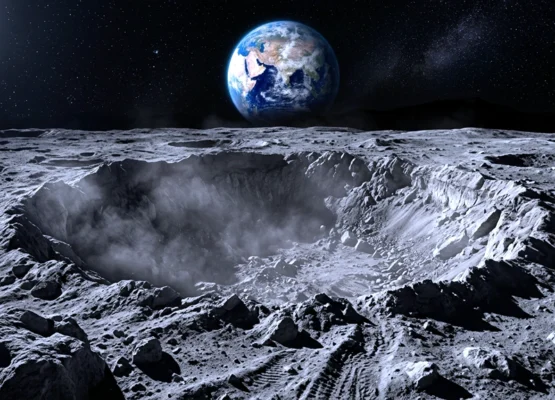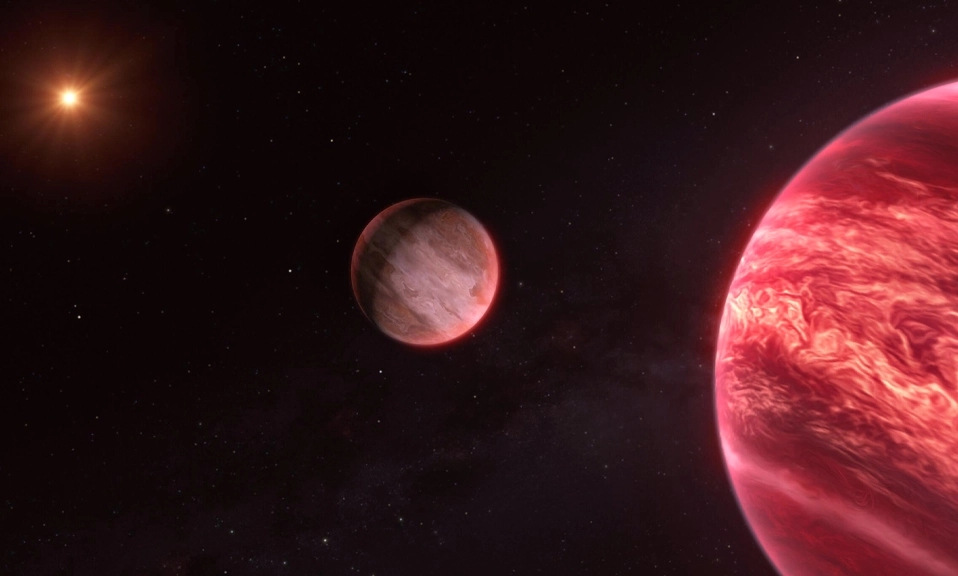
For decades, astronomers have found thousands of planets beyond our Solar System but not a single confirmed moon. That drought may finally be over—though the object they’ve found is so strange it is forcing scientists to rethink what a moon even is. In a star system 73 light-years from Earth, a Jupiter-sized body appears to be orbiting a brown dwarf, which in turn orbits a star. It is a three-tiered arrangement unlike anything in our own Solar System, and if confirmed, it would be the first natural satellite ever detected beyond the Sun’s family of worlds.
The System: “Super Weird” and Proud of It
The discovery centres on CD-35 2722, a relatively young star with about half the mass of the Sun. Orbiting the star is a brown dwarf—an object too massive to be a planet but not massive enough to sustain the hydrogen fusion that powers a star. And orbiting that brown dwarf is the newly detected object: a body at least as massive as Jupiter, with models suggesting a mass around 0.9 Jupiter masses.
Kevin Hoy, an ESO student in Chile and lead author of the study published in Nature, described the system as “super weird” compared with our own. The team calls the object an exosatellite—a neutral term that avoids prejudging whether it qualifies as a “moon” in the conventional sense.
How They Found It
Detecting something this small and distant is a technical triumph. The team used the CRIRES+ instrument on ESO’s Very Large Telescope (VLT) in Chile, applying the radial velocity method—the same technique that was used to discover the first exoplanet around a Sun-like star.
The principle is simple in theory: as the brown dwarf and the exosatellite orbit their shared centre of mass, the brown dwarf wobbles slightly. That wobble shows up as tiny shifts in the brown dwarf’s spectrum, moving toward and away from the observer. By monitoring those shifts over more than two years—from October 2023 to February 2026—the team found evidence of a companion orbiting the brown dwarf roughly every 170 days.
Models for two satellites were found to be highly unstable, suggesting a single orbiting body is the most plausible explanation.
The Classification Problem: Is It a Moon?
Here is where the discovery gets genuinely philosophical. In our Solar System, the definition of a moon is straightforward: a natural satellite orbiting a planet. But the CD-35 2722 system blurs the lines.
The exosatellite does not orbit a planet. It orbits a brown dwarf, which is itself a substellar object. As Hoy put it: “The exosatellite is clearly massive enough to be a planet, but it does not orbit a star, though it orbits an object that orbits a star. Being the third wheel in this system makes us want to call it a moon, even if it is nothing like the small, rocky moons we have in our system”.
The authors note that the object’s position as the last component in a three-tiered hierarchical system might support a moon-like classification, but because it is planet-sized and orbiting a brown dwarf rather than a planet, it is “probably not apt to call it an exomoon”. The paper concludes that a clear classification system for exosatellites will be needed as more of these objects are found.
Alice Zurlo, director of the Millennium Nucleus of Young Exoplanets and their Moons (YEMS) and a collaborator on the study, framed the discovery as a breakthrough regardless of the label: “As exotic as it is, this system is truly unique and represents a breakthrough: the first plausible detection of an exosatellite”.
Why It Matters: A Window Into How Systems Form
Exomoons have been elusive for a simple reason: they are small, faint, and hard to separate from the glare of their host bodies. Transit surveys, which have found most exoplanets, struggle to detect the tiny dips caused by a moon. Radial velocity surveys can detect the wobble a moon induces, but the signal is minuscule.
This discovery demonstrates that radial velocity analysis can detect exosatellites, opening a new avenue for the search. It also offers a rare glimpse into a system with a three-tiered hierarchy—star, brown dwarf, satellite—which may help astronomers understand how such arrangements form and survive.
There is also a broader scientific payoff. As Zurlo explained, confirming such objects could help scientists better understand how planetary systems form and evolve, and why some systems differ so dramatically from our own.
The Caveats: Skepticism and the Road Ahead
It is important to be clear: this is a candidate, not a confirmed detection. The team itself describes the evidence as “strong” but not definitive, and the classification remains unresolved.
There is also active scientific debate. Another team, led by Quentin Kral, reported hints of a satellite in the HD 206893 system earlier in 2026 using ESO’s Very Large Telescope Interferometer, but that was not a firm detection either. And as Science News reported in October 2026, skepticism is growing over whether the first known exomoon exists, with new analyses of the data reaching conflicting results. The CD-35 2722 detection will need independent confirmation before it is accepted as definitive.
The next generation of instruments should help. The Extremely Large Telescope (ELT), with its 39-metre mirror, is expected to improve the search for exomoons, including smaller objects beyond the reach of current telescopes.
The first moon beyond our
Solar System may have been found—but it is not the kind of moon anyone expected. It is a Jupiter-sized giant orbiting a failed star, in a system that defies the tidy categories of “star,” “planet,” and “moon.” Whether astronomers ultimately call it an exomoon or an exosatellite, the discovery is a milestone: the first plausible detection of a natural satellite in another star system, and a reminder that the universe is far stranger and more varied than the labels we bring to it.
For now, the object in CD-35 2722 sits at the frontier of a new field of study—one that will, in the coming years, tell us whether moons are as common in the cosmos as they are in our own backyard. The answer, if this system is any indication, will be anything but simple.