They were right under our feet the whole time. Small, brown, and almost indistinguishable from one another, seven new species of “diamond frogs” have been hiding in the leaf litter and underground burrows of Madagascar’s forests—eluding scientists for over a decade.
An international team of researchers has described the seven new species in the journal Vertebrate Zoology, bringing the total number of recognised diamond frogs in the genus Rhombophryne to 27. The discovery, published on July 22, 2026, resolves a long-standing taxonomic puzzle and reveals that one of Madagascar’s most mysterious groups of amphibians is far more diverse than anyone realised.
Here is the story of the frogs that hid their diversity beneath the forest floor—and why naming them matters for conservation.
The Frogs: Masters of Disguise
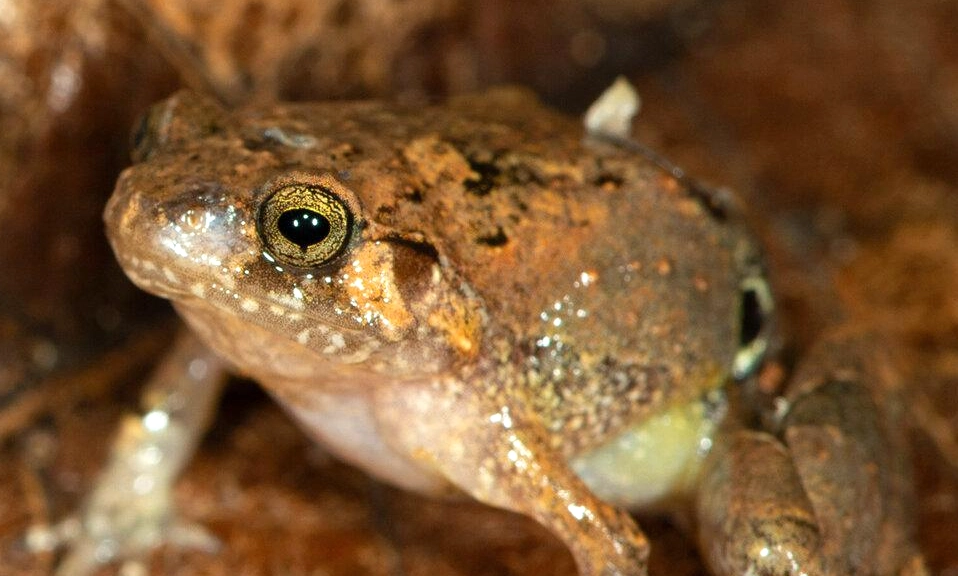
Diamond frogs are not the colourful, eye-catching amphibians that come to mind when most people picture a frog. They are small, brown, and exceptionally well-camouflaged, spending much of their lives tucked beneath leaf litter or hidden underground in Madagascar’s humid forests.
Their secretive habits have made them some of the least-studied vertebrates on the island. Even when they emerge, they look deceptively similar to one another—so similar that many species were long grouped together as a single species, when they were actually distinct evolutionary lineages separated by millions of years.
“Many species spend most of their lives beneath the leaf litter,” said Dr. Mark D. Scherz, Curator of Herpetology at the Natural History Museum Denmark and lead author of the study. “And even when they emerge, they can look deceptively similar”.
Some species are remarkably round, resembling the rain frogs of mainland Africa. Others are long-legged moss dwellers or strong-bodied terrestrial species. Although most appear brown at first glance, several conceal flashes of orange, bright white, or black markings on their thighs and lower backs—colouration that may serve to startle predators.
The 12-Year Search: “Almost Every Expedition Revealed Another One”
The project began more than 12 years ago, after researchers repeatedly encountered frogs that clearly belonged to undescribed species.
Resolving their identities was not easy. The researchers could not confidently match historical species names to modern genetic lineages. Old names, assigned decades or centuries ago, were ambiguous. Some of the type specimens—the original specimens used to define a species—were collected before 1976 and were difficult to analyse with conventional methods.
“When I started this project twelve years ago, we already knew there were several species waiting to be described, and almost every expedition to Madagascar revealed another one,” Scherz said. “Some were relatively straightforward to describe, but others were complicated by uncertainty surrounding older species names. Untangling that puzzle took years”.
The Breakthrough: Sequencing DNA From Museum Specimens
The turning point came through museomics—the sequencing of DNA from historical museum specimens.
By extracting and analysing genetic material from specimens collected decades ago, the researchers were able to match historical names to the correct evolutionary lineages. They combined this genetic data with newly collected material, along with analyses of external and skeletal anatomy, CT scans, and frog calls.
“Museum collections are far more than archives of the past—they are essential scientific resources for understanding biodiversity today,” said Dr. Alice Petzold of the University of Potsdam, who led the museomics work. “By sequencing historical specimens, including the original type specimens, we were able to answer questions that have persisted for generations”.
The approach revealed something remarkable: frogs that had long been grouped together as a single species often turned out to represent entirely different evolutionary lineages, separated by mountains or forests and evolving independently for millions of years despite looking almost identical.
The Seven New Species: A Closer Look
The study formally describes seven new species. While the full descriptions are detailed in the paper, several have already made headlines for their distinctive names and characteristics.
Rhombophryne quentini — A frog with orange thighs from the high-altitude forests of northern Madagascar, named after the son of the lead researcher.
Rhombophryne kilonjy — A small frog from the lowland forests of the northwest coast, named from the Malagasy word for “pebble” because it resembles a stone. It is considered probably highly threatened, and the researchers suggest it may warrant Critically Endangered status.
Rhombophryne kotrobaratra — A species that emerges mostly during storms, according to the Natural History Museum of Denmark.
Rhombophryne anatiala — A species that is very poorly known, highlighting how much remains to be learned about these frogs.
The other new species include R. mavokely, R. maraorao, and R. sonaliae, each occupying its own small range within Madagascar’s fragmented forests.
A Conservation Wake-Up Call
The discovery is not just a taxonomic curiosity. It is a conservation emergency.
The researchers estimate that 24 of the 27 recognised diamond frog species are threatened. Many have surprisingly small ranges—some are found only in a single mountain region or isolated patch of forest. Species that exist only in small pockets of habitat can disappear before scientists even realise they are unique.
Madagascar has already lost significant areas of its native forest to agriculture, logging, and expanding human settlements. For many diamond frogs, scientists still know almost nothing about their breeding biology, population sizes, or ecological requirements—knowledge that is essential for assessing extinction risk and designing effective protection measures.
“Accurate taxonomy is essential for conservation planning,” the researchers note. “A frog believed to be part of a widespread population may actually represent a rare species confined to a single forest”.
The findings are already having an impact. During a protected area planning workshop in March 2026, held as part of Madagascar’s Biodiversity 30×30 Program, several of the newly described species—including R. quentini—contributed directly to proposals to strengthen and expand protected areas.
Seven new frogs.
Twelve years of searching. Countless hours in museum collections, sequencing DNA from specimens collected before the researchers were born, and trudging through Madagascar’s forests in the rain.
The diamond frogs of Madagascar are not charismatic megafauna. They are small, brown, and hidden. But they are also irreplaceable—each one a unique branch on the tree of life, shaped by millions of years of isolation in a forest that is disappearing fast.
“Diamond frogs have been hiding their diversity beneath our feet,” Scherz said.
Now that we know they are there, the question is whether we will protect them—before they vanish back into the leaf litter, this time for good.